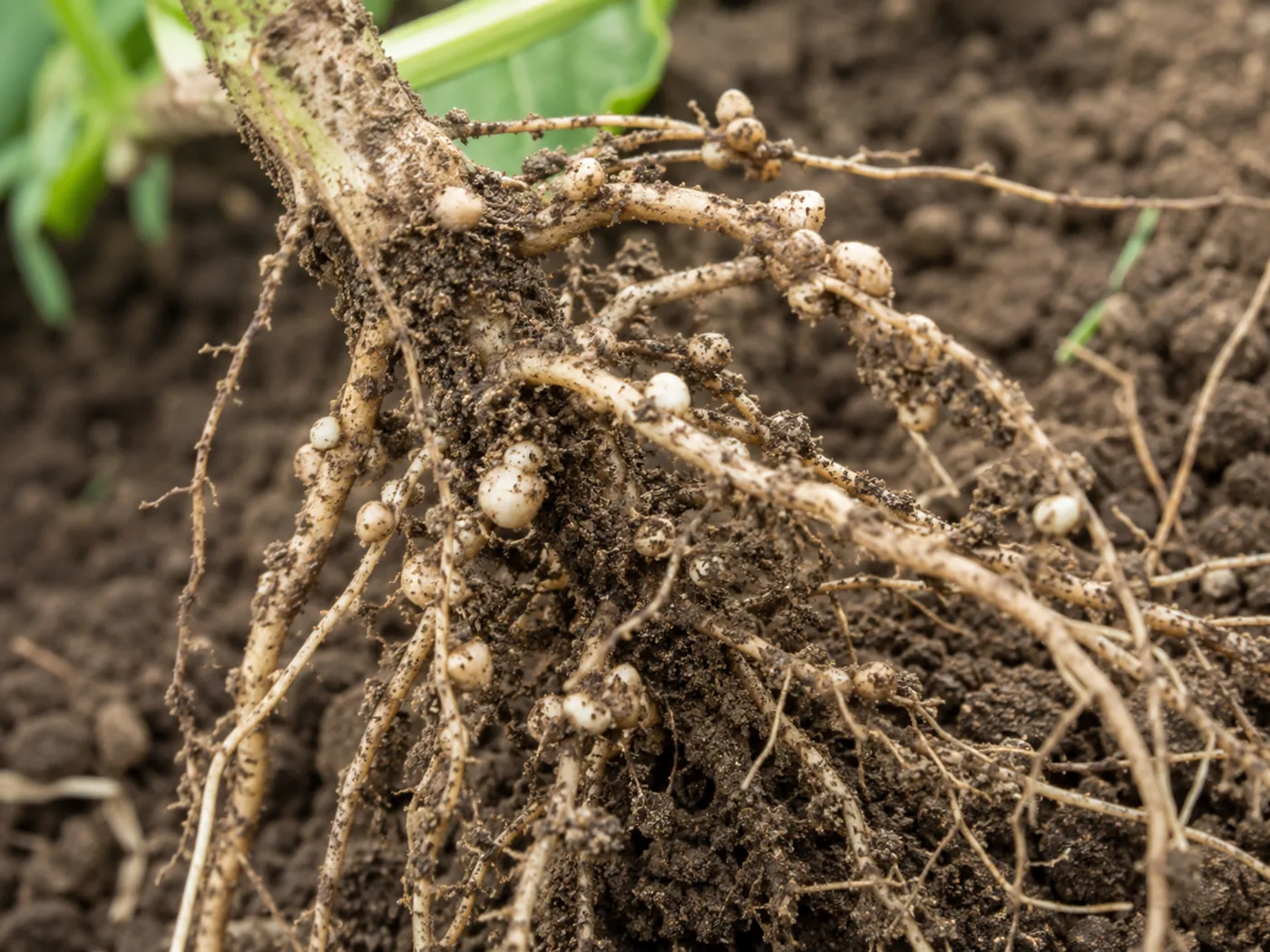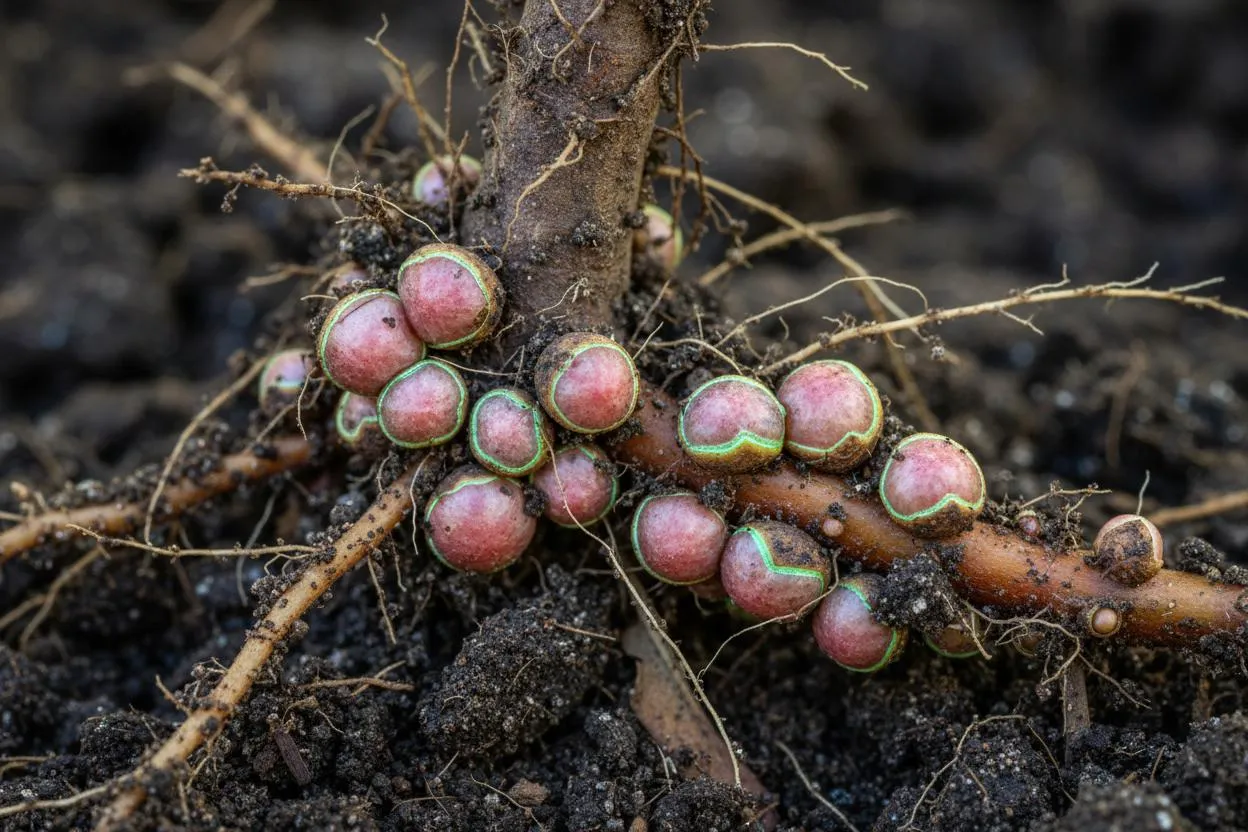
Rhizobial inoculants need a local match
The same legume is nodulated by different local rhizobial populations across regions — and effective strains are region- and soil-specific.
Accordingly, Nodu™ strains are selected and matched to local conditions (not one global strain), and Orvan™ contains no rhizobia — it amplifies the native or co-applied rhizobia already adapted to each region, fitting local soils rather than imposing a single strain.
Cross-inoculation groups — match by group, then by region
Legumes fall into cross-inoculation groups defined by the rhizobia that can nodulate them. Matching the right group first — then confirming the right strain for local soils — is what makes inoculation reliable.
Soybean-specific Bradyrhizobium
Soybean
Soybean needs Bradyrhizobium japonicum / diazoefficiens (USDA 110-type) — the general tropical group will not nodulate it effectively, so a dedicated strain is essential.
Fast-growing Rhizobium (bean)
Common bean
Common bean is nodulated by fast-growing Rhizobium — R. tropici / etli / phaseoli. R. tropici (CIAT 899-type) is acid-, heat-, and aluminium-tolerant and our most mature line.
Cowpea-miscellany Bradyrhizobium
Peanut · cowpea · mung bean · black gram · pigeon pea
These tropical legumes are promiscuously nodulated by slow-growing Bradyrhizobium of the cowpea-miscellany group; effective strains still differ by region.
Sinorhizobium (Ensifer) meliloti — alfalfa group
Alfalfa · medics · sweet clover · fenugreek
The alfalfa cross-inoculation group — Medicago, Melilotus and Trigonella — is nodulated by fast-growing Sinorhizobium (Ensifer) meliloti, with the closely related S. medicae on annual medics in acid soils. Distinct from the Bradyrhizobium and Rhizobium groups, S. meliloti thrives above pH 6 but is often sparse in first-time or strongly alkaline-saline fields, so inoculation pays off.
Nodu™ is matched to the right group and confirmed against local populations; Vigor™ adds the phosphate-solubilising and stress-tolerance strains; and Orvan™ carries no rhizobia of its own — it amplifies whatever is already adapted to your soil. Together they form a crop-matched consortium.
Regional reference rhizobia
From public literature — for reference, not Huasheng's proprietary strains.
| Legume | Americas | Africa | Asia |
|---|---|---|---|
| Soybean | B. diazoefficiens USDA 110 (US) · SEMIA 5079/5080, B. elkanii 587 (Brazil, EMBRAPA) | Bradyrhizobium + promiscuous soybeans (e.g. N. Ghana) | native Bradyrhizobium · Sinorhizobium fredii (saline soils, N. China) |
| Common bean | R. tropici (Brazil) · R. etli / phaseoli (Mexico) | R. leguminosarum · Pararhizobium giardinii (Ethiopia) | R. leguminosarum bv. phaseoli |
| Cowpea | Bradyrhizobium BR 3267 / BR 3262 (Brazil, MoA-approved) | native Bradyrhizobium (BR 3267 validated in N. Ghana) | native Bradyrhizobium (cowpea/Vigna group) |
| Alfalfa | S. meliloti B399 (Argentina, commercial) · commercial strains (US/Canada) | S. meliloti · S. medicae on acid-soil annual medics (Mediterranean) | native S. meliloti (saline-alkali alfalfa soils, N. China & Central Asia) |
Documented regional rhizobia (EMBRAPA–SEMIA, USDA, Brazilian Ministry of Agriculture & peer-reviewed literature) — for reference; not Huasheng's proprietary strains. Nodu™ is matched to the regional context and confirmed against local populations.