Transplant establishment: where biological inputs fit around the root
The move from nursery to field changes a plant’s water balance and root environment. A clear view of that transition makes product choices more useful.
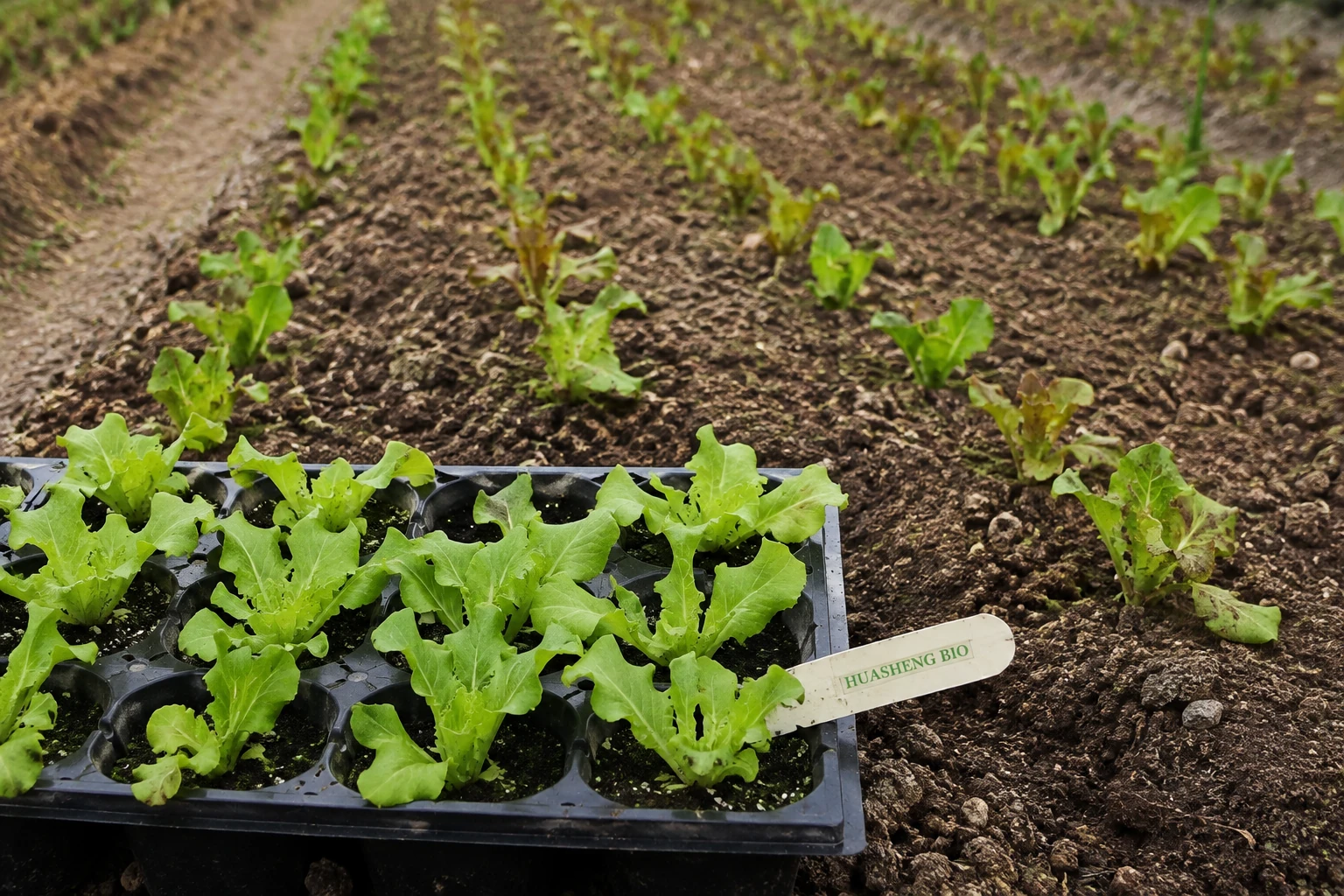
The first days after transplanting connect two production systems. A plant leaves a nursery with a particular root ball, moisture history and growing environment, then enters a field or greenhouse bed with different demands. Establishment depends on how well that transition works. Biological inputs can be considered within it, alongside the factors that determine whether roots can support new growth.
1. Look at the transition, not just the transplant
University of California guidance on vegetable transplants describes establishment in terms of plant quality, handling, environmental adjustment and water management [1]. A large shoot alone does not show that a plant is ready. The condition of the root ball and what the plant experienced before arrival also matter.
For a production team, this makes nursery records valuable. Crop and variety, delivery condition and any delay before planting provide context for later differences. When one batch establishes unevenly, the explanation may begin before the field operation. A product comparison becomes more informative when the starting plants are documented as carefully as the treatment.
2. A wet surface does not describe the whole root zone
Water supply has to match the root environment. University of Maryland guidance for container vegetables notes that both insufficient watering and overwatering can create problems; waterlogged media can deprive roots of oxygen [2]. Around the time of transplanting, the visible surface alone is therefore a poor description of what the roots experience.
An agronomic review should distinguish the plug or root ball from the surrounding soil or substrate. Record where moisture is being assessed rather than using a single impression of “wet” or “dry”. That distinction helps the team investigate uneven establishment without immediately attributing every difference to nutrition or a missing input.
3. Hardening prepares the plant for different demands
University of Minnesota Extension describes hardening as acclimatisation that reduces the growth delay associated with transplant shock [3]. Its guidance also cautions that excessive conditioning can delay growth [4]. The purpose is a workable transition into the intended conditions, rather than a visibly stressed plant at dispatch.
For a biological product evaluation, keep this part of the crop history consistent. Comparing a well-acclimatised batch with a poorly prepared batch would make any product difference difficult to read. A simple nursery-to-field handover record can be more useful here than an elaborate explanation added after problems appear.
4. Match the biological input to a defined role
Different product categories raise different questions. For a biostimulant, the discussion may concern a physiological response or growth under a specified constraint. For a microbial inoculant, it includes the organism’s relationship with the crop and the root environment. For a nutritional input, it includes the supply and availability of the relevant nutrient. Combining them under “rooting products” can conceal what each is expected to contribute.
A controlled lettuce study examined a microbial biostimulant combined with a plant-derived protein hydrolysate under saline and alkaline conditions [5]. It illustrates why the background conditions deserve attention when interpreting a combination. It also leaves a specific commercial question to answer: does the proposed finished product fit the crop, root environment and objective of the current operation?
5. Follow establishment through several observations
A nursery-to-field observation checklist
| Point in the transition | Useful observations | Reason to keep the record |
|---|---|---|
| At arrival | Batch identity, plant uniformity and root-ball condition | Establishes the starting condition |
| After planting | Plant posture and moisture in the actual root zone | Connects above-ground appearance with the root environment |
| As growth resumes | New leaves, crop uniformity and replacement plants | Shows whether establishment is progressing consistently |
| Later in the crop | Development timing and marketable harvest | Checks whether early differences remain agriculturally relevant |
Use the same observation points for every treatment in the comparison. Photographs are most useful when their crop stage and location are recorded, and when they are accompanied by a count or other repeatable observation. A few vigorous plants at the edge of a bed should not stand in for the whole planting.
6. Define success before adding another input
“Better establishment” can mean fewer replacement plants, greater uniformity, earlier return to growth or a more predictable harvest schedule. Choose the outcome that matters to the operation before selecting the product. Each outcome calls for a different record, and not every early visual improvement will affect harvest.
This approach gives biological inputs a clear agricultural role. The product is considered in relation to a specific transition problem, the supporting management remains visible, and the result can be discussed in the language of the crop business. For nurseries, growers and technical partners, that is a stronger basis for the next decision than treating transplant stress as one undifferentiated problem.
Further reading
- [1] University of California Agriculture and Natural Resources. Using Transplants in Vegetable Production, Publication 8013.
- [2] University of Maryland Extension. Growing Vegetables in Containers and Salad Tables.
- [3] University of Minnesota Extension. Planting the vegetable garden; hardening and transplanting.
- [4] University of Minnesota Extension. Maintaining healthy transplants through cool weather (2020).
- [5] Rouphael et al. (2017). Synergistic Action of a Microbial-based Biostimulant and a Plant Derived-Protein Hydrolysate Enhances Lettuce Tolerance to Alkalinity and Salinity. Frontiers in Plant Science.