Mycorrhizae: understanding the partnership beyond the root
A fungal partner can change how a crop explores its soil. The useful question is where that partnership adds value, given the crop and its existing root environment.
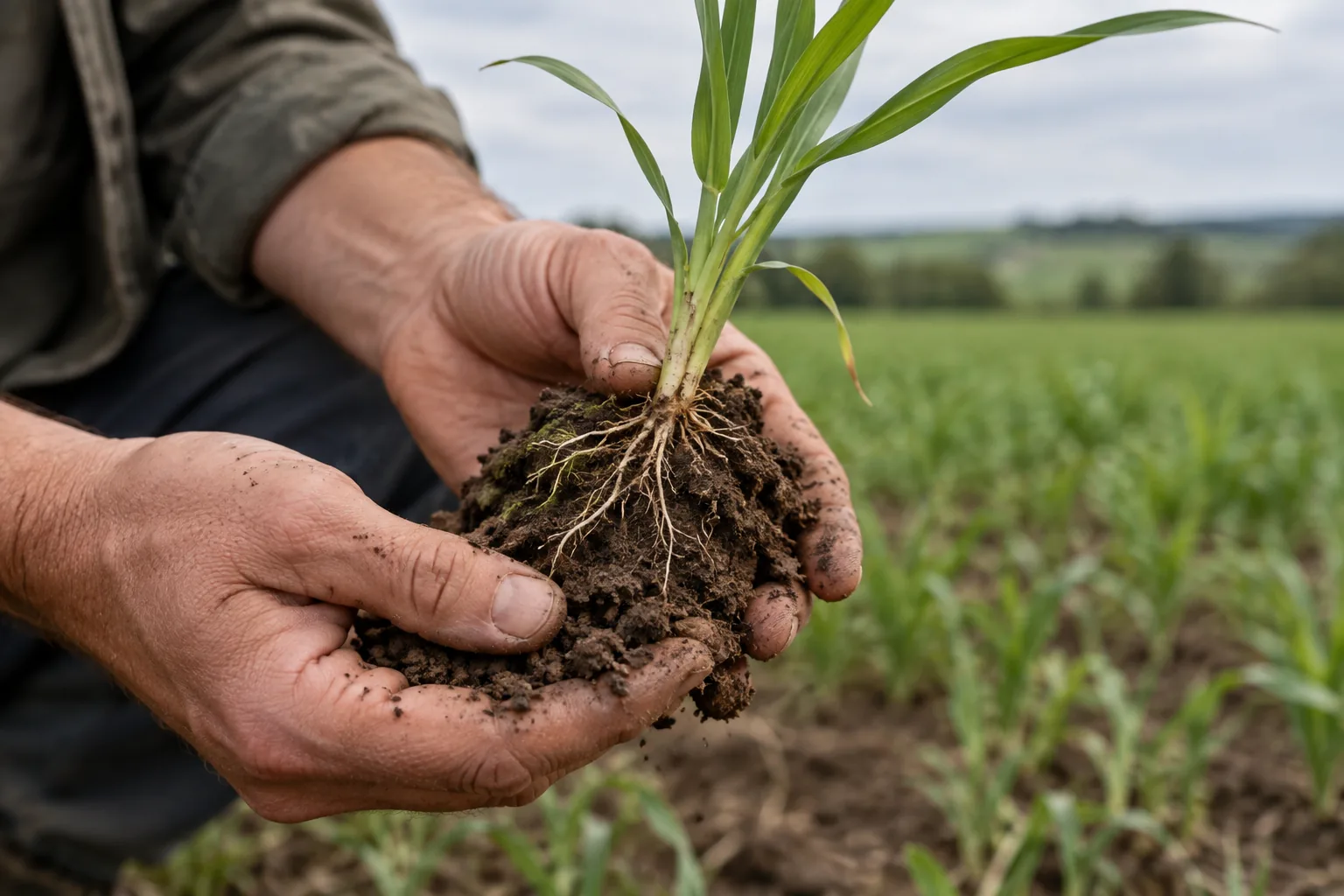
A root system occupies only part of the soil around a plant. Arbuscular mycorrhizal fungi extend that biological reach through fine fungal threads. This creates an appealing agricultural idea: help the crop access resources through a living partner. Turning the idea into a useful decision requires understanding the exchange, the host crop and the soil community already present.
1. The partnership is an exchange
Fungal hyphae can explore soil beyond the immediate zone depleted by roots, including spaces too small for root hairs. Nutrients acquired through this pathway can be transferred to the plant [1]. In return, the plant supplies its partner with carbon compounds. Experimental work has also demonstrated transfer of plant-derived lipids to arbuscular mycorrhizal fungi [2].
This matters because the relationship has a cost as well as a benefit. “More fungus” is therefore an incomplete goal. The agricultural question is whether the partnership improves the crop outcome sufficiently under the particular growing conditions. A root image that shows colonisation helps establish that a relationship exists; it does not, by itself, measure the return to the crop.
2. Host identity comes before a product choice
Many agricultural crops can form arbuscular mycorrhizal associations, but this is not a universal plant trait. Oregon State University guidance identifies important exceptions, including brassica crops and crops in the beet family [3]. A product discussion for maize or a compatible vegetable should therefore differ from one for cabbage or beet.
Name the crop specifically. “Vegetables” can include hosts and non-hosts, while a mixed planting may involve several different biological relationships. Naming the crop is a useful first filter for a catalogue, nursery plan or agronomic recommendation. Broad compatibility claims become less helpful when they hide those distinctions.
3. The existing soil is part of the product context
A field is not an empty container waiting for an inoculant. In a study across 54 Swiss maize fields, researchers found substantial variation in crop response and showed that soil microbiome information helped explain that variation [4]. The study’s significance lies in the range of outcomes across fields: a successful result from one location needs to be understood alongside the conditions that produced it.
For a grower or channel partner, this suggests a more specific conversation. What is known about the field history? Which crops preceded the current crop? How was the soil managed? Is the comparison taking place in field soil or a nursery substrate? Recording those details makes future results easier to interpret and keeps a promising observation attached to a recognisable production setting.
4. Phosphorus is a starting point, not the whole explanation
Phosphorus access is central to mycorrhizal science, but a low phosphorus number is not a complete product-selection rule. In the Swiss field study, phosphorus explained only a small part of the variation in growth response [4]. Local nutrient status remains relevant, alongside the biological and physical root environment.
When evaluating a product, keep the intended nutrient programme clearly in view. A claim about improved nutrient acquisition needs an appropriate measurement of crop nutrition. A claim about using less fertiliser requires a comparison that actually tests the altered fertiliser programme. Those are separate questions, even when the same product is involved.
Four questions that make a mycorrhizal discussion more useful
| Question | Information to collect | Decision it supports |
|---|---|---|
| Is the crop a compatible host? | Specific crop and propagation material | Whether the biological relationship is relevant |
| What root environment is involved? | Field or substrate; crop and management history | Which evidence is comparable to this situation |
| What is the target benefit? | Nutrition, establishment or another defined crop outcome | Which observations are needed |
| What happened at crop level? | Root observations alongside growth, quality and harvest data | Whether colonisation translated into useful performance |
5. Separate presence, function and harvest
A practical assessment has three layers. First, was the expected association observed? Second, did the crop show the relevant functional response? Third, did that response contribute to the production objective? These layers prevent a biological measurement from carrying a commercial conclusion it cannot support alone.
They also help explain a result that appears disappointing. If the crop did not respond, the next discussion can examine host fit, the root environment or the target outcome instead of assuming that every mycorrhizal approach is equivalent. Good records lead to a better-informed product decision next time.
6. Think in terms of a crop–soil partnership
Mycorrhizae offer a way to consider crop nutrition through the living root environment. A well-constructed programme connects a compatible crop, a clearly characterised product and an agricultural objective that can be assessed. The strength of the idea comes from that connection. It gives technical teams and growers a shared basis for discussing where a fungal partner may contribute, and what evidence would show that it did.
Further reading
- [1] Field et al. (2012). Contrasting arbuscular mycorrhizal responses of vascular and non-vascular plants to a simulated Palaeozoic CO₂ decline. Nature Communications.
- [2] Keymer et al. (2017). Lipid transfer from plants to arbuscular mycorrhiza fungi. eLife.
- [3] Oregon State University Extension. Nutrient Management for Sustainable Vegetable Cropping Systems in Western Oregon; section on vesicular arbuscular mycorrhizal fungi.
- [4] Lutz et al. (2023). Soil microbiome indicators can predict crop growth response to large-scale inoculation with arbuscular mycorrhizal fungi. Nature Microbiology.