Powdery mildew: identification, monitoring and fungicide resistance management
How to recognise powdery mildew on cucurbits, grapevine, strawberry and tomato, when to act, and how to rotate FRAC groups and biological options so that the programme keeps working.
Technical review: Wang Liqun, Researcher; Chen Zhiyuan, Senior Agronomist
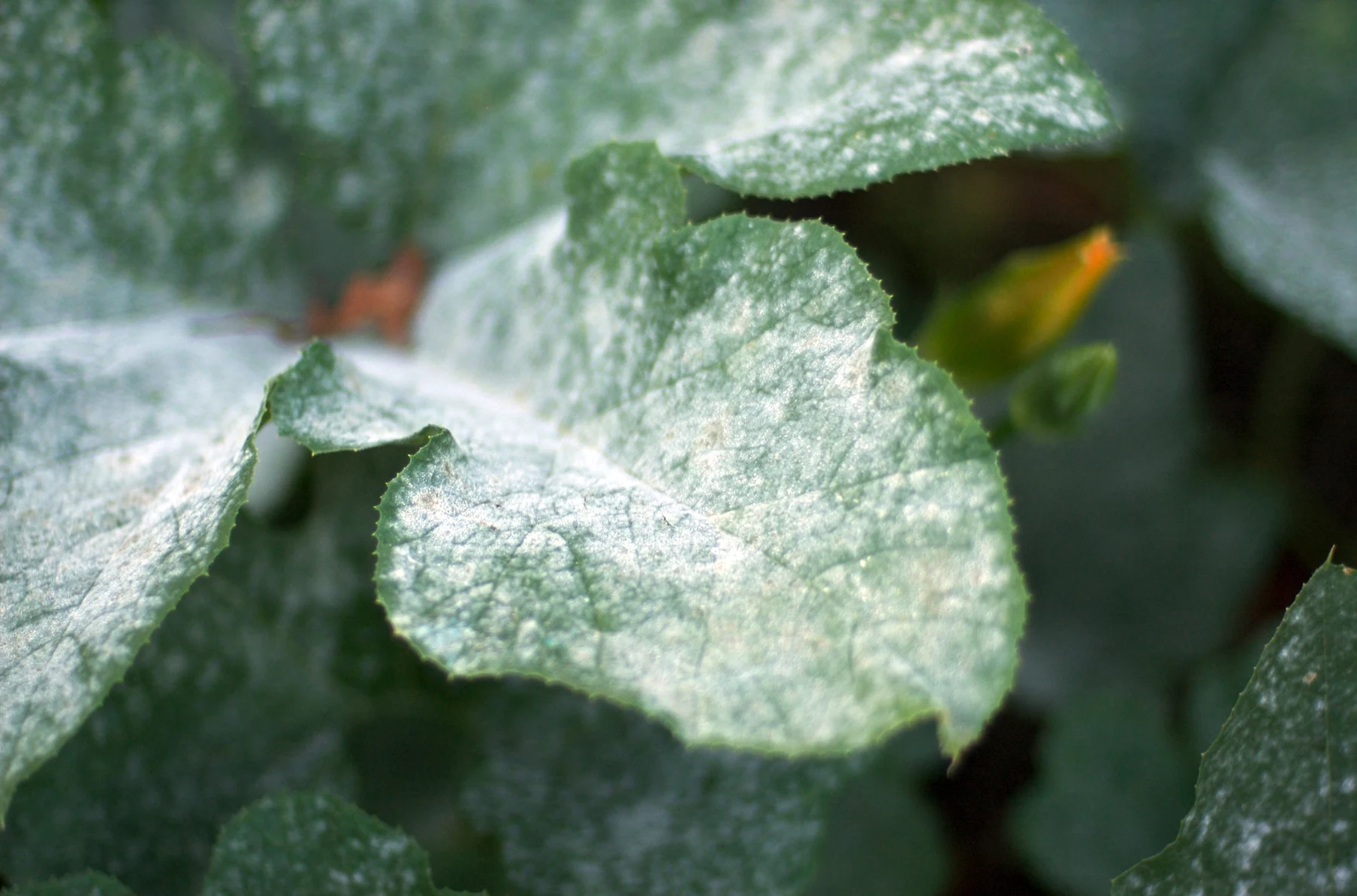
Powdery mildews (family Erysiphaceae, 900 species) are obligate parasites of living plants that attack nearly 10,000 species of flowering plants, including cereals, grapes, fruits and vegetables [1]. This guide covers cucurbits (Podosphaera xanthii), grapevine (Erysiphe necator), strawberry (Podosphaera aphanis) and tomato (Leveillula taurica, Oidium neolycopersici) [1]. Infected cucurbit leaves die early, leaving fewer or smaller fruit of poor quality [2]; in grapevine the disease can destroy clusters and reduce yield and quality [3]. Because programmes involve many sprays per season, the risk of resistance is high [1].
1. How to recognise it
Look for white, powdery growth on leaves, stems and sometimes fruit: chains of spores (conidia) on fungal threads that grow over the surface and feed through haustoria inserted into the outer cells [1][4]. Late in the season, tiny dark spheres (chasmothecia, the sexual fruiting bodies) may form in the colonies [2][5].
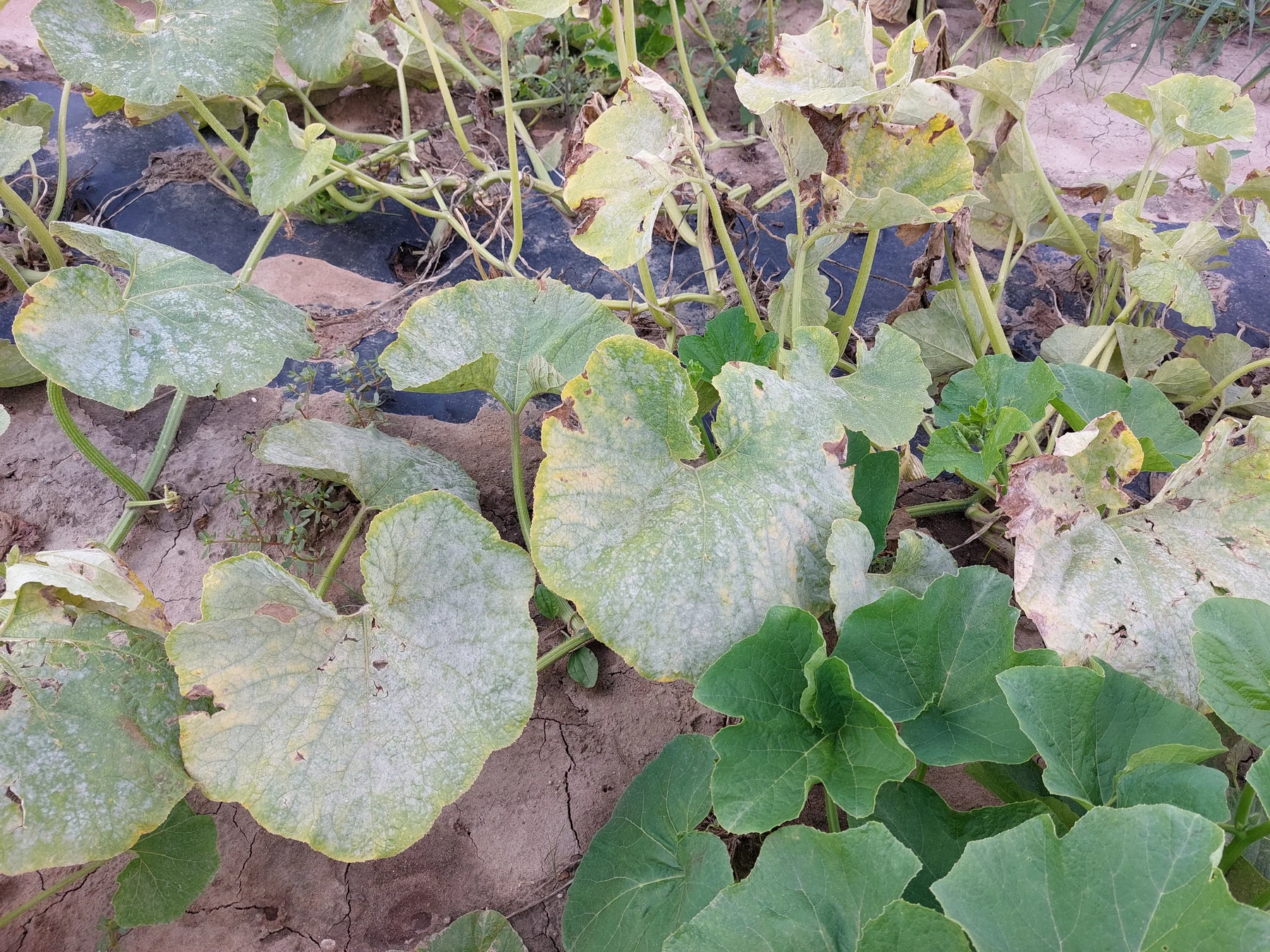
On cucurbits the growth appears on both leaf surfaces, usually first on shaded lower leaves and undersides, sometimes with yellow spots above the colonies [2]. On strawberry, colonies start on the leaf undersides, leaf edges roll up and purple-red blotches appear [6]. Tomato powdery mildew caused by Leveillula taurica shows as bright yellow blotches [7], and unlike other powdery mildews it grows mainly inside the leaf [8].
Downy mildew is often confused with it but is an oomycete, not a true fungus: it forms fluffy, bluish to grey or purple growth on leaf undersides, and on grapes starts as oily spots [5]. Fungicides targeted at powdery mildew do not control downy mildew [2].
2. Symptoms and damage
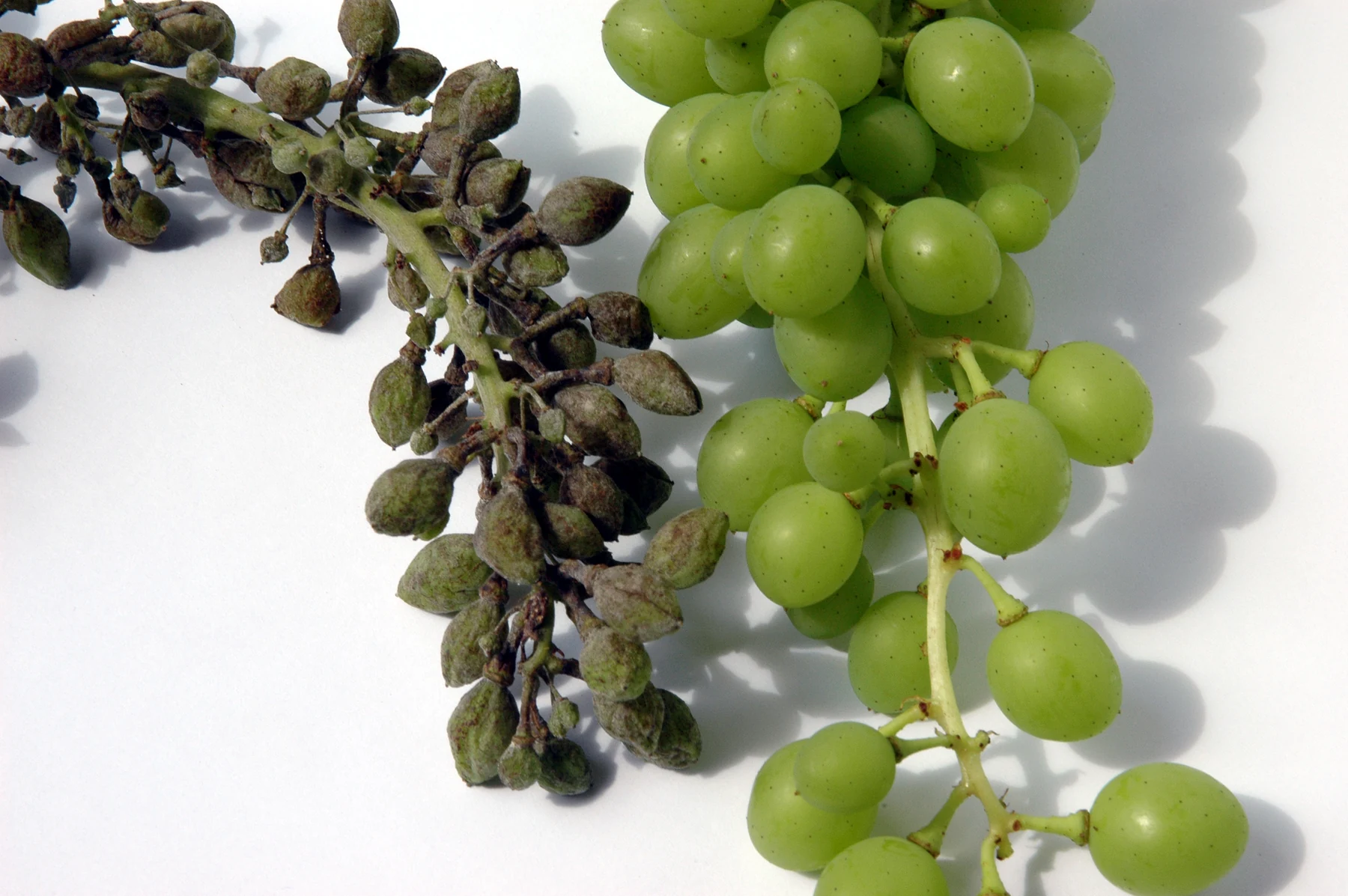
On grapevine, chlorotic spots on the upper leaf surface are followed by white growth underneath that turns powdery. Berries and rachises can be covered with white powder, mature fruit show dark web-like scars, and dormant canes show red blotches [9]. Infected berries may split and later become vulnerable to bunch rots [3].
Cucurbit leaves turn dull and chlorotic, then brown and papery [10]. Leaf loss leads to sunburnt or poorly ripened fruit, low soluble solids in melon and poor storage in winter squash [2].
In strawberry, infected flowers give deformed fruit or none, and mature fruit look seedy with white colonies [6]. On field tomatoes, L. taurica kills leaves without lesions on stems or fruit, but leaf loss causes sunburn and lower soluble solids [7].
3. Disease cycle
A spore landing on a susceptible leaf penetrates an epidermal cell, forms a haustorium to take up nutrients, and the fungus then spreads over the surface and produces new spores [1]. Because E. necator lives entirely outside the plant, fungicides need not penetrate the tissue to control it [3]. Cycles are short: symptoms appear 3 to 7 days after infection in cucurbits [2], and new spores 5 to 10 days after infection in grapevine [4][9]. Free water is not needed for infection [5]; in cucurbits, infection occurs at relative humidity as low as 50%, and rain is unfavourable [2].
Main powdery mildews of the crops covered
| Crop and pathogen | How the season starts | Favourable conditions |
|---|---|---|
| Cucurbits: Podosphaera xanthii | Believed to be airborne spores from other crops, possibly from far away [2] | Dense growth, low light; mean 20 to 27 °C; development stops at daytime 38 °C or more [2] |
| Grapevine: Erysiphe necator | Chasmothecia in the bark release spores after about 2 to 2.5 mm of rain above 10 °C; infected buds give flag shoots [3][9] | 21 to 29 °C; growth slows after 12 hours above 35 °C [9] |
| Strawberry: Podosphaera aphanis | Infected leaves and nursery plants [6] | Dry leaf surfaces, high humidity, cool to warm temperatures; severe under cover [6] |
| Tomato: Leveillula taurica, Oidium neolycopersici | L. taurica: wind-borne spores from solanaceous crops and weeds [7] | High humidity, mild temperatures, late season [7]; O. neolycopersici mainly in greenhouses [11] |
FRAC, the Fungicide Resistance Action Committee, rates resistance risk higher in pathogens with many short cycles and wide spore dispersal, and lists cucurbit powdery mildew as high risk [12].
4. Monitoring and when to act
In California vineyards, UC IPM advises checking the undersides of 10 to 15 basal leaves from about 20 vines 7 to 10 days after the first spring infection. Once colonies are found, the UC Davis powdery mildew risk index tracks canopy temperature: each day with at least six continuous hours between 21 and 29 °C (70 to 85 °F) adds 20 points, and at 60 points, after three such days in a row, an epidemic is under way. The index then moves between 0 and 100, falling on days without six such hours or with over 15 minutes above 35 °C. At 60 or more, the fungus reproduces about every 5 days, and spray intervals are shortened or lengthened by index [9]. Cornell names three weeks before to three weeks after bloom as the critical period for clusters [3].
For cucurbits, Cornell advises checking both surfaces of older leaves weekly from the start of fruit formation, for example five leaves at each of ten sites. In New York the action threshold is one affected leaf out of 50; starting later compromises control and favours resistance [2]. In California strawberries, treatment starts when leaf distortion and discoloration are first detected, and autumn control reduces spring disease [6].
5. Prevention
Resistance is standard in modern cucumber varieties and common in melon, but squash and pumpkin are only moderately resistant, and a decline in suppression indicates adaptation in P. xanthii. Separate successive plantings, or plant upwind of older ones [2].
In vineyards, shoot thinning, shoot positioning and leaf removal in the cluster zone improve air flow and light; avoid low, shaded, wet sites and consider less susceptible varieties [3]. Removing prunings reduces overwintering inoculum [4]. In strawberry, avoid overhead irrigation and excess nitrogen [6]. FRAC stresses that fungicides do not replace resistant varieties, good agronomy and hygiene [13].
6. Resistance is documented
FRAC rates QoI (Group 11) and MBC (Group 1) fungicides as high risk, SDHIs (Group 7) as medium to high and DMIs (Group 3) as medium; multi-site fungicides are low risk [14].
QoI resistance in cucurbit powdery mildew appeared within a few years of the first QoIs, with cross-resistance to all QoIs tested [1][15]. In grapevine it was first described in the United States and later found at high frequency in several states [1]; the G143A mutation behind it persists for years without QoI use [16]. In 2024, FRAC monitoring found high frequencies in grape powdery mildew in eight European countries [17]. QoI resistance is also confirmed in strawberry powdery mildew [15].
MBC resistance is confirmed in cucurbit and grape powdery mildews [15]. In New York, MBC and QoI fungicides are no longer recommended for cucurbits, and boscalid (SDHI) resistance has been routine since 2009 [2]; FRAC found SDHI resistance at moderate to high frequency in European cucurbit samples from 2021 to 2023 [18]. DMI resistance builds up gradually: sensitivity shifts in grape powdery mildew are reported from the United States, Chile, Europe and Australia [16]. FRAC also records resistance to Group 13 in E. necator, to cyflufenamid (U06) and flutianil (U13) in cucurbit powdery mildew, and less sensitive isolates to Group 50 [14][15][19].
7. Rotate modes of action
Count every product containing a group, alone or in mixture, and pair it with a partner from another group that controls the disease alone; two QoIs or two SDHIs together give no protection [17][18].
- Grapevine, QoI: at most 2 powdery mildew sprays per crop, preferably in mixture; solo products in strict alternation [17].
- Cucurbits, QoI: at most 3 sprays per crop and one in every three applications, never consecutive [17].
- SDHI: all are cross-resistant; in grapes at most 3 applications a year and half of all applications, no more than 2 in a row in mixture [18].
- DMI: preventively; in grapevine at most 4 applications per season, in mixture or alternation, at the full recommended rate [13].
- Group 13: in grapes at most 3 sprays a season; in cucurbits and strawberries at most half of powdery mildew sprays [19]. Group 50: at most 3 in grapes, 2 in vegetables [20].
- Multi-sites and biologicals (BM01, BM02): no FRAC limit beyond the label [21].
FRAC groups used against powdery mildew
| FRAC group | Class | Examples | What the sources say |
|---|---|---|---|
| 11 | QoI (strobilurins) | Azoxystrobin, pyraclostrobin, trifloxystrobin | High risk [14]; field resistance in cucurbit, grape and strawberry powdery mildews [15] |
| 3 | DMI | Difenoconazole, tebuconazole | Medium risk; activity spectra differ, assume cross-resistance [14]; listed by UC IPM for grapes [9] |
| 7 | SDHI | Boscalid, fluopyram | Medium to high risk [14]; resistance common in cucurbit powdery mildew in parts of Europe [18] |
| 1 | MBC | Thiophanate-methyl, carbendazim | High risk [14]; field resistance in cucurbit and grape powdery mildews [15] |
| 13, 50 | Aza-naphthalenes; aryl-phenyl-ketones | Quinoxyfen; metrafenone | Medium risk; resistance or less sensitive isolates known [14][19] |
| M02 | Inorganic sulphur | Sulphur | Low risk [14]; first spray in UC IPM grape programmes [9]; melons are sensitive [2] |
| M05, M01 | Chloronitrile; copper | Chlorothalonil, copper hydroxide | Low risk [14]; contact protectants for cucurbit powdery mildew [2] |
| M03 | Dithiocarbamates | Mancozeb | Low risk [14], but lacks contact activity on cucurbit powdery mildew [2] |
| BM02 | Microbial | Bacillus amyloliquefaciens D747 | No FRAC limit within the label [14][21]; D747 products labelled for cucurbit powdery mildew in the United States [2] |
The table describes FRAC groups and what the cited sources say. It is not a list of registered uses. Which products may be used, on which crops, at what rate and interval is set by each country’s registration and by the product label.
8. Biological options in the same programme
FRAC treats microbial biologicals (BM02) as low risk with no limit beyond the label [21]. UC IPM advises starting Bacillus products before disease onset and dropping soft products when pressure is high, as alone they will not give adequate control [9].
Ampelomyces quisqualis strain AQ10 is a hyperparasite that attacks the hyphae, conidiophores and chasmothecia of powdery mildews; the EU peer review found sufficient efficacy in grapes, tomato, pepper and aubergine [22]. AQ10 is the basis of Mycovia™, a product in development at Huasheng, with a documented scope for powdery mildew in tomato, pepper, cucumber and strawberry. Bacillus amyloliquefaciens D747 is in FRAC group BM02 [14]; Baciva™ is based on this strain, with documented scopes including powdery mildew control in the grape and cucumber crop groups and suppression in tomato, pepper and strawberry.
9. Regional notes
China
FRAC monitoring found reduced SDHI sensitivity in cucurbit powdery mildew in a few Chinese samples, and at low frequency in Hebei and Liaoning in 2018 [18]. In Guangxi, isolates collected from 2007 to 2012 showed varying resistance to kresoxim-methyl (Group 11), most frequently on bitter gourd (63.89%), and highly resistant isolates were also resistant to carbendazim [23]. Products registered in China are listed by the Institute for the Control of Agrochemicals (ICAMA) [24].
Latin America
In Chile, powdery mildew is one of the most important grapevine diseases [25], and control relies on up to 18 sprays per season; in a high-pressure Maule Valley field, two to four sprays guided by field observation kept severity at 0.6%, against 8.5% with seven calendar sprays [26]. DMI sensitivity shifts are also reported in Chile [16]. In Brazil, Embrapa guidance limits QoIs to two applications per season against grape powdery mildew [27].
10. A practical sequence
- Before the season, list locally registered FRAC groups and any with documented local resistance.
- Use resistant or less susceptible varieties, and manage canopy and hygiene.
- Scout weekly from the susceptible stage, checking both leaf surfaces; in vineyards, follow a risk index.
- Start at the first colonies or local threshold, and protect the most susceptible stages.
- Keep site-specific groups within FRAC limits, alternate them and add a multi-site partner.
- Use biologicals early, while pressure is low.
- Check leaf undersides after each spray, never repeat a failed group, and follow the local label.
Frequently asked questions
What is the best fungicide for powdery mildew?
There is no single best product. Resistance is documented to QoI and MBC fungicides and, in places, to SDHI and DMI groups [2][15]. Rotate effective, locally registered groups within FRAC limits and add a multi-site protectant [2][17].
How do I control powdery mildew on cucumbers?
Grow resistant varieties, check older leaves weekly from fruit set, start at the local threshold (one affected leaf in 50 in New York), and alternate mobile fungicides with a protectant [2].
How do I control powdery mildew on grapes?
Start with sulphur or oil, follow the UC Davis risk index, and protect clusters from three weeks before to three weeks after bloom [3][9]. Limit QoIs to two and DMIs to four applications per season [13][17].
Does azoxystrobin still work against powdery mildew?
Azoxystrobin is a QoI. QoI resistance is documented in cucurbit, grape and strawberry powdery mildews, and Cornell no longer recommends QoIs for cucurbits in New York [2][15].
Is powdery mildew the same as downy mildew?
No. Downy mildew is an oomycete with fluffy growth on leaf undersides; powdery mildew is a true fungus [5], and its targeted fungicides do not control downy mildew [2].
Can biological products control powdery mildew?
They help at low pressure and in rotation, not when pressure is high [9]. Examples include Ampelomyces quisqualis and Bacillus amyloliquefaciens D747 [2][22].
Further reading
- Enquire about azoxystrobin, difenoconazole, tebuconazole and chlorothalonil
- Azoxystrobin: formulations and supply
- Pyraclostrobin: formulations and supply
- Trifloxystrobin: formulations and supply
- Difenoconazole: formulations and supply
- Tebuconazole: formulations and supply
- Chlorothalonil: formulations and supply
- Copper hydroxide: formulations and supply
- Baciva™ (Bacillus amyloliquefaciens D747)
- Mycovia™ (Ampelomyces quisqualis AQ10)
- [1] Vielba-Fernández A., Polonio Á., Ruiz-Jiménez L., de Vicente A., Pérez-García A., Fernández-Ortuño D. (2020). Fungicide resistance in powdery mildew fungi. Microorganisms 8: 1431.
- [2] McGrath M. T. (updated April 2024). Cucurbit powdery mildew. Cornell Vegetables, Cornell University.
- [3] Kanaley K., Bekelja K., Lemus Garza R. E. (2025). Grapevine powdery mildew (Erysiphe necator): fruit IPM fact sheet. Cornell Integrated Pest Management.
- [4] Ferrandino F. J. (n.d.). Grape powdery mildew. The Connecticut Agricultural Experiment Station.
- [5] Pollard A. C. (updated 2026). Addressing downy mildew and powdery mildew in the home garden. Penn State Extension.
- [6] UC IPM (2018). Strawberry: powdery mildew (Podosphaera aphanis). UC ANR Publication 3468.
- [7] UC IPM (2023). Tomato: powdery mildew on field-grown tomatoes (Leveillula taurica). UC ANR Publication 3470.
- [8] UC IPM (2010). Peppers: powdery mildew (Leveillula taurica).
- [9] UC IPM (2014). Grape: powdery mildew (Erysiphe necator). UC ANR Publication 3448.
- [10] UC IPM (2016). Cucurbits: powdery mildew. UC ANR Publication 3445.
- [11] UC IPM (2013). Tomato: powdery mildew on greenhouse and coastal tomatoes (Oidium neolycopersici). UC ANR Publication 3470.
- [12] FRAC (2019). FRAC Pathogen Risk List.
- [13] FRAC SBI Working Group (2026). Minutes of the 2026 meeting and use recommendations.
- [14] FRAC (2026). FRAC Code List 2026: fungal control agents sorted by cross-resistance pattern and mode of action.
- [15] FRAC (2020). List of first confirmed cases of plant pathogenic organisms resistant to disease control agents.
- [16] Kunova A., Pizzatti C., Saracchi M., Pasquali M., Cortesi P. (2021). Grapevine powdery mildew: fungicides for its management and advances in molecular detection of markers associated with resistance. Microorganisms 9: 1541.
- [17] FRAC QoI Working Group (2026). Minutes of the 2026 meeting and use recommendations.
- [18] FRAC SDHI Working Group (2026). Minutes of the 2026 meeting and use recommendations.
- [19] FRAC (2022). Group 13 (aza-naphthalenes): resistance status and resistance management recommendations.
- [20] FRAC (2021). Group 50 (metrafenone, pyriofenone): resistance management recommendations.
- [21] FRAC. Fungicide resistance management with/of multi-site fungicides, biological control agents and plant defence inducers.
- [22] EFSA (2017). Peer review of the pesticide risk assessment of the active substance Ampelomyces quisqualis strain AQ10. EFSA Journal 15(12): 5078.
- [23] Lin S., Zhu G., Yan M., Xian X. (2014). Resistance of melon powdery mildew isolates to kresoxim-methyl in Guangxi and determination of its sensitivity to three fungicides. Journal of Southern Agriculture (in Chinese).
- [24] Institute for the Control of Agrochemicals, Ministry of Agriculture and Rural Affairs (ICAMA). China Pesticide Information Network.
- [25] Araya C., Rosales I. M., Méndez M. A., Delmotte F. (2014). Identification and geographic distribution of genetic groups of Erysiphe necator in Chilean vineyards. Vitis 53(3): 163-165.
- [26] Valdés-Gómez H., Acevedo-Opazo C., Pañitrur de la Fuente C., Verdugo-Vásquez N., Bratti J., Donoso E. (2017). Evaluation of three control strategies against grapevine powdery mildew in the central region of Chile. GiESCO 2017.
- [27] Garrido L. R. (2022). Resistência de isolados de fungos e cromistas a diferentes princípios ativos: classificação e medidas de manejo. Embrapa Uva e Vinho, Documentos 129.
Products in this article