Private label agrochemicals and biostimulants: what to agree with your supplier
What a distributor or agricultural input company should agree with a contract manufacturer before a product goes out under its own brand: specification, label and languages, packaging, batch documents and who holds the registration.
Technical review: Wang Liqun, Researcher; Chen Zhiyuan, Senior Agronomist
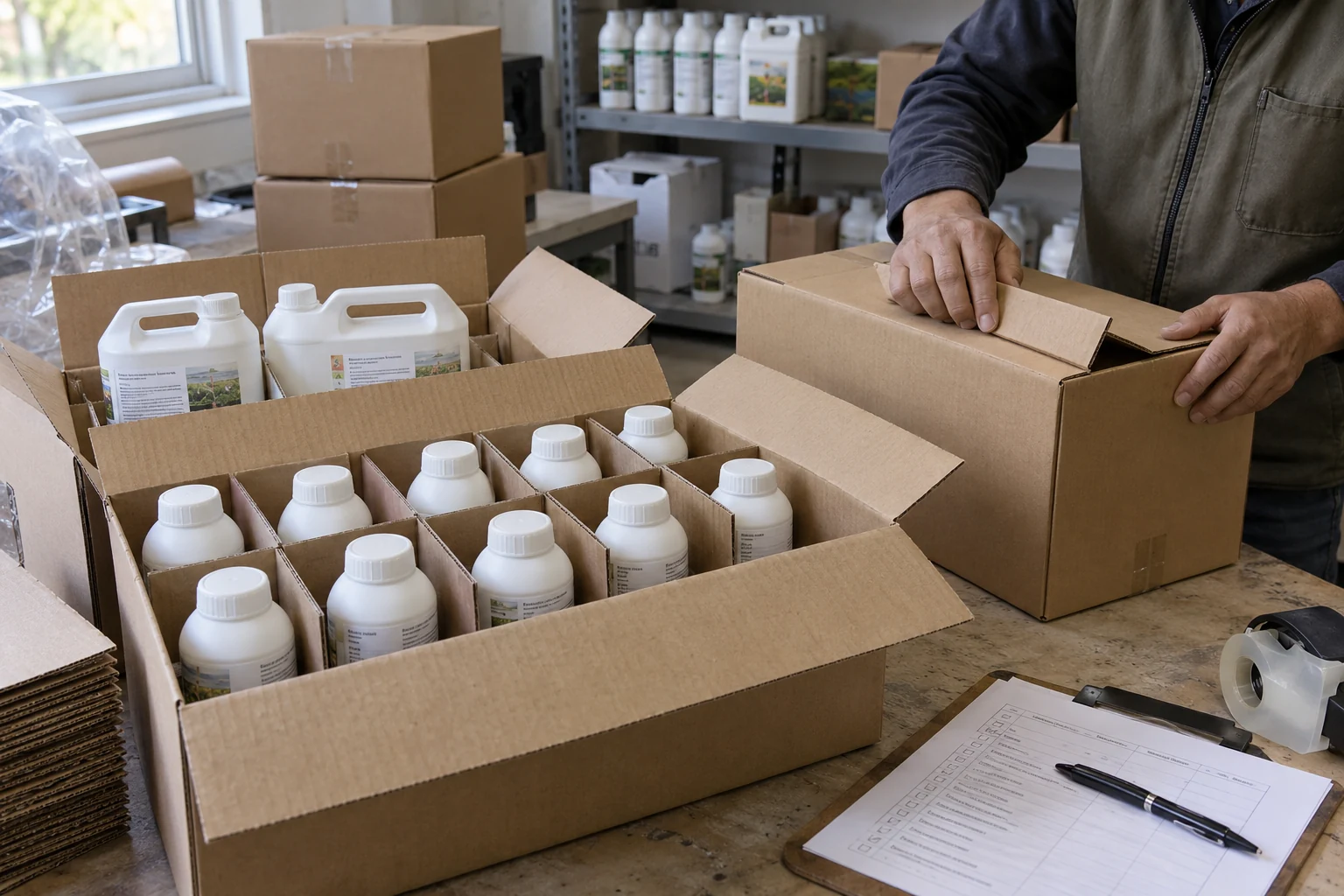
Many distributors and agri-input companies sell pesticides, fertilisers and biostimulants under their own brand while a contract manufacturer formulates and packs them. The FAO/WHO International Code of Conduct on Pesticide Management provides for this: it defines a manufacturer as an entity that makes an active ingredient or formulation directly or through an entity under contract with it, and expects industry and traders to supply only products of adequate quality, packaged and labelled as appropriate for each market [1].
1. What private label means in crop protection and crop nutrition
Here, a private-label product is one that a supplier manufactures and a distributor or agri-input company sells under its own brand. Buyers also say own brand, white label or OEM supply; in Spanish, marca propia or maquila; in Chinese, 贴牌 or OEM 代加工.
For pesticides, a new brand does not create a new product. The Code asks industry to ensure that the active ingredient and co-formulants of a marketed product correspond in identity, quality, purity and composition to those of the registered product that was tested and evaluated [1].
Fertilisers and biostimulants follow different rules. FAO’s 2019 Fertilizer Code asks industry to label fertilisers clearly, legibly and accurately, consistent with the rules of the country of sale [2]. In the European Union, Regulation (EU) 2019/1009 treats an importer or distributor that places a fertilising product on the market under its own name or trademark as the manufacturer, with the manufacturer’s obligations [3]. That rule applies in the EU only.
2. Product and specification
Start with a written specification: the parameters and criteria that define the product’s appearance and physical and chemical properties [1]. The FAO/WHO specifications manual gives it two uses: in a contract of sale, to give the buyer some guarantee of quality, and by the authority, to check that the product on the market is the one registered. Its clauses should be quantifiable, with limits and test methods [4].
A pesticide specification covers a description that can be checked by inspection, identity and content of the active ingredient, limits for relevant impurities, physical properties for the formulation type, and storage stability [4].
Tolerances on declared active ingredient content in FAO/WHO specifications
| Declared content (g/kg or g/L at 20 °C) | Tolerance on the average measured content |
|---|---|
| Up to 25 | ±15% for homogeneous formulations (EC, SC, SL and similar); ±25% for heterogeneous ones (GR, WG and similar) [4] |
| Above 25, up to 100 | ±10% [4] |
| Above 100, up to 250 | ±6% [4] |
| Above 250, up to 500 | ±5% [4] |
| Above 500 | ±25 g/kg or g/L [4] |
These tolerances cover variation in manufacturing, packaging, storage, sampling and analysis. FAO/WHO specifications are an international reference and do not replace national registration requirements [4].
Agree storage stability too. In the FAO/WHO accelerated test, a formulation kept at 54 ± 2 °C for 14 days must still meet its clauses, with average active ingredient content not below 95% of the starting value. Chemical formulations are generally expected to remain satisfactory for at least two years from the release date in unopened original containers; a shorter shelf life must be stated on the label [4].
Fix the composition, not only the content. Registration evaluates the formulated product as a whole, so a change of co-formulants can change its properties and should be reported to the authority; technical material from a different manufacturer is assessed for equivalence [5]. Name the formulation version in the contract.
For fertilisers and biostimulants, specify declared content, physical form and contaminant limits. In the EU, plant biostimulants have contaminant limits and must have the effects claimed on the label [3].
3. The label
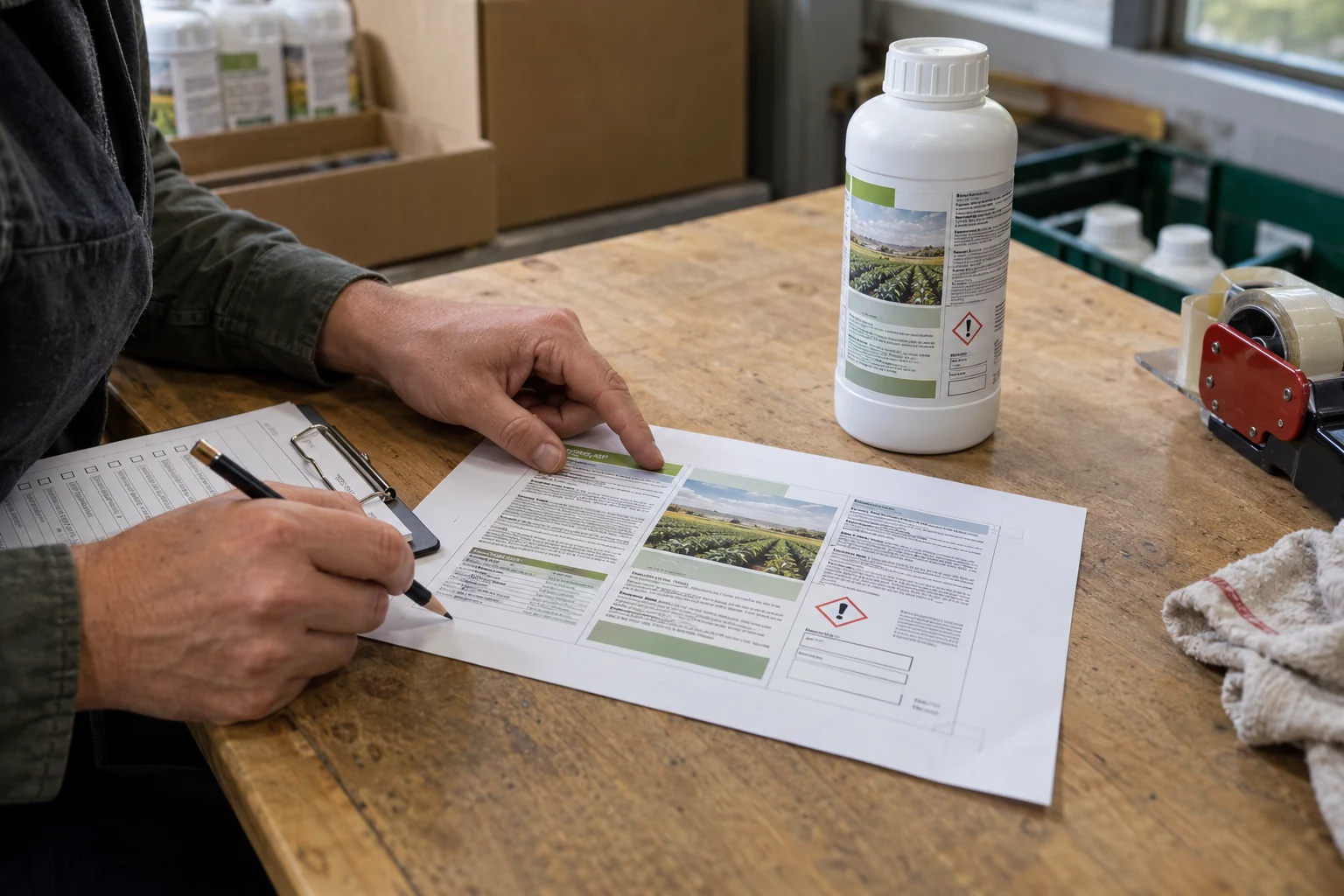
The label is the principal, and sometimes the only, contact between supplier and user. In many countries it is a legal document, and all labels and any modifications must be approved by the responsible authority. The FAO/WHO guidance on good labelling practice (second revision, 2022) lists what a label should contain [6].
Label content listed in the FAO/WHO labelling guidance
| Part of the label | Elements |
|---|---|
| Product content | Product name and category; formulation type and code; active ingredient name and content; hazardous co-formulants; net contents; batch number; registration number [6] |
| Hazard and safety | Hazard symbols, signal word and hazard statements; precautionary statements and pictograms; protective equipment; first aid; spill advice [6] |
| Directions for use | Crops and target pests; dose rates and timing; pre-harvest and re-entry intervals; mode of action code where appropriate [6] |
| Storage and disposal | Storage conditions; warning against reusing containers; disposal of containers and left-over product [6] |
| Supplier and dates | Local distributor or supplier, and registration holder if different; release date; expiry date if shelf life is under two years [6] |
For a private label, the supplier block matters most. The local distributor’s or supplier’s name, address, telephone number and email should always appear, and this will often be the registration holder; if the two differ, the holder’s contact details should appear too. The manufacturer’s name may appear [6]. Each batch should be identified in numbers or letters understandable without code references, with the release date (month and year) [1].
For microbial products, the guidance suggests stating content as colony forming units (cfu) per kilogram or litre, or as biopotency, and naming the organism by genus, species and, where appropriate, strain [6]. In the EU, a microbial plant biostimulant label must also list the intentionally added micro-organisms and strains with their concentration and warn that micro-organisms may provoke sensitising reactions [3].
Languages. The guidance recommends official, locally understood languages; a complete label in each language, or extra languages on an attached leaflet with key safety information kept on the container; and independent checks such as back-translation [6]. In the EU, each Member State sets the language for fertilising products [3].
Pictograms and claims. GHS hazard pictograms are a black symbol on white in a red-framed diamond, at least 10 × 10 mm; precautionary pictograms should echo the text, never contradict it. Labels should not use words such as “safe”, “non-toxic” or “best”, or show crops that are not approved [6]. EU fertilising product labels must not claim to prevent or treat plant diseases [3].
Artwork approval. Check the draft for content, wording and print style before it goes to the authority, then confirm that the printed label is the same as the approved draft, legible at arm’s length, and printed on paper, ink and adhesive that withstand transport, storage and contact with the product [6].
4. Packaging
The Code asks that packaging follow FAO, UNEP and WHO guidelines, and that packing or repacking take place only on licensed premises where staff are protected and the product is properly packaged, labelled and of the right quality [1]. Registration guidelines advise authorities to check that packaging suits the product and the country’s transport and climatic conditions, is of an appropriate size and conforms to UN packaging guidelines [5].
FAO/WHO guidelines on empty containers list the criteria for a well-designed container [7]:
- it complies with the UN packaging codes and is labelled appropriately;
- its materials are inert and impermeable to the contents;
- it is robust, liquid-tight and resealable;
- it pours without dripping or glugging, empties completely and is easy to rinse.
A water-soluble bag counts as part of the formulation and needs waterproof outer packaging [7]. The rate at which a stored product changes depends on the formulation and the packaging as well as storage conditions [4], so ask for stability data on the pack that will be sold.
Both Codes ask for pack sizes suited to small-scale farmers, to discourage repackaging into unlabelled containers [1][2]. Internationally traded pesticides should also conform to the UN Recommendations on the Transport of Dangerous Goods for packaging, marking and transport [1], and bulk material shipped for local repacking should travel with a safety data sheet [6].
5. Documents that travel with each batch
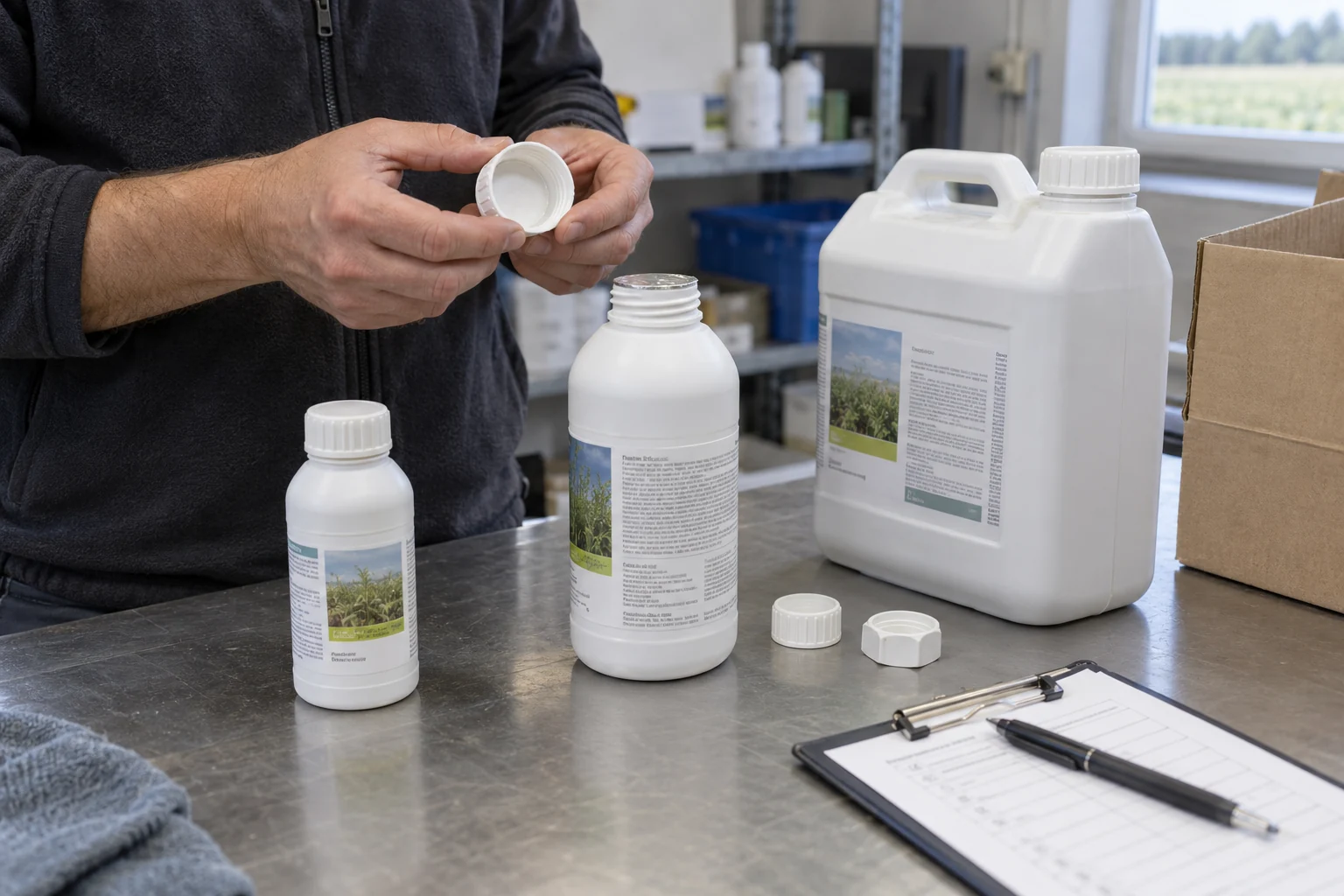
Batch documents connect the goods to the agreed specification and the approved label. The Fertilizer Code asks governments to check that the product loaded and the product delivered are the same and match the specifications on the labels [2].
Documents to agree for each batch
| Document | What it should show | Basis |
|---|---|---|
| Specification | Clauses, limits and test methods | FAO/WHO specifications manual [4] |
| Certificate of analysis (COA) | Batch results against each clause, with the batch number | Supply contract |
| Safety data sheet (SDS) | GHS hazard and handling information, consistent with the approved label | FAO/WHO labelling guidance [6] |
| Approved label | The approved version, with batch number and release date | Code of Conduct [1] |
| Shipping records | Batch numbers in each consignment; transport documents where they apply | Supply contract |
The registrant must ensure that the SDS is not inconsistent with the approved label, yet signal words, hazard statements or symbols can differ between them [6]. Review both whenever either changes. Keep records so that every batch can be traced: the Code asks manufacturers and distributors to act when a product needs recalling [1], and in the EU economic operators must identify their suppliers and customers for five years [3].
6. Registration and responsibility
The Code asks industry to use labels that comply with registration requirements in the country of sale [1]. FAO/WHO registration guidelines have the authority publish the registrant, trade name, active ingredients, formulation and uses, and recommend that only registrants import or manufacture the product for sale [5]. Brand, holder and label must line up before the first shipment.
Label changes and new uses are major changes that need a review of the data, and even new distributor details affect the labelling. The same guidelines ask vendors to ensure that registered products are not repackaged or relabelled [5]: a private label is created through the registration and approved label, not by relabelling stock.
Who holds the registration is agreed for each project. The holder carries the industry duties in these texts: supplying the registered composition, reporting new information, taking corrective action and keeping labels and safety data sheets consistent with the registration [1][5].
In the EU, Regulation (EU) 2019/1009 covers CE-marked fertilising products. Their manufacturer, including a distributor that markets under its own name, must prepare technical documentation, complete the conformity assessment, issue an EU declaration of conformity and take corrective action when a product does not conform [3]. This applies in the EU only.
7. A practical sequence
- Confirm the destination market’s requirements: approval route, label languages and who may hold the approval.
- Agree the specification in writing, with tolerances, storage stability, test methods and the formulation version.
- Decide who holds the registration and whose name goes on the label; check that brand, holder and label text match the approval.
- Draft the label from the approved text, add the supplier block, batch number and release date, and back-translate each language.
- Agree pack sizes, materials and closures for the product, climate and route, and confirm stability in the pack to be sold.
- Approve printed artwork against the approved draft before production.
- For each batch, check the COA against the specification and the SDS against the label, and link batch numbers to shipping records.
- Agree how complaints and recalls are handled; treat any change of formulant, source, label or pack as one that may need approval.
Frequently asked questions
What is private label fertilizer?
A fertiliser or biostimulant made by one company and sold by another under its own brand. The FAO Fertilizer Code recommends that labels show at least net weight, nutrient content, release date, safety information and where to find use instructions [2]. In the EU, the company marketing it under its own name is treated as the manufacturer [3].
Can a distributor sell a pesticide under its own brand?
Yes, where the market allows it, but the product must match the registered product and the label must comply with the registration [1]. FAO/WHO guidelines recommend that only registrants import or manufacture registered products for sale, so settle who holds the registration first [5].
Whose name goes on a private label pesticide label?
The local distributor or supplier, with full contact details; this is often the registration holder. If the holder is another company, its details should appear too, and the manufacturer’s name may appear [6].
Can I relabel a product that is already registered?
Not on your own. FAO/WHO guidelines ask vendors to ensure that registered products are not repackaged or relabelled, and label modifications generally need the authority’s approval [5][6].
What documents should come with each batch?
A certificate of analysis against the agreed specification, a safety data sheet consistent with the approved label, and shipping records that link batch numbers to the consignment [4][6].
How many languages does the label need?
The official, locally understood languages of the country of sale. Each needs a complete label or an attached leaflet, with key safety information on the container [6].
Further reading
- Agricultural input sourcing and supply
- Quality: from specification to delivery
- Product catalogue
- [1] FAO and WHO (2014). The International Code of Conduct on Pesticide Management.
- [2] FAO (2019). The International Code of Conduct for the Sustainable Use and Management of Fertilizers.
- [3] European Union (2019, consolidated text of 30 December 2025). Regulation (EU) 2019/1009 laying down rules on the making available on the market of EU fertilising products.
- [4] FAO and WHO (2025). Manual on the development and use of FAO and WHO specifications for chemical pesticides. Third edition.
- [5] FAO and WHO (2010). Guidelines for the registration of pesticides.
- [6] FAO and WHO (2022). Guidance on good labelling practice for pesticides (second revision). International Code of Conduct on Pesticide Management.
- [7] FAO and WHO (2008). Guidelines on management options for empty pesticide containers.