Root-knot nematodes: diagnosis, sampling and integrated management
How to recognise root-knot nematode galls, sample soil and roots, and combine resistant varieties and rootstocks, rotation, soil treatment, biologicals and nematicide groups in vegetables and protected crops.
Technical review: Wang Liqun, Researcher; Chen Zhiyuan, Senior Agronomist
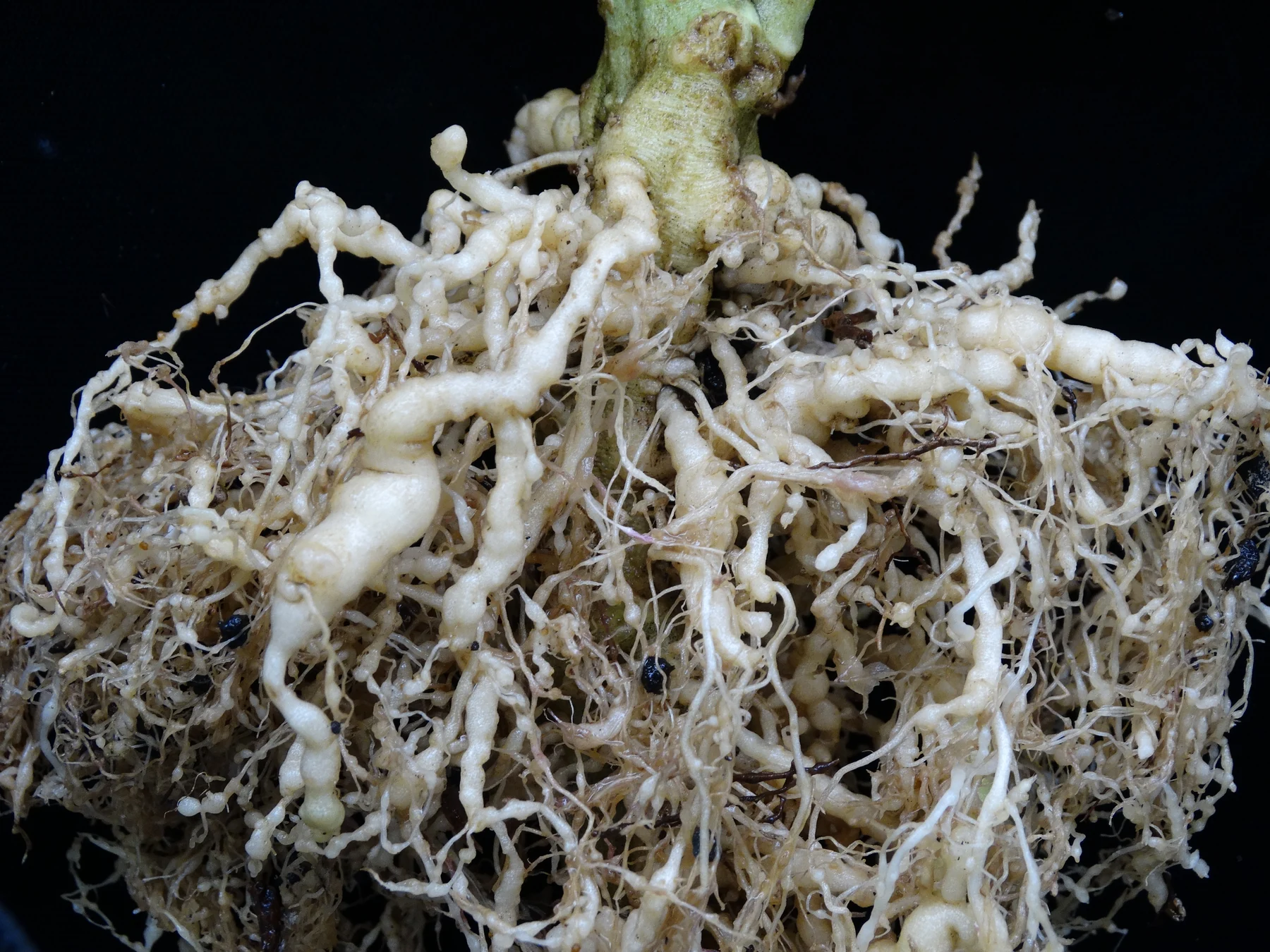
Root-knot nematodes (Meloidogyne spp.) are microscopic roundworms that feed inside roots. Of more than 90 species, M. incognita, M. javanica, M. arenaria and M. hapla are the most widespread in tomato, with the heaviest losses in warm regions on sandy soils [1]. M. incognita and M. javanica have more than 1,000 known host plant species [1]. In Florida they are the main nematode pest of tomato, pepper, eggplant and cucurbits, including cucumber [2][3].
1. How to recognise it
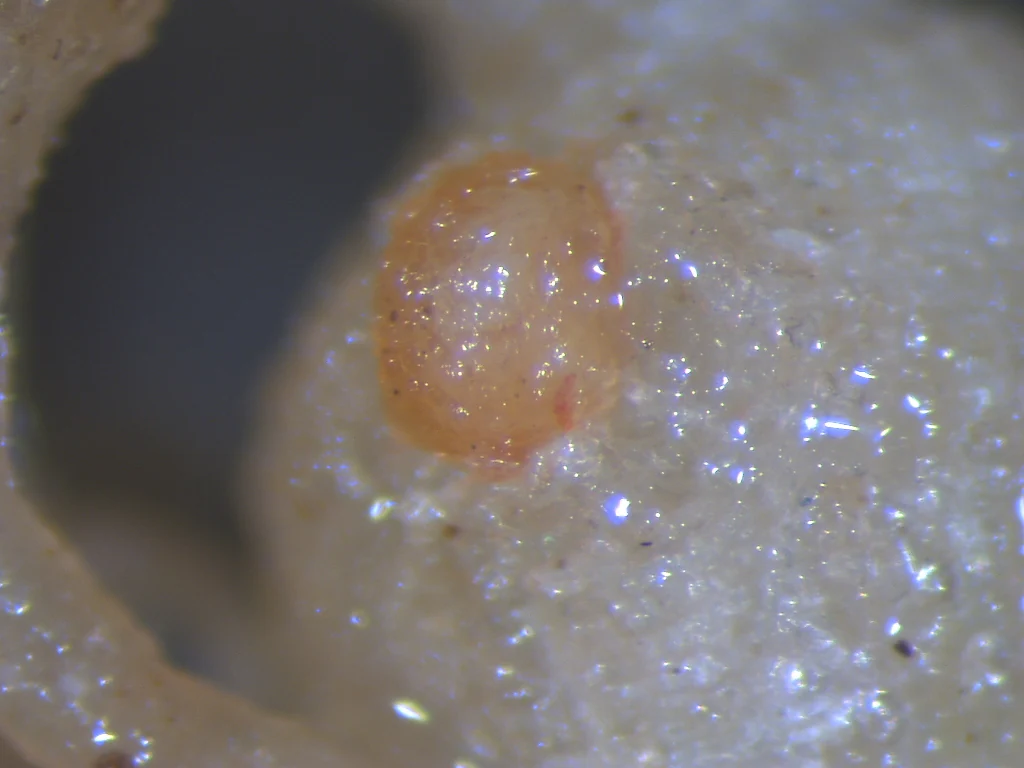
Galls are swellings of the root tissue itself, usually small but up to about 2.5 cm across. In a cut gall, a hand lens may show the females as tiny white, pear-shaped pearls [4]; egg masses on the gall surface are visible to the naked eye [1]. M. hapla usually causes small galls; the other main species, including M. enterolobii, cause large, irregular galls that can rot when secondary pathogens invade [1].
Look-alikes: nitrogen-fixing nodules on legume roots rub off, galls do not [5]. In Latin America the false root-knot nematode, Nacobbus aberrans, galls tomato, pepper and bean roots in a rosary-bead pattern rather than the fused galls of heavy Meloidogyne infection [6]. Have the species identified: resistant varieties and rotations work only against some species [3][4].
2. Symptoms
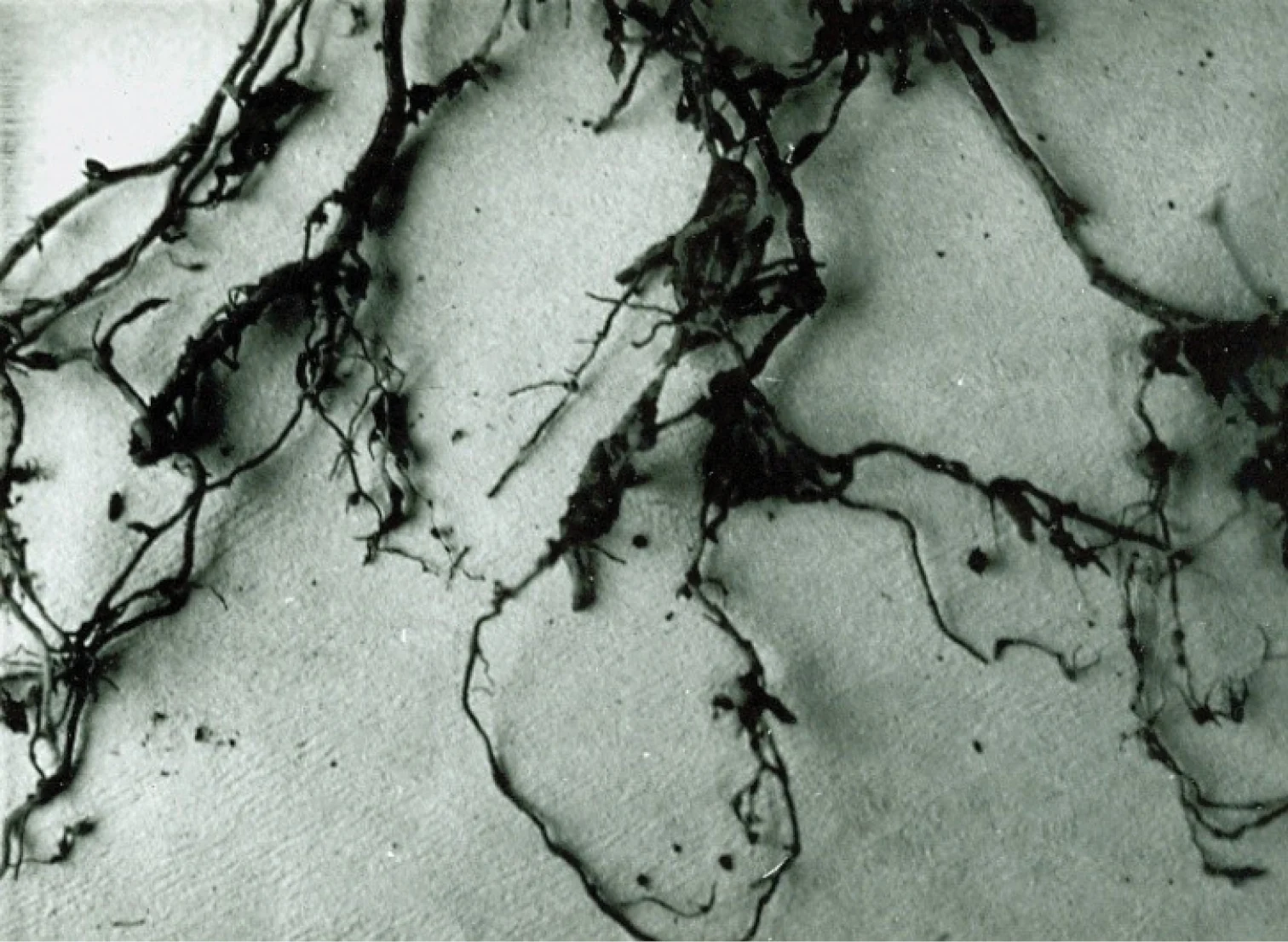
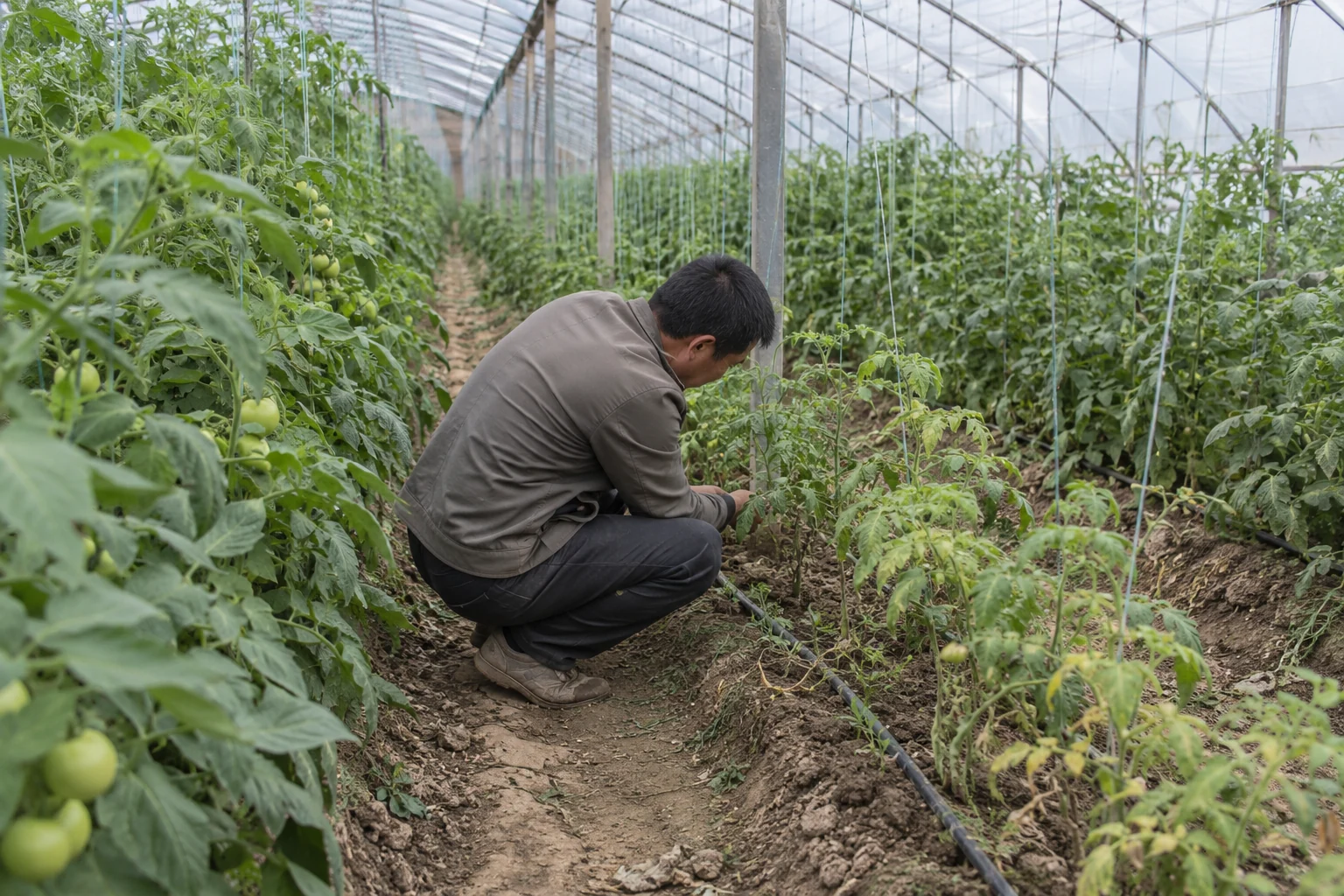
Above ground, stunting, yellowing, wilting in the heat of the day despite moist soil, poor response to fertiliser and malformed fruit are easily mistaken for nutrient or water deficiency, blocked drip lines or root disease [2][4][5]. Damage shows as irregular patches, often on sandy soil [4]. With Fusarium wilt, tomato plants can die early [2]; cucumber and watermelon generally suffer more than squash [3].
3. Life cycle
Root-knot nematode life stages
| Stage | Key facts | Practical note |
|---|---|---|
| Egg | 500 to 1,000 per gelatinous egg mass, sometimes over 2,000 [1] | Egg masses sit on the gall surface [1] |
| Second-stage juvenile (J2) | About 0.5 mm long; moves through soil and infects roots [2] | The stage counted in soil samples [4] |
| Female | Feeds on giant cells; lays eggs after about 2 to 4 weeks in favourable conditions [2] | Inside galls [4] |
| Whole cycle | 21 to 45 days; 3 to 4 weeks in warm months, up to 70 days in winter [1][7] | 4 or 5 generations in one warm season [1] |
| Without a host | Eggs or juveniles survive up to two years [7] | Remove galled roots after harvest [2] |
Most species reproduce without mating and, in warm climates, stay active all year in moist soil [1]. Most nematodes cannot penetrate roots below about 18°C (64°F) soil temperature [5].
4. Monitoring and when to act
Check roots. Dig up and wash roots of a few poor plants in midseason, or earlier if plants wilt; galls can appear a month after planting. Include the sandiest areas. In fallow fields, galls on nightshade weeds show that a susceptible tomato crop would be infected [4].
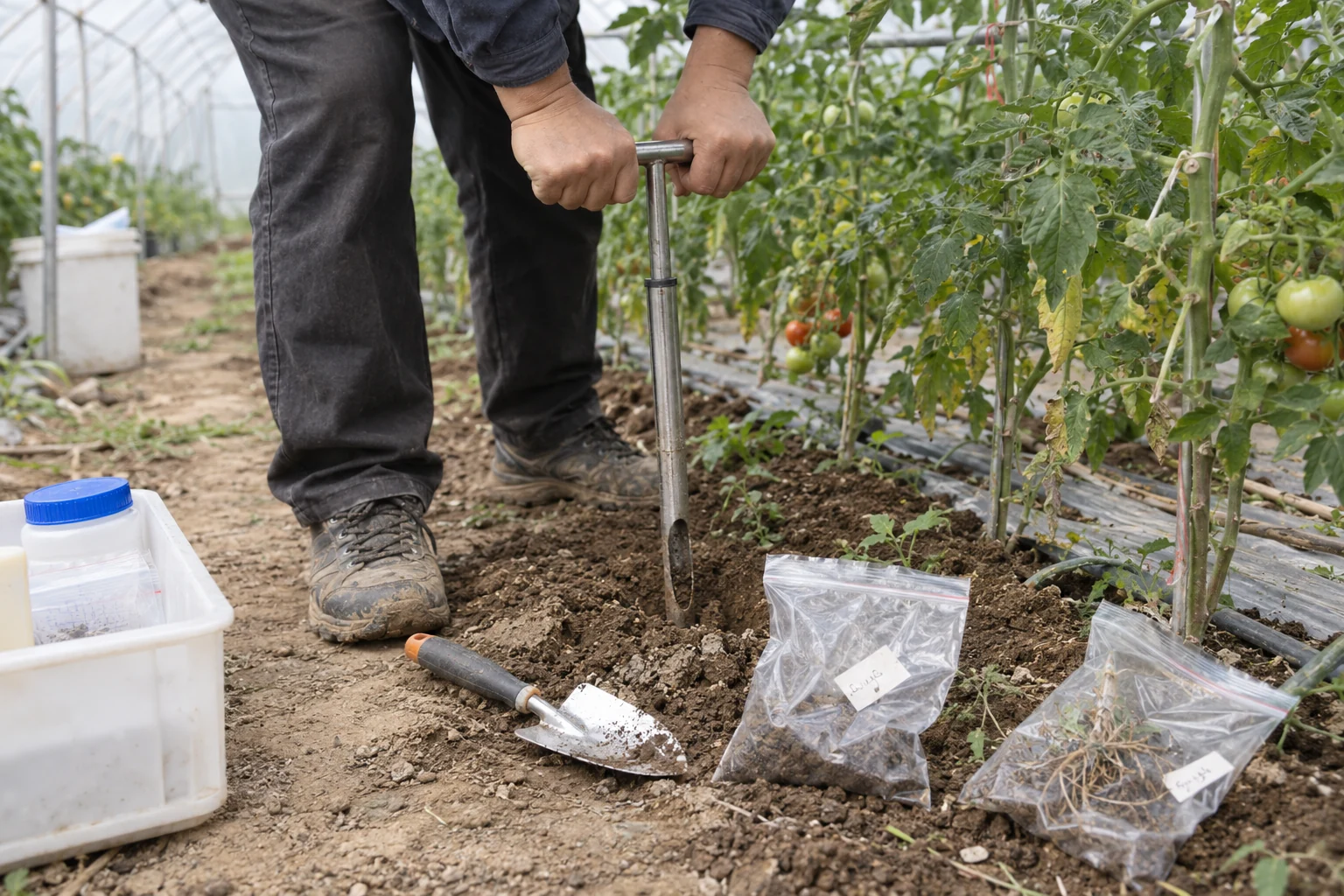
Sample soil before planting. For California tomato fields, UC IPM advises blocks of no more than about 4 ha (10 acres) and at least 20 cores per block from moist soil to at least 45 cm (18 inches), with roots; keep samples cool (10 to 16°C) but not frozen and send them at once. Results take about two weeks [4]. Embrapa's tomato protocol in Brazil takes 15 to 20 subsamples per hectare in a zigzag at 20 to 30 cm, sending 400 to 500 g of soil with 200 to 300 g of roots [1]. Always send roots with the soil [2].
Thresholds are regional. For processing tomatoes on sandy loam in California's San Joaquin Valley, UC IPM links 200 juveniles per kilogram in spring samples to about 88% of normal yield, with no formula for other areas [4]. Without a laboratory, melon seedlings in pots of moist field soil at about 27°C show galls within about three weeks if root-knot nematodes are present [5].
5. Prevention: hygiene, resistance, rotation and soil treatment
Hygiene. Use nematode-free transplants, clean soil off machinery, limit run-off water, control weeds and remove galled roots after harvest [1][2][4]. In greenhouses, FAO advises removing all roots of the previous crop and washing equipment that moves between houses [8].
Resistant varieties. The tomato Mi gene, found in the 1940s in Solanum peruvianum, protects against M. incognita, M. javanica and M. arenaria but not M. hapla or M. enterolobii [4][9]. It weakens in hot soil: galling increases above about 28°C and complete loss has been reported at 32°C or more (Embrapa gives above 30°C), though resistance recovered after a short heat spike [1][10]. Resistance-breaking M. incognita populations, widespread in California, are favoured by continuous resistant cropping, and then any resistant tomato in that field is likely to fail [4][9]. In pepper, the N and Me genes cover the same three species [2].
Grafting. Tomato rootstocks generally include root-knot resistance, but traits vary, so test new combinations on a small scale [8]. In Brazil, commercial tomato rootstocks resistant to the three main species were all susceptible to M. enterolobii [1]. Eggplant can be grafted onto the resistant Solanum torvum [2]. There are no root-knot-resistant commercial cucurbit varieties [3], and FAO lists its cucurbit rootstocks, including fig-leaf gourd for cucumber, for Fusarium and other diseases, not root-knot nematodes [8].
Rotation and cover crops must match the species. Brassicas are generally poorer hosts; most M. javanica populations do not infect pepper; sunn hemp and sorghum-sudangrass are poor hosts that release nematicidal compounds when incorporated; cowpea hosts M. arenaria, M. enterolobii and M. javanica well [2]. In California, rotation with resistant varieties and nonhost crops is as effective as fumigation [4].
Soil treatment between crops. Solarisation, clear plastic over moist soil for four to six weeks in the hottest season, reduces Meloidogyne mainly in the upper soil layers, and used adequately it significantly reduces fumigant use [2][5][8]. Steam at 70°C for half an hour controls nematodes, though in sandy and loam soils only upper layers may reach it [8]. In trials cited by Embrapa, a moist, weed-free fallow cut populations by over 75% in two months [1][2]. Where all this fails in a greenhouse, FAO advises soilless culture [8].
6. Resistance: what is documented
Nematodes becoming resistant to nematicides is a separate question. IRAC, the Insecticide Resistance Action Committee, finds no substantiated cases of resistance causing commercial nematicides to fail in the field; shifts are reported only in the laboratory, and IRAC rates field resistance as unconfirmed, theoretically unlikely and low risk [11].
What is documented is enhanced microbial biodegradation: repeated use of one chemical nematicide in the same soil builds up microbes that break it down, so less product reaches the nematodes [11]. It tends to be specific to a chemical class, and the risk is higher in crops treated several times a season, such as vegetables and banana [12].
7. Nematicide groups and rotation
IRAC classifies selective nematicides separately from insecticides [13], in groups N-1 to N-4 plus unnumbered groups of unknown mode of action [14]. Its guidance: where several applications are needed in one crop cycle, or on one field over several cycles, rotate modes of action; rotate chemical classes or apply less often to slow biodegradation; and base rotations on numbered groups [11]. IRAC South Africa adds: avoid treating consecutive generations with the same mode of action, never reduce rates, and apply each active in a mixture at its registered rate [7]. We found no nematicide-specific rules on treatment windows or applications per group, so none are given here.
IRAC nematicide groups
| IRAC group | Class | Examples | What the sources say |
|---|---|---|---|
| N-1A | Carbamates | Oxamyl, thiodicarb | Listed in N-1A [11]; oxamyl is listed for California tomato [4] |
| N-1B | Organophosphates | Fosthiazate, ethoprophos, cadusafos | Listed in N-1B [11]; China bans cadusafos and bars ethoprophos from vegetables [15] |
| N-2 | Avermectins | Abamectin | Also insecticide group 6 [14]; an abamectin product for cotton and maize is registered in South Africa [7] |
| N-3 | SDHI (pyridinyl-ethyl-benzamides) | Fluopyram | Listed in N-3 [7]; also FRAC 7 [14]; listed for cucurbits in Florida [3] |
| N-4 | Tetronic and tetramic acid derivatives | Spirotetramat | Also insecticide group 23 [11][14] |
| N-UN | Unknown mode of action | Fluensulfone, fluazaindolizine | Group per CropLife Australia [16]; listed for cucurbits in Florida [3] |
| N-UNX | Fumigants | 1,3-dichloropropene, chloropicrin, metam sodium, dazomet | Listed in N-UNX [7]; 1,3-dichloropropene and metam sodium are listed preplant for California tomato, by permit [4] |
| N-UNB, N-UNF, N-UNE | Bacteria, fungi, botanicals | Bacillus spp., Purpureocillium lilacinum, azadirachtin | Unknown mode of action [11][14]; see section 8 |
The table describes IRAC groups and how the cited sources list some products. It is not a list of registered uses. Which products may be used, on which crops and at what rate is set by each country's registration and by the product label.
Abamectin has both insecticidal and nematicidal properties [7]. As a cotton seed treatment it reduced root penetration by M. incognita, but protection faded as the taproot grew, because little abamectin moved from the seed coat into the roots [17][18].
8. Biological options in the same programme
Biological nematicides sit in IRAC's unnumbered groups for bacteria (N-UNB), fungi (N-UNF) and botanicals (N-UNE) [14]. FAO calls nematophagous fungi the most promising biological agents [8].
Purpureocillium lilacinum, formerly Paecilomyces lilacinus, is a soil fungus that parasitises nematode eggs and is widely used in commercial preparations [19][20]. It penetrated M. incognita eggs, reduced hatching and juvenile survival, and reduced galls on potted eggplant [19]. Results vary: egg-parasitic fungal strains reduced M. enterolobii hatching by 13 to 84% in the laboratory, and in pots the effect weakened as nematode density rose, so reviewers see these fungi as one component of integrated management where pressure is low [21].
Bacillus nematocida B16, a bacterium isolated from soil, attracted the model nematode Caenorhabditis elegans with volatile compounds and, once swallowed, killed it with proteases that attack the gut [22].
Two Huasheng biologicals are in development. Nemia™ uses P. lilacinum PL11, a third-party strain whose documented scope is Meloidogyne spp. in protected tomato, pepper and cucumber, with partial and variable efficacy. Nemia B16™ uses B. nematocida B16, a domestic strain whose scope is documented in China for root-knot nematodes in tomato. Neither is supplied yet.
9. Regional notes
China
In Shaanxi greenhouse vegetables, M. incognita, M. javanica, M. arenaria and M. hapla were detected, with M. incognita dominant [23]. China's list of banned and restricted pesticides bans methyl bromide except for quarantine fumigation, and bans fenamiphos, cadusafos and terbufos; aldicarb, ethoprophos, carbofuran and phorate may not be used on vegetables, melons and fruit, tea, mushrooms or medicinal herbs [15]. The Institute for the Control of Agrochemicals (ICAMA) lists registered products.
Latin America
In Brazil, where M. incognita and M. javanica prevail, most tomato cultivars carry Mi, but some species and races break it; M. enterolobii, now across almost the whole country, damages tomato and pepper resistant to other species, and in 2014 Embrapa reported no resistant solanaceous rootstocks or cultivars in Brazil. Embrapa ranks chemical control last among integrated measures; registrations are listed in AGROFIT [1]. In Corrientes, Argentina, Mi-carrying greenhouse tomato cultivars showed neither galls nor egg masses with a local M. incognita population [24]. In Mexico, reported tomato losses to Nacobbus aberrans average 55%, and organic amendments, Pochonia chlamydosporia and biofumigation have been very effective in greenhouse tomato [6].
Other regions
In Florida, chemical nematicides require an applicator licence, with a separate licence for fumigants [2]. For Mediterranean greenhouses, FAO promotes solarisation and grafting [8]. South African labels display the nematicide group, for example GROUP N2 NEMATICIDE [7].
10. A practical sequence
- Sample soil and roots before planting, and have the species identified.
- After each crop, dig up roots, map galled patches and remove infested roots.
- Match resistant varieties or rootstocks to the species; do not rely on Mi in very hot soil.
- Use clean transplants and equipment, and control weeds during and after the crop.
- Rotate with poor or nonhost crops, and treat soil between crops where practical.
- If a nematicide is needed, use a locally registered product, note its IRAC group and rotate groups on the same field.
- Add biologicals, especially at low pressure, and follow the local label for crop, rate and interval.
Frequently asked questions
How do you control root-knot nematodes?
No single measure is enough. Sample before planting, identify the species, and combine hygiene, resistant varieties or rootstocks, rotation, soil treatment and, if needed, a registered nematicide [1][2][4].
What are the symptoms of root-knot nematodes?
Stunting, yellowing, wilting in the heat of the day and poor response to fertiliser, often in patches, with root galls that cannot be rubbed off [4][5].
What is the best nematicide for root-knot nematodes?
There is no single best product. Use one registered locally for the crop, note its IRAC group, and rotate groups or chemical classes on fields treated repeatedly [11].
Does the Mi gene protect tomato from all root-knot nematodes?
No. It does not cover M. hapla or M. enterolobii, it weakens in hot soil, and resistance-breaking populations exist [4][9][10].
Do biological nematicides work?
They can reduce egg hatching and galling, but results vary by strain and weaken at high nematode density [19][21].
How should soil be sampled for root-knot nematodes?
Take many cores per uniform block from moist root-zone soil, with roots; keep the sample cool and send it at once [1][4].
Further reading
- Enquire about abamectin
- Abamectin: formulations and supply
- Nemia™ (Purpureocillium lilacinum PL11)
- Nemia B16™ (Bacillus nematocida B16)
- [1] Pinheiro, J. B., Pereira, R. B. and Suinaga, F. A. (2014). Manejo de nematoides na cultura do tomate. Embrapa Hortaliças, Circular Técnica 132.
- [2] Desaeger, J. and Noling, J. W. (2026). Nematode management in tomatoes, peppers, and eggplant (ENY-032). UF/IFAS Extension.
- [3] Desaeger, J., Bui, H. X. and Noling, J. W. (2025). Nematode management in cucurbit crops (ENY-025). UF/IFAS Extension.
- [4] Ploeg, A. T. (2025). UC IPM Pest Management Guidelines: Tomato. Root-knot nematode (UC ANR Publication 3470).
- [5] UC IPM (2010). Pest Notes: Nematodes (UC ANR Publication 7489).
- [6] UC Davis Nemaplex (2026). Nacobbus aberrans, false root-knot nematode.
- [7] IRAC South Africa (2021). Nematodes, nematicides and resistance management.
- [8] FAO (2013). Good Agricultural Practices for greenhouse vegetable crops: principles for Mediterranean climate areas. FAO Plant Production and Protection Paper 217.
- [9] Regmi, H. and Desaeger, J. (2019, revised 2023). Nematode resistance: a useful tool for root-knot nematode (RKN) management in tomato (ENY-072). UF/IFAS Extension.
- [10] de Carvalho, L. M. et al. (2015). Mi-1-mediated nematode resistance in tomatoes is broken by short-term heat stress but recovers over time. Journal of Nematology 47(2): 133-140.
- [11] IRAC Nematode Working Group (2024). Nematicide mode of action classification poster, edition 2.2, with the nematicide resistance risk statement.
- [12] IRAC (2026). Nematodes team page.
- [13] IRAC (2026). IRAC mode of action classification scheme, version 11.5.
- [14] IRAC Nematode Working Group (2021). Nematicide mode of action classification, version 2.0.
- [15] Ministry of Agriculture and Rural Affairs of China, Department of Pesticide Management (2019). List of banned and restricted pesticides, as republished by the Shantou municipal government.
- [16] CropLife Australia (2026). Nematicide mode of action table.
- [17] Bessi, R., Sujimoto, F. R. and Inomoto, M. M. (2010). Seed treatment affects Meloidogyne incognita penetration, colonization and reproduction on cotton. Ciência Rural 40(6).
- [18] Faske, T. R. and Starr, J. L. (2007). Cotton root protection from plant-parasitic nematodes by abamectin-treated seed. Journal of Nematology 39(1): 27-30.
- [19] Khan, M. and Tanaka, K. (2023). Purpureocillium lilacinum for plant growth promotion and biocontrol against root-knot nematodes infecting eggplant. PLOS ONE 18(3): e0283550.
- [20] Xu, W.-F. et al. (2021). Understanding the transcriptional changes during infection of Meloidogyne incognita eggs by the egg-parasitic fungus Purpureocillium lilacinum. Frontiers in Microbiology 12: 617710.
- [21] Forghani, F. and Hajihassani, A. (2020). Recent advances in the development of environmentally benign treatments to control root-knot nematodes. Frontiers in Plant Science 11: 1125.
- [22] Niu, Q. et al. (2010). A Trojan horse mechanism of bacterial pathogenesis against nematodes. Proceedings of the National Academy of Sciences 107(38): 16631-16636.
- [23] Zhang, F., Yang, M., Sun, J. and Hong, B. (2014). Specific molecular assay for the detection of greenhouse vegetables Meloidogyne spp. in Shaanxi. Chinese Agricultural Science Bulletin 30(31): 136-140.
- [24] Gauna, P. I. (2011). Evaluación de la reacción de cultivares comerciales de tomate a la agresión del nematodo del nudo de la raíz (Meloidogyne incognita) en Corrientes. Master's thesis, INTA EEA Bella Vista and Universidad Nacional del Nordeste.
Products in this article