Inner Mongolia’s Hinggan League agrees to scale up bio-coupling in soybean
At the launch of Inner Mongolia’s 2026 Science and Technology Week, OCRI-CAAS — the institute behind the bio-coupling technology in our Orvan™ range — signed a cooperation agreement to bring bio-coupling into industrial-scale use across Hinggan League, a major soybean region where three seasons of trials raised average yields by more than 15%.
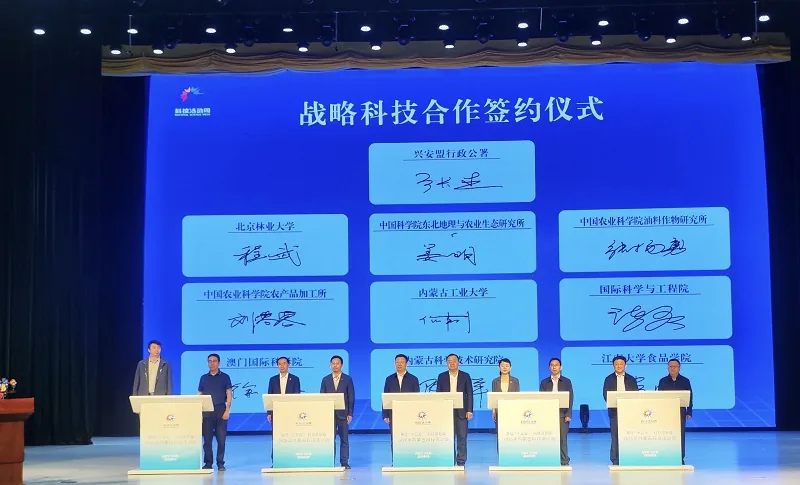
On 24 May 2026, at the opening ceremony of Inner Mongolia’s 2026 Science and Technology Week, the Oil Crops Research Institute of the Chinese Academy of Agricultural Sciences (OCRI-CAAS) signed a science-and-technology cooperation agreement with Hinggan League. The two sides will work together to bring OCRI’s bio-coupling technology and related research results into industrial-scale use across the region, with the aim of upgrading Hinggan League’s soybean and oil-crop sector and supporting rural revitalisation and high-quality regional development. This is the same coupling science our Orvan™ range brings to growers commercially. OCRI director Zhang Yangyong attended the signing.
Why Hinggan League
Hinggan League, in eastern Inner Mongolia, is one of China’s principal soybean regions, with more than two million mu — over 130,000 hectares — sown each year. Scaling up a technology that improves yield and quality in a region like this has national significance: China has made soybean and oil-crop capacity a policy priority for four consecutive years, and gains in a core producing region of this size affect national output.
From trial to track record: 2022–2025
The agreement does not start from scratch. Hinggan League first introduced the bio-coupling technology — developed by a team at OCRI-CAAS — in 2022, then carried out extension and demonstration work from 2023 to 2025. Across those seasons soybean yields rose by an average of more than 15%, and several demonstration sites were named national model cases for large-area yield improvement in soybean and oil crops. The new agreement formalises and scales up what those three seasons demonstrated.
Towards a “Hinggan League model”
Building on that base, the agreement ties research and production more tightly together — pairing Hinggan League’s ecological resources and its standing as a major growing region with OCRI’s science, expertise and research results. The stated aim is a replicable “Hinggan League model” for soybean and oil-crop quality, nitrogen fixation and environmentally sound yield gains: an approach intended to be adopted in large-area yield programmes nationwide.
Orvan™: technical background
The technology at the centre of this agreement is the same Aspergillus–Rhizobia Coupling our Orvan™ range is built to deliver. Applied alongside rhizobia, it strengthens nodulation and nitrogen fixation, while research on the peanut aflatoxin side continues; a single application serves both yield and crop quality. A regional partnership on this scale — measured across three seasons in a demanding northern soybean belt — is the kind of validation that stands behind the product we put in the furrow.