Biological nitrogen fixation: how legumes make their own fertiliser
A practical explanation of the biology behind nitrogen fixation — the enzyme, the nodule, the energy exchange, and the conditions that determine whether fixation actually takes place in the field.
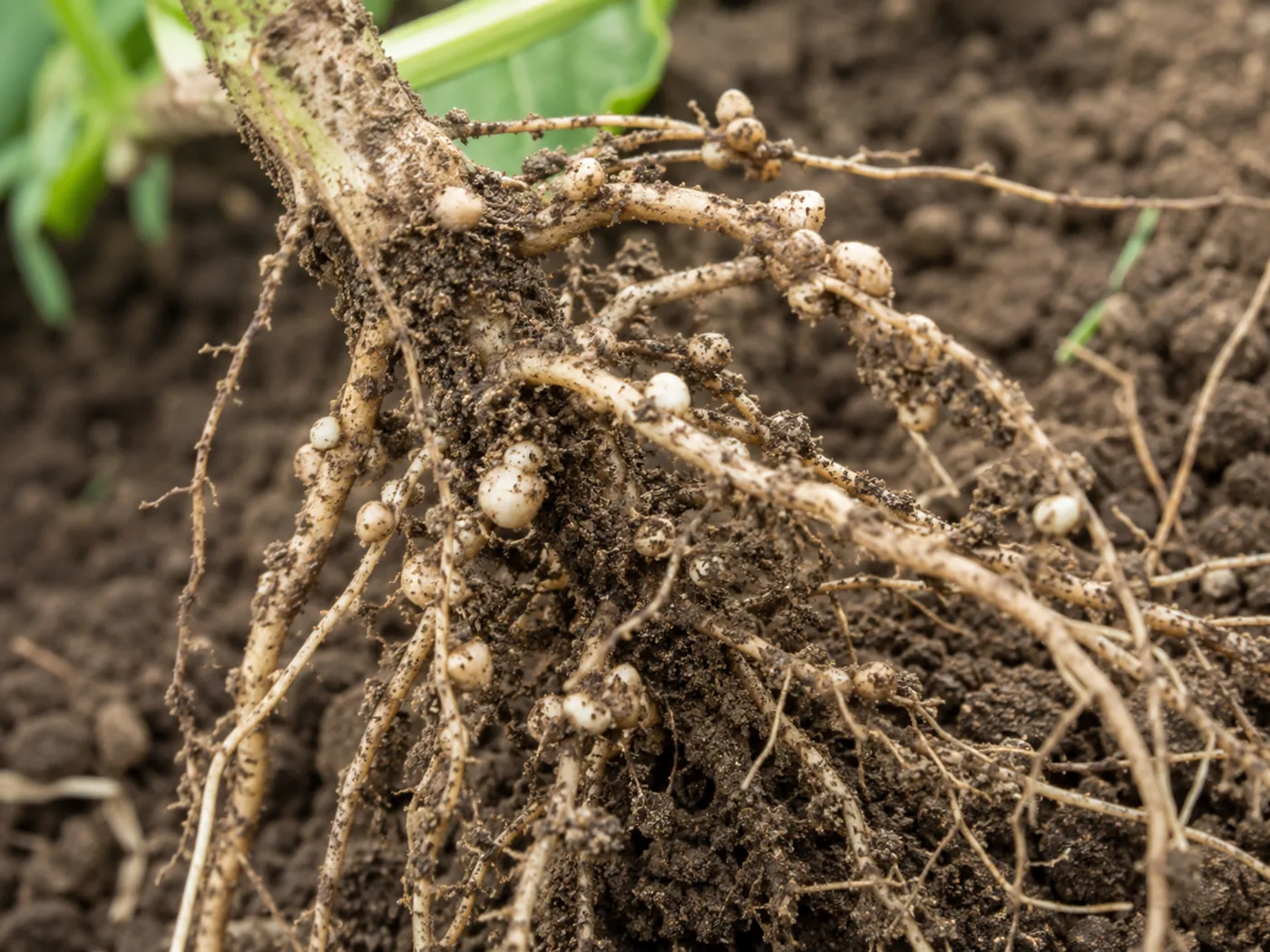
Nitrogen is the nutrient plants need in the largest quantity, and it is everywhere: nearly four-fifths of the air is nitrogen gas (N₂). Yet crops are routinely short of it. The reason is chemical, and the way legumes overcome it is one of the most elegant partnerships in biology. Understanding how it works, and why it fails, makes the difference between a crop that supplies its own nitrogen and one that could have but did not.
Why nitrogen is so hard to get
The two nitrogen atoms in N₂ are joined by a triple bond — one of the strongest chemical bonds in nature, at roughly 945 kJ/mol. That bond makes N₂ almost completely inert, and plants cannot break it. Industry breaks it through the Haber–Bosch process, which combines nitrogen and hydrogen at around 400–500 °C and 150–300 atmospheres and consumes on the order of 1–2% of the world’s total energy. Legumes carry out the same reaction in ordinary soil, at ambient temperature and pressure, using an enzyme called nitrogenase. In effect, a nodule is an ammonia factory that runs at room temperature.
The enzyme, and its oxygen problem
Nitrogenase is the catalyst at the heart of fixation. It reduces N₂ to ammonia (NH₃) — the form a plant can build into amino acids and proteins. The reaction is inherently expensive: fixing one molecule of N₂ costs the bacteria on the order of 16 ATP, plus eight electrons and eight protons, and unavoidably releases some hydrogen gas as a by-product.
Nitrogenase also has a well-known vulnerability: it is irreversibly inactivated by oxygen. That creates a genuine paradox, because generating all of that ATP requires respiration, which requires oxygen. Much of the architecture of a nodule exists precisely to resolve this contradiction: to supply enough oxygen to power the bacteria while keeping it away from the enzyme they depend on.
The nodule: an organ built for a truce
Nodules do not appear by accident; they are the product of a precise molecular dialogue. The legume root releases flavonoids into the soil. Compatible rhizobia answer with signal molecules called Nod factors. The root recognises them, a root hair curls around the bacteria, and an “infection thread” carries the rhizobia into the root, where cortical cells divide to form the nodule. Inside, the bacteria differentiate into nitrogen-fixing bacteroids, each enclosed in a plant-derived compartment called a symbiosome.
The pink or red colour inside a healthy nodule is leghemoglobin — a protein chemically related to the haemoglobin in blood. It binds oxygen and releases it at a rate high enough to fuel respiration but low enough to protect nitrogenase. That colour is the single most reliable field sign that a nodule is actually fixing nitrogen; a white, grey, or green interior indicates that it is not.
What the plant pays — and why it caps its own nodulation
The partnership is not free. The plant pays for it with sugars from photosynthesis — a substantial share of its carbon budget — in exchange for fixed nitrogen. Because that cost is significant, the plant actively controls how many nodules it forms through a systemic feedback mechanism known as autoregulation of nodulation (AON). AON prevents the plant from over-investing, but it also puts a ceiling on the benefit. This is why more nodules never follow automatically, and why nodulation is biologically more complex than simply adding bacteria — a point that becomes important in explaining how Orvan™ works.
How much nitrogen is fixed, and how it is measured
Agronomists quantify fixation with a metric called %Ndfa: the proportion of a crop’s nitrogen derived from the atmosphere rather than the soil, estimated using reference (non-fixing) plants or ¹⁵N isotope methods. Totals vary widely with the crop, the effectiveness of the rhizobia, and the season, but the ranges are large enough to matter — a well-nodulated legume commonly fixes on the order of 200–300 kg N/ha in a season, and a perennial such as alfalfa can fix more still:
Indicative ranges of biologically fixed nitrogen (varying with conditions)
| Legume | Typical N fixed | Note |
|---|---|---|
| Grain pulses (bean, cowpea, mung bean…) | ~30–150 kg N/ha per season | Shorter cycle, lower totals |
| Peanut (groundnut) | ~50–150 kg N/ha per season | Promiscuous Bradyrhizobium host |
| Soybean | ~60–300 kg N/ha per season | Can supply ~50–60% of its own N |
| Alfalfa (perennial) | ~150–500 kg N/ha per year | The highest — fixes all season, every year |
What determines whether fixation takes place
Fixation is not guaranteed simply because a legume is growing. It depends on several conditions being met at once, and any one of them can become the bottleneck that limits the whole system:
| Factor | Why it matters |
|---|---|
| Rhizobia | The right species must be compatible with the crop and an effective fixer — not merely present in the soil. |
| Soil mineral nitrogen | High nitrate suppresses nodulation and fixation (see the paradox below). |
| pH | Rhizobia are sensitive to acidity; strongly acid, alkaline, or saline soils reduce survival and nodulation. |
| Micronutrients | Nitrogenase needs molybdenum and iron; energy metabolism needs phosphorus; cobalt and boron also play a role. |
| Water & temperature | Drought and temperature extremes slow the plant and the bacteria alike. |
The nitrate paradox
One of the most counter-intuitive facts in legume agronomy is that applying nitrogen fertiliser to a legume can reduce its own nitrogen fixation. When mineral nitrogen is freely available, the plant takes the less costly route, down-regulates nodulation, and fixes less. A modest starter dose can sustain a seedling until its nodules become active, but heavy nitrogen applications are usually self-defeating: the grower pays for the fertiliser and switches off the free supply at the same time.
What it means in the field
A well-nodulated legume can meet much of its own nitrogen demand and leave a nitrogen credit for the next crop, which is a large part of why legumes are central to sustainable rotations. But that value is realised only if nodulation is early and effective. Where the right rhizobia are missing, sparse, or weak — as is common on new ground and in stressed soils — the biology stalls and the crop behaves like any other nitrogen-demanding crop. That gap between what a legume could fix and what it actually fixes is precisely what a well-made inoculant is designed to close.
Products in this article