What is Orvan™? Coupling the aflatoxin and nitrogen problems in peanut
Orvan™ treats two of peanut farming’s hardest problems — aflatoxin and inefficient nitrogen use — as one coupled question in the soil. It is based on Aspergillus–Rhizobia Coupling research. This article explains what it is, how it amplifies nitrogen fixation, and the science behind the coupling.
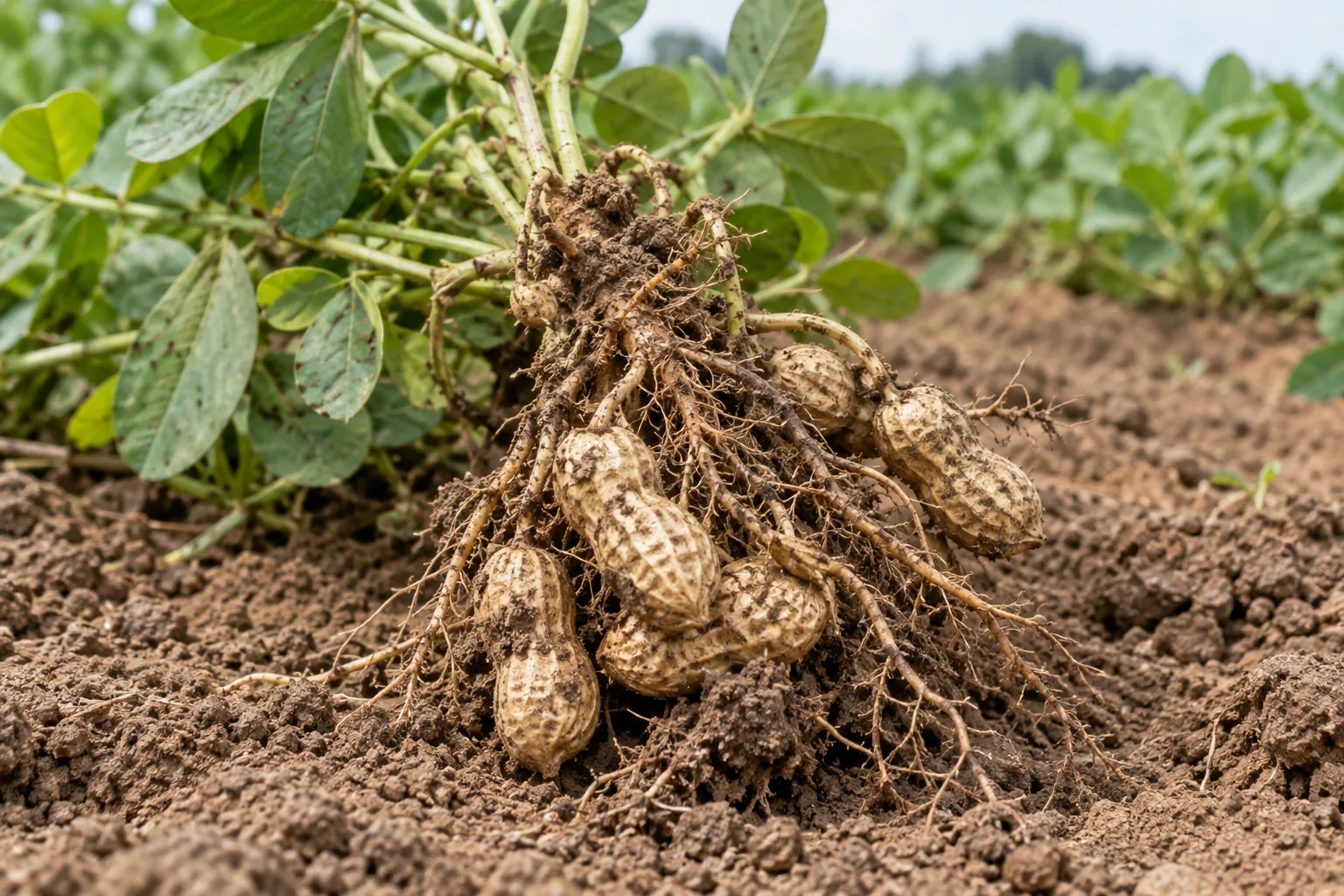
Orvan™ is based on Aspergillus–Rhizobia Coupling. It is a microbial consortium — a defined community of beneficial bacteria — applied alongside a rhizobial inoculant. One point should be made at the outset: Orvan™ does not itself contain rhizobia. It works by amplifying the native or co-applied rhizobia already at the root, not by replacing them. The broader idea behind the coupling is to treat two seemingly separate problems as one.
Two problems that meet in the soil
Peanut growers face two costly problems at once. Aspergillus flavus contaminates kernels with aflatoxin, and nitrogen use remains inefficient. These have traditionally been handled with different tools — fungicides and drying for one, fertiliser and inoculants for the other. Orvan™’s premise is that in the rhizosphere — the thin, biologically active zone of soil around the roots — the toxigenic fungus and the nitrogen-fixing symbiosis are not independent. They interact, so an intervention aimed at one can also affect the other.
What Orvan™ is
Orvan™ is a defined community of beneficial, non-rhizobial bacteria — including strains such as Bacillus velezensis and Brevibacillus laterosporus — selected to work together in the root zone. None of them is a rhizobium: Orvan™ is designed to work with the crop’s rhizobia, not to take their place. All strains are spore-forming, which gives the product genuine tolerance of heat and desiccation and a shelf life of 12 to 18 months, depending on the formulation.
How it works, in brief
On the aflatoxin side, research examines how the community interacts with A. flavus in the soil and pod zone, through mechanisms such as competitive exclusion for space and resources and the natural compounds these bacteria produce. The scientific question is whether shifting the rhizosphere microbiome before harvest can lower the fungal load during the pre-harvest period, which drying and storage cannot address.
On the nitrogen side, Orvan™ improves the conditions for nodulation, so the crop forms more effective nodules and fixes more of its own nitrogen — without the usual trade-off between more nodules and yield. What matters in the field is that both problems move in the right direction from a single application.
The coupling insight
Why might the two be connected? Picture the rhizosphere as a seesaw between the pathogenic Aspergillus and the beneficial nitrogen-fixing symbiosis. The hypothesis behind the coupling is that shifting the balance away from the pathogen improves the environment for nodulation — so the same intervention that supports the microbiome could also help the crop fix more of its own nitrogen. That coupling of the aflatoxin and nitrogen questions is the central idea, and it is what the name Aspergillus–Rhizobia Coupling refers to.
What the field trials show
Orvan™ has been evaluated in multi-year field trials covering all eight legumes we serve at hundreds of sites, with each crop working through its own locally adapted rhizobia. The yield response is consistent across the range:
Orvan™ yield response by crop (multi-site field trials)
| Crop | Sites / provinces | Yield gain |
|---|---|---|
| Peanut | 405 / 19 | +19.9% |
| Soybean | 253 / 18 | +16.1% |
| Mung bean | 54 / 5 | +15.3% |
| Alfalfa | 96 / 4 | +15.2% |
| Common bean | 62 / 6 | +14.2% |
| Cowpea | 48 / 5 | +13.8% |
| Pigeon pea | 36 / 4 | +12.6% |
| Black gram | 30 / 4 | +11.9% |
The two flagship crops show the coupling most clearly. Across the multi-site network, peanut averaged +19.9% and soybean +16.1%; in OCRI-CAAS trials, soil under peanut contained over 80% less A. flavus and soybean showed higher isoflavone content. Beneath the yield figures, the symbiosis itself changed markedly: nodule numbers rose up to 8.5× on peanut and 3.7× on soybean, and nitrogenase activity — the direct measure of fixation — up to 10.7× and 4.8× respectively. In dedicated trials over three consecutive years, Orvan™-treated fields maintained a yield gain above 10% even with 20–40% less synthetic nitrogen — the clearest sign that the biology is genuinely substituting for purchased fertiliser.
How it is applied
Orvan™ is applied at sowing and can be co-applied with NPK and with Nodu™ and Vigor™. It comes in three formats, matched to how the product reaches the crop: Base, a granule broadcast or banded with base fertiliser at 30–60 kg/ha; Root, a water-soluble powder dissolved and applied in-furrow at 30–60 kg/ha; and Coat, a liquid concentrate applied on the seed at 2.5 mL per kilogram. Each carries its own guaranteed live count to expiry, and the counts differ by format, because a granule applied at 30–60 kg/ha and a seed coating applied at 2.5 mL/kg of seed are not required to deliver the same concentration. The handling rules are the same as for any live product: apply Orvan™ after any fungicide seed treatment and before any rhizobial inoculant, and avoid copper fungicides, strongly alkaline conditions (pH > 9), and chlorinated water.
What Orvan™ is — and is not
- It is not a rhizobial inoculant. Orvan™ needs rhizobia to be present in order to amplify them; on ground that lacks them, pair it with Nodu™.
- It is not a chemical fungicide. It works through the soil microbiome and complements good drying and storage rather than replacing them.
- It is a coupling consortium: a single application amplifies nodulation and nitrogen fixation, and the consortium is the subject of our aflatoxin-coupling research.
How the three biologicals divide the work
| Product | Role in the programme |
|---|---|
| Nodu™ | Establishes region-matched, nitrogen-fixing rhizobia |
| Vigor™ | Builds roots, unlocks soil phosphorus, improves stress tolerance |
| Orvan™ | Amplifies nodulation and nitrogen fixation |