Soybean on saline-alkali ground: a measured harvest in Heilongjiang
On a Heilongjiang farm where every field is meadow saline-alkali soil, an independently measured harvest put the bio-coupling demonstration 10.4% above the untreated control. Bio-coupling is the same Aspergillus–Rhizobia Coupling science our Orvan™ range delivers.
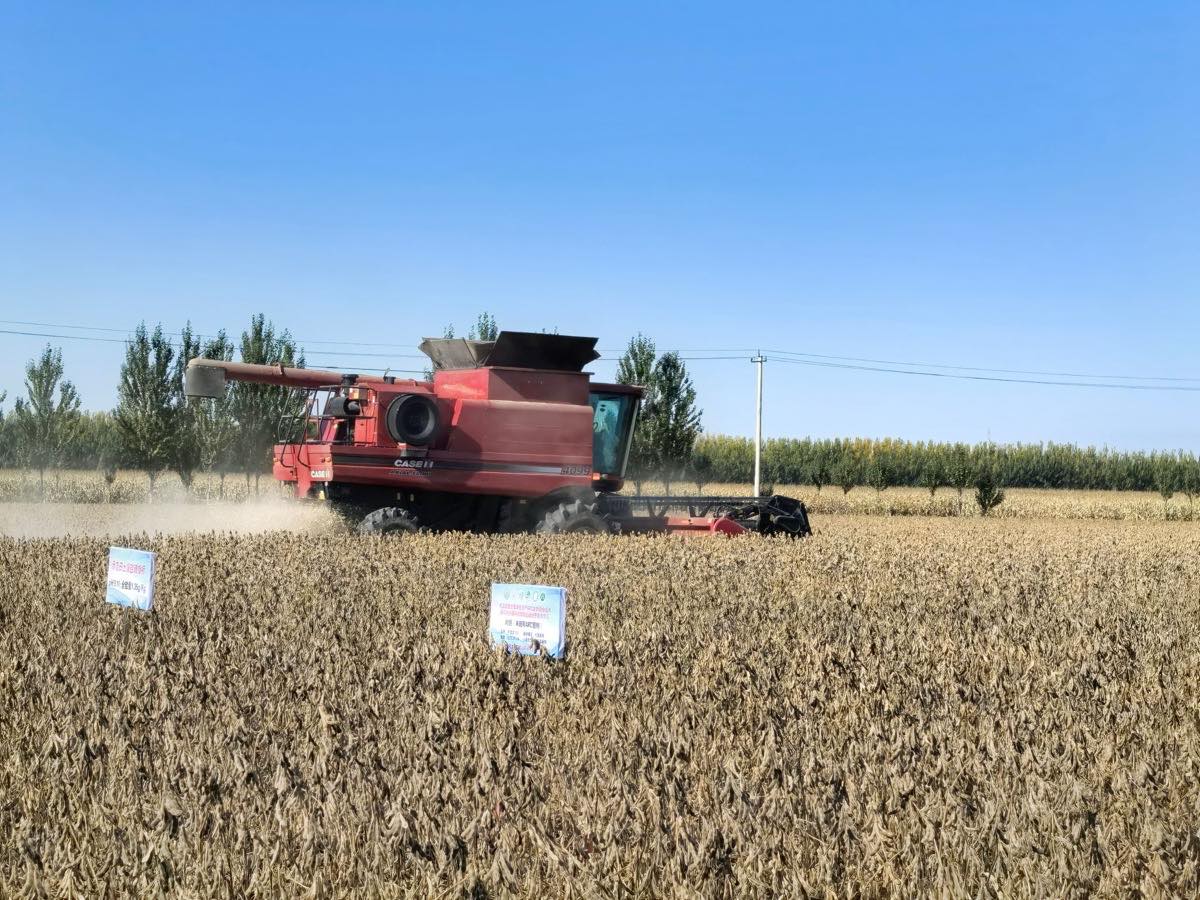
On 9 October 2025, a field-measurement and observation meeting was held at Sifangshan Farm, part of the Beidahuang Group in Heilongjiang, for the bio-coupling programme to improve soybean quality and nitrogen fixation. It was convened by the National Agro-Tech Extension and Service Centre, the Chinese Academy of Agricultural Sciences and the Heilongjiang Academy of Agricultural Sciences, with the CAAS Oil Crops Research Institute (OCRI-CAAS) among the co-hosts. The harvest was cut and weighed in front of the panel: 190.2 kg per mu — about 2.85 t/ha — or 10.4% above the untreated control.
Where the yield was measured
The significance of the figure lies in where it was measured. Every one of the farm’s 115,200 mu — roughly 7,680 hectares — is meadow saline-alkali soil, with a pH between 7.5 and 8.8 and, on the worst blocks, salt content of 3‰ to 5‰. Such soil is low in fertility and holds water poorly, and it is precisely the kind of ground where rhizobia struggle to survive and nodulation fails unnoticed. The farm began working with CAAS and the Heilongjiang Academy in 2023 on exactly this problem.
Sifangshan Farm demonstration, measured 9 October 2025
| Figure | |
|---|---|
| Measured yield, demonstration block | 190.2 kg/mu (~2.85 t/ha) |
| Compared with the untreated control | +10.4% |
| Farm area, all saline-alkali | 115,200 mu (~7,680 ha) |
| Soil pH | 7.5–8.8 |
| Salt content, worst blocks | 3‰–5‰ |
Two seasons apart, in the same field
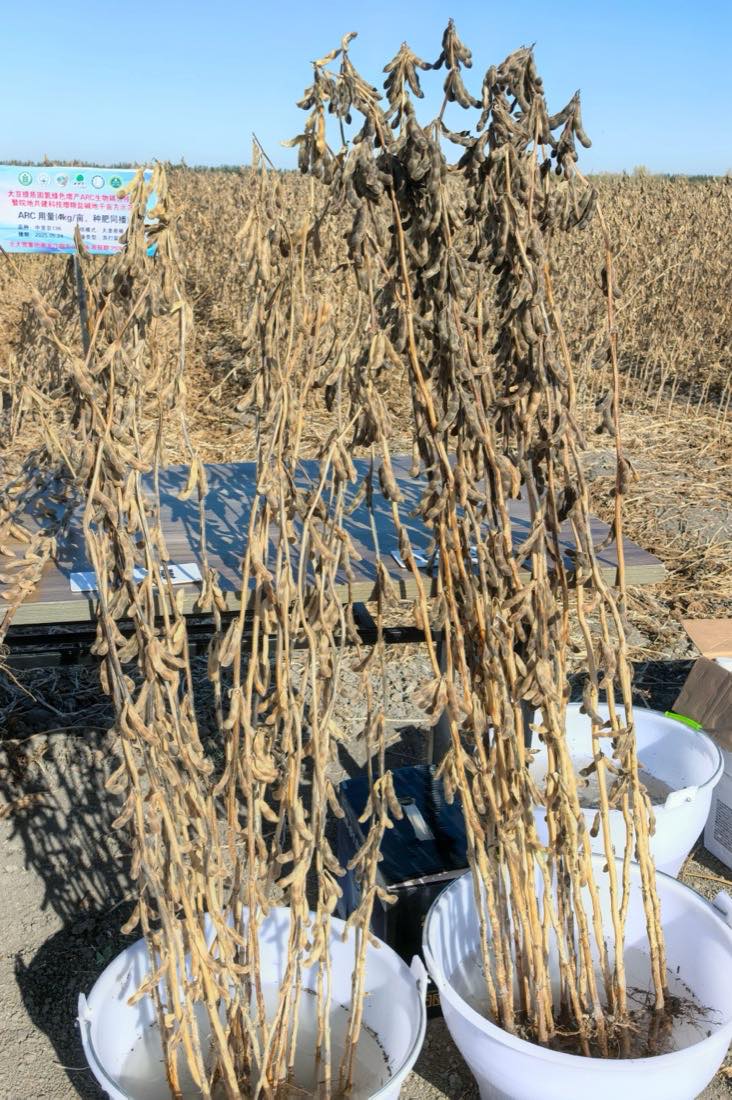
The clearest evidence on this ground is not the percentage but the change between visits. In autumn 2023 the soybean here stood no more than about 70 cm, set few pods, and the stems took real effort to pull from the soil. In autumn 2025, in the same field, plants were over a metre tall, the canopy closed properly at the top, the grain was fuller and rounder — and the stems came out of the ground easily by hand. On examining the roots, the panel noted markedly more nodules than in previous years, and nodulation that stayed active longer into the season. On saline-alkali land that last point matters doubly: it is what feeds the crop, and it is what begins rebuilding the soil for the crops that follow.
The technology, and the variety underneath it
The bio-coupling technology was developed at the CAAS Oil Crops Research Institute (OCRI-CAAS). Applied in the field as a microbial inoculant, it is designed to induce nodulation and nitrogen fixation efficiently, to reduce fertiliser use and emissions while raising yield, and to improve safety and nutritional quality. It has been named among China’s national lead-promotion agricultural technologies and among its Top 10 Major Leading Agricultural Technologies, and, after the Heilongjiang Academy adapted and refined it for local conditions, it was again selected as a national lead-promotion technology in 2025.
Biology alone cannot overcome saline-alkali conditions, and the demonstration did not rely on it to do so. The measured block was sown to Zhonglongdou 167, a soybean bred at the Academy’s Institute of Crop Cultivation: about 120 days from emergence to maturity in its adapted range, 40.89% protein and 19.55% oil. It serves as a demonstration variety under a national key R&D programme on the genetic basis of salt-alkali and other stress tolerance in wild rice and soybean resources. Good seed and good methods were measured together.
The scale of the programme
This was one of many sites. Under the National Agro-Tech Extension and Service Centre’s coordination, the Heilongjiang Academy of Agricultural Sciences ran large-area bio-coupling demonstrations at 29 locations across the province in 2025, seven of them at 1,000 mu (about 67 ha) or larger, spanning the province’s different production regions and soil types.
Orvan™: technical background
The bio-coupling at the centre of this work is the same Aspergillus–Rhizobia Coupling that our Orvan™ range is built to deliver commercially. Applied alongside the crop’s rhizobia, it amplifies nodulation and nitrogen fixation rather than replacing the partner already in the soil — which is why it has something to offer on ground where that partner is under stress. A result measured in this way, by an expert panel, on land this difficult, is the kind of validation that stands behind what we put in the furrow.
Further reading
- What is Orvan™? The coupling idea, and the field results
- Inoculating soybean: the legume that almost always needs it
- Nodu™: crop-matched rhizobia
- Troubleshooting poor nodulation — including alkaline and saline soils
- Source: Longtou News · Heilongjiang Daily, via the Heilongjiang Academy of Agricultural Sciences (13 October 2025)