Inoculating soybean: the legume that almost always needs it
Soybean is the most selective of the common legumes: it needs its own specific Bradyrhizobium, which is often absent from new ground. That single fact makes inoculation one of the highest-return decisions in soybean production.
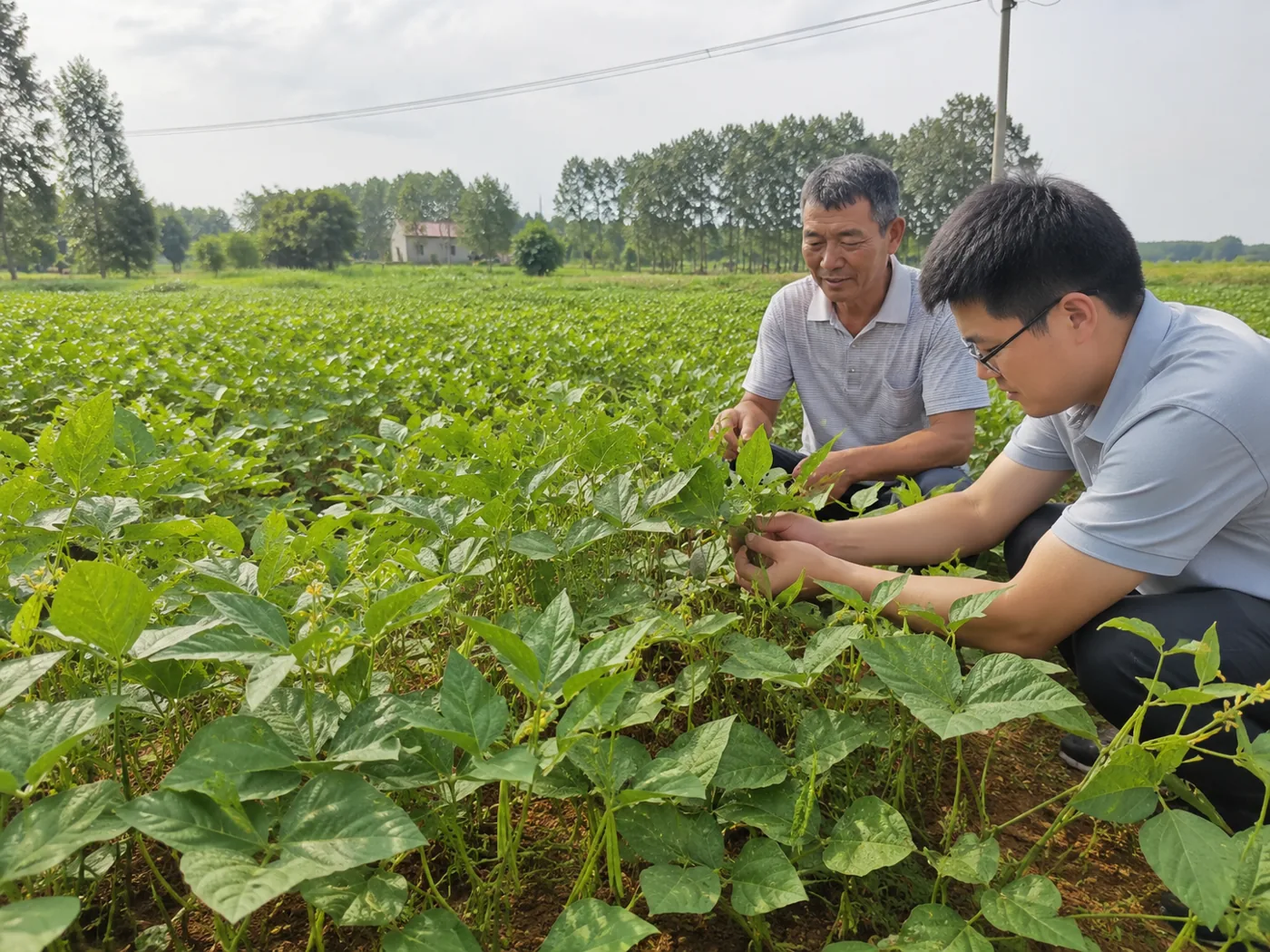
Soybean (Glycine max) is the world’s most important protein and oil crop — and, for the grower, one of the most nitrogen-demanding. A three-tonne crop can hold on the order of 200–300 kg of nitrogen in its above-ground parts, far more than most cereals, because the grain itself is roughly 40% protein. That nitrogen has to come from somewhere. A well-nodulated soybean crop draws most of it from the air at no cost; a poorly nodulated one has to take it from the soil and runs short at the worst possible moment — during pod fill, when demand peaks. The difference between those two outcomes comes down almost entirely to one question: are the right rhizobia present, alive, and on the root? This guide explains why soybean depends on inoculation more than any other common legume, what determines whether it works, and how to get it right in the field.
How much nitrogen soybean needs — and why fertiliser is not the answer
Consider the demand first. Soybean removes roughly 40–80 kg of nitrogen with every tonne of grain, and holds still more in leaves and stems, so a modest 2.5–3 t/ha crop needs on the order of 150–250 kg N/ha across the season. Supplying that as fertiliser would be expensive and environmentally costly — and, with soybean, largely self-defeating, because heavy mineral nitrogen suppresses the crop’s own fixation (see below). This is why soybean is grown worldwide as a nitrogen-fixing crop rather than a fertilised one.
Biological fixation is meant to cover the bulk of that need. Reviews put soybean’s fixation at roughly 60–300 kg N/ha in a season, commonly supplying 50–60% of the crop’s total nitrogen — and more where nodulation is excellent and soil nitrogen is low. The rest comes from the soil. The practical implication is clear: if fixation fails, there is usually no cheap way to make up a 100–200 kg N/ha shortfall mid-season, so the crop yields less.
Why soybean needs its own specific partner
Legumes are not equally selective about their rhizobia. The promiscuous ones — peanut, cowpea and their relatives — nodulate with a wide range of native Bradyrhizobium, so some compatible partner is usually already in the soil. Soybean sits at the opposite extreme. It pairs specifically with Bradyrhizobium japonicum and the closely related B. diazoefficiens, and little else will do. These bacteria are not native to soils that have never grown soybean.
The consequence on new ground is stark. An uninoculated soybean crop on a first-time field can barely nodulate at all — a plant dug up carries a handful of nodules, or none — and the plants are pale and short of nitrogen even when the soil looks fertile in every other respect. The field is full of nitrogen-cycling microbes; it simply lacks the one specific partner soybean can work with.
The handshake, briefly
The specificity is chemical. The soybean root releases flavonoids that only its matching Bradyrhizobium recognises; the bacterium answers with a precisely shaped signal molecule — a Nod factor — that only the soybean root accepts. It works like a lock and key. That is why a peanut or clover inoculant applied to soybean does nothing at all: the key does not fit. Understanding that this is a matched pair, not a generic “add some bacteria” step, underpins every practical decision that follows.
The one variable that predicts almost everything: field history
If only one question could be asked before deciding whether to inoculate soybean, it would be this: has this field grown well-nodulated soybean recently? Field history predicts the outcome better than soil type or fertility, because it indicates whether the specific partner is already present.
The first time soybean is grown on a field, the response to inoculation is large and reliable, because no B. japonicum is present to begin with. Once a crop nodulates well, it seeds the soil with billions of rhizobia and a resident population becomes established. But that population is not permanent: it declines between soybean crops, and declines faster in sandy, low-organic-matter, acidic, or strongly seasonal soils, where survival is poor. After a few years without soybean, or in a hostile soil, it can fall low enough that re-inoculation pays again.
Field history vs the inoculation decision
| Field history | Resident B. japonicum | Inoculation response |
|---|---|---|
| Never grown soybean / newly reclaimed | Absent | Large and reliable — essential |
| Grew soybean 4+ years ago | Declined, often low | Usually worthwhile |
| Soybean in recent rotation, nodulated well | Established | Smaller — but cheap insurance |
| Any of the above on sandy, acid or saline soil | Poor survival | Worthwhile — populations decline rapidly |
What determines whether the inoculant actually works
Choosing the right product is necessary but not sufficient. An inoculant is a bag of living bacteria, and between the bag and the root there are several ways to kill or waste them. The following factors separate strong, early nodulation from a wasted application.
Keep the bacteria alive
Rhizobia are killed by heat, direct sunlight, and drying. Store the product cool and out of the sun, observe the expiry date, and do not leave treated seed in a hot shed or a sunlit planter box. Every hour of heat and desiccation costs living cells — the very cells that were meant to nodulate the crop.
Mind the seed treatment
Much soybean seed arrives pre-treated with fungicides and insecticides, and some of those chemistries are toxic to rhizobia. Two rules help: inoculate as close to sowing as possible, so the bacteria spend as little time as possible against the coating; and where the treatment is aggressive or a high rate is needed, switch to a granular in-furrow inoculant that never touches the seed.
Placement and rate
The goal is simple: living bacteria in contact with the emerging root. Seed-applied inoculant does this cheaply and works well in most situations. Granular in-furrow forms cost more but carry a far larger dose, keep the bacteria away from hostile seed coatings, and are the better choice on first-time fields, in stressful soils, and wherever maximum insurance is wanted. On new ground, erring towards more bacteria is the safer choice.
Sow into moisture
Rhizobia need moisture to survive on the seed and to move to and infect the root. Sowing inoculated seed into hot, dry surface soil is one of the most common, and least visible, causes of failure: the bacteria die before the root forms. Sow into moisture, and avoid the hottest, driest period where possible.
How soybean inoculation usually fails
When nodulation disappoints, the cause is rarely a mystery. Failures fall into a short list, and almost all are preventable:
- No inoculation on new ground — the most common cause of a nitrogen-short first crop.
- Inoculant killed by heat, sun, or drying before it reached the root.
- An incompatible fungicide seed treatment that sterilised the coating.
- Heavy starter nitrogen that suppressed the plant’s own fixation.
- A hot, dry seedbed that killed the bacteria at sowing.
- The wrong product — a non-soybean inoculant that could never nodulate the crop.
If a crop nodulates poorly despite inoculation, work down that list before blaming the product. Reading the nodules will usually point directly to the cause.
The nitrogen paradox — why extra fertiliser is not a safeguard
It is tempting to hedge by applying a generous dose of nitrogen fertiliser alongside the inoculant. With soybean, that instinct usually backfires. When mineral nitrogen is freely available, the plant takes the less costly route — it down-regulates nodulation and fixes less. Heavy starter nitrogen can therefore switch off the very free supply the inoculant was bought to establish; the grower pays twice and gains little. In a cold or infertile soil, a small starter dose can sustain a seedling until its nodules become active, but as a rule soybean does better when the grower relies on the biology rather than fertilising over it.
The economics — insurance you can measure
Taken together, the numbers usually make the decision straightforward. A bag of inoculant costs a small fraction of the value of the nitrogen it can supply — the crop needs 150–250 kg N/ha, most of it fixed for free — and a smaller fraction still of the yield it protects. On first-time ground, where the alternative is a badly nitrogen-short crop, inoculation is not really a cost; it is an insurance premium with a very high payout.
Two returns never appear on the invoice. Biological nitrogen replaces fertiliser that would otherwise be bought, so part of the value is an input avoided; and a well-nodulated soybean crop leaves nitrogen-rich residues that benefit the following cereal. The surest way to measure the return on a given farm is a check strip — inoculate the field but leave a few passes untreated, then compare nodulation at flowering and yield at harvest. One season turns “should I inoculate?” into a measured figure.