Inoculating alfalfa: the perennial that fixes the most — if it establishes
Alfalfa fixes more nitrogen per season than any legume in our programme, but only if it nodulates well in the establishment year. Its partner, Sinorhizobium meliloti, is specific, and the crop’s weak spot is acid soil.
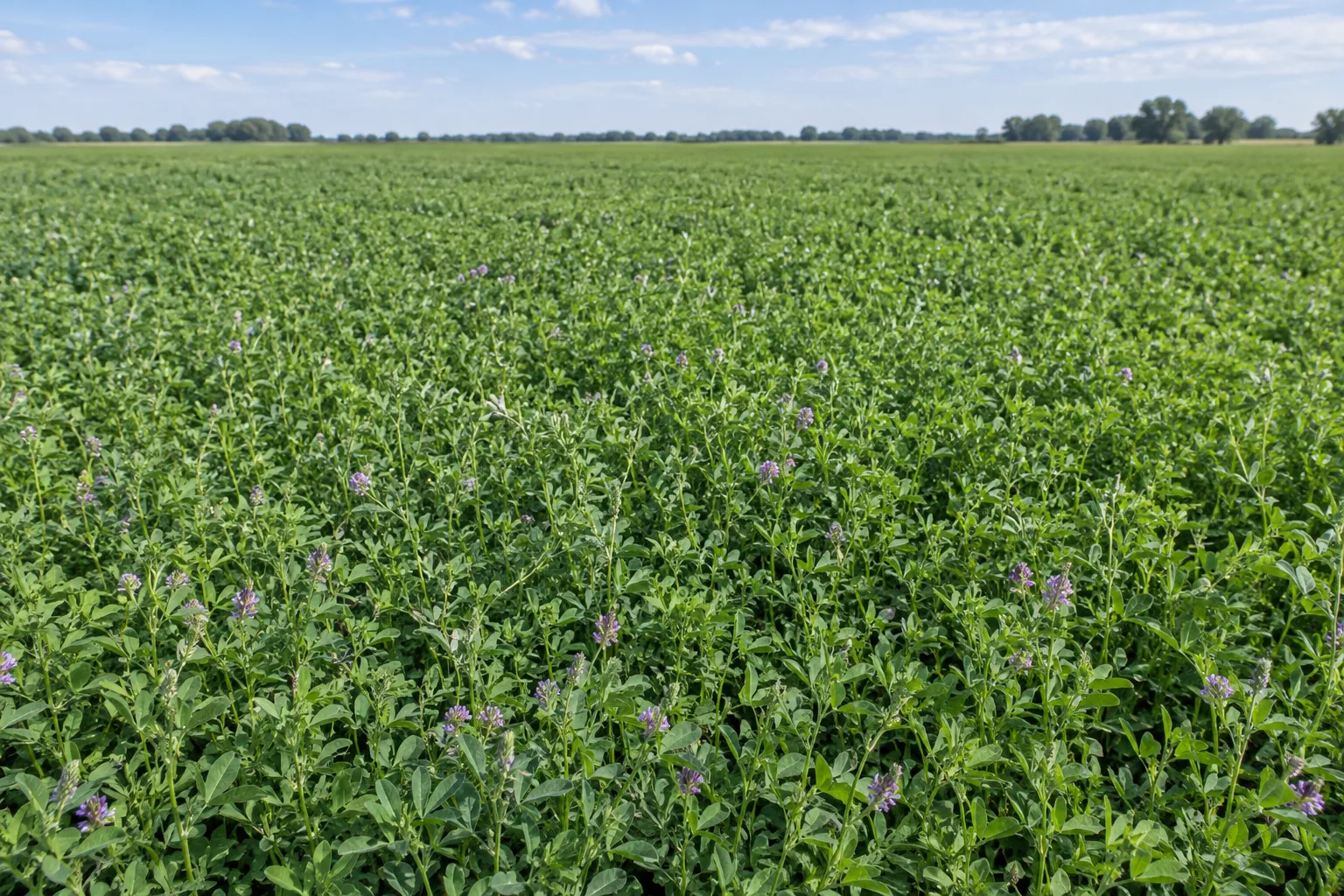
Alfalfa (Medicago sativa), or lucerne, is the highest-yielding perennial forage legume in the world and the largest nitrogen fixer among the crops we serve. Because it regrows and fixes nitrogen throughout the season, year after year, its seasonal totals are the highest in the group — reviews put a healthy stand at roughly 150–500 kg N/ha per year, well above any annual grain legume. But all of that return depends on one thing: establishing a well-nodulated stand in the first year. Alfalfa is a perennial, so the decisions made at sowing compound across the whole life of the stand — and a crop that under-nodulates at establishment almost never catches up. This guide focuses on getting that first year right.
Why alfalfa fixes more than any other crop we serve
Two features set alfalfa apart. First, it is a perennial: a single sowing can be cut several times a year for several years, and it fixes nitrogen at every regrowth rather than for a single season. Second, the whole plant is the product — a high-protein forage — so the crop invests heavily in nitrogen and, when well nodulated, obtains most of it from the air. Together these make alfalfa both the largest nitrogen fixer and the crop on which nodulation failure is most costly, because the loss extends over several seasons rather than one.
A specific partner — Sinorhizobium meliloti
Alfalfa does not nodulate with just any rhizobium. Its partner is Sinorhizobium meliloti, the same species that nodulates sweet clover and the annual medics, and nothing outside that group will work — a clover or soybean inoculant applied to alfalfa fails. Because the relationship is specific, the right Sinorhizobium is usually absent from land that has never grown alfalfa or its relatives, so new stands should always be inoculated. Even on land that grew alfalfa years ago, the resident population declines between stands, so re-inoculating a new sowing is cheap insurance.
The acid-soil weakness — alfalfa’s Achilles heel
If alfalfa has one predictable failure point, it is acid soil. Both the plant and its rhizobium are unusually sensitive to acidity: as pH falls below about 6, nodulation drops off sharply, and the aluminium and manganese that become soluble in acid soils are directly toxic to seedlings and to Sinorhizobium alike. The practical target is a soil pH of roughly 6.5–7.0, a range that suits both the plant and the bacterium and keeps the nutrients they need available.
When the soil is corrected matters as much as whether it is corrected. Agricultural lime is slow to react and slow to move down the profile, so it must be applied and incorporated well ahead of sowing — often months ahead — to raise pH in the zone where the seedlings will nodulate. Liming on the day of sowing does little for that first, decisive year. On acid ground, in other words, the inoculation decision and the liming decision are really one decision, made together and made early.
The establishment year decides the whole stand
Because alfalfa is long-lived, the establishment year sets a trajectory that is hard to change later. A stand that nodulates well in year one fixes nitrogen at every cutting for years; one that establishes thin and under-nodulated stays that way, is slower to close its canopy, and is more easily invaded by weeds. There is no practical way to “re-inoculate” a standing perennial crop to correct a poor start — the only window is at establishment. That is why alfalfa is the last crop on which to economise on inoculation, pH, or seedbed quality.
Alfalfa establishment checklist
| Factor | Target | Why it matters |
|---|---|---|
| Rhizobium | Inoculate with S. meliloti on new ground | The right partner is usually absent |
| Soil pH | Lime to about 6.5–7.0, months before sowing | Nodulation collapses in acid soil; lime reacts slowly |
| Seedbed | Firm, fine, moist | Small seed needs good soil contact |
| Sowing depth | Shallow, roughly 1–2 cm | Small seed sown too deep fails to emerge |
| Molybdenum | Adequate | The fixing enzyme depends on it; often deficient in acid soils |
| Weed control | A weed-free start | Seedlings compete poorly early on |
Saline-alkali and marginal land — where alfalfa delivers twice
Alfalfa is also one of the most salt-tolerant forages and a deep-rooted perennial, which makes it a mainstay for improving saline-alkali and marginal land — precisely the ground where effective native rhizobia are scarcest and the inoculation response is largest. On this land the crop does two jobs at once: it produces forage while its taproot opens the soil, and its fixed nitrogen and residues rebuild fertility for the crops that follow. Pairing the crop with the right Sinorhizobium on reclamation ground is therefore both an agronomic decision and a soil-building one — and this is where inoculation is least optional, because without the partner the crop cannot establish on the very soils that need it most.
Getting it right in the field
Product, coating, and timing
Use an alfalfa-specific Nodu™ carrying S. meliloti. Much alfalfa seed is sold pre-inoculated or lime-coated, and the inoculant on it has a limited shelf life — so check the date and re-inoculate old or long-stored seed rather than relying on a coating applied a year ago. Whatever the form, keep it cool and out of the sun, and get it into the ground before the bacteria decline.
Seedbed and sowing
Alfalfa seed is small, so the seedbed must be firm, fine, and moist, and the seed sown shallow — roughly 1–2 cm. If the seed is sown too deep, or into a loose or dry seedbed, the seedling exhausts its reserves before it emerges, and no amount of inoculant can rescue a plant that never reaches the light. Sow into moisture, and time sowing so the seedlings establish before heat or cold stress.
How alfalfa establishment fails
Most failed alfalfa stands can be traced to a short list of causes, every one of them preventable at sowing:
- Acid soil that was never limed, or limed too late to raise pH in time.
- Old or long-stored pre-inoculated seed whose bacteria had already died.
- Seed sown too deep, so the small seedlings never emerged.
- A loose or dry seedbed that killed the rhizobia or the seedlings.
- Weeds left to smother slow-starting seedlings in the first weeks.
Products in this article