A 34.7% gain in Heihe: soybean yield measured by an expert panel
At an official field measurement in Heihe, Heilongjiang, the soybean block treated with the bio-coupling inoculant yielded 34.7% more than the untreated control. Bio-coupling is the same Aspergillus–Rhizobia Coupling science our Orvan™ range delivers.
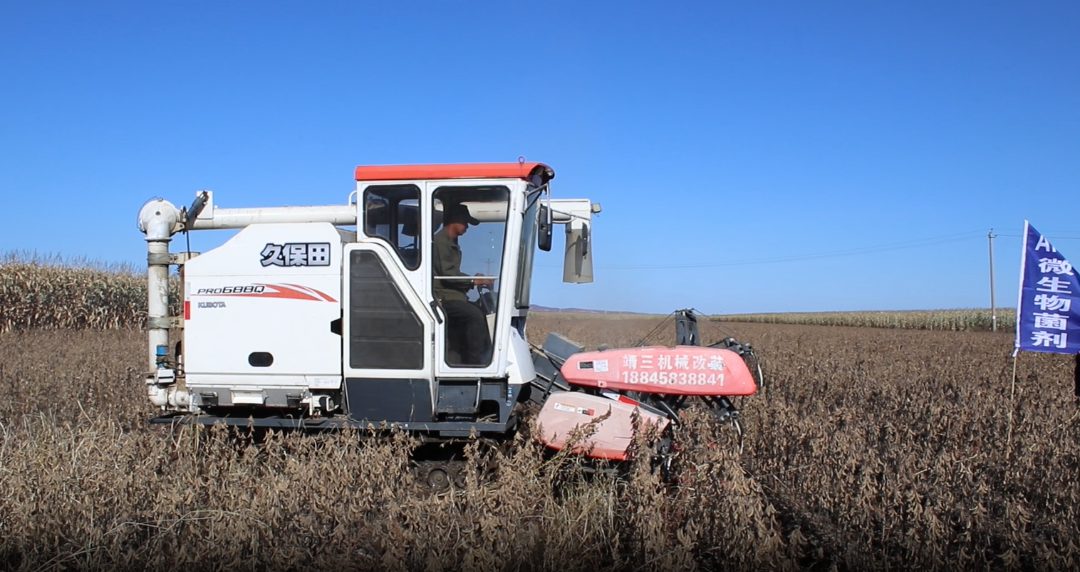
On 10 October 2023, an expert panel convened by the National Agro-Tech Extension and Service Centre visited Xigangzi Village in Aihui District, Heihe, Heilongjiang, to harvest and weigh a soybean demonstration. After adjustment for moisture, the block treated with the bio-coupling inoculant yielded 152.82 kg per mu and the untreated control 113.46 kg — a gain of 34.7%. The project behind it, “Quality, nitrogen fixation and green yield gains: from research to industrialisation”, is run by the CAAS Oil Crops Research Institute (OCRI-CAAS) together with Xinyangfeng and others; an academician of the Chinese Academy of Engineering attended the measurement.
Where the yield was measured
Heihe is a fitting place to test a soybean claim: it grows about a third of all the soybean in Heilongjiang and close to a seventh of the national crop, so a new method that proves itself here carries weight. The two blocks were identical in variety, sowing date and field management; the only difference, one of the site’s technical leads at OCRI-CAAS noted, was the microbial inoculant added to the treated strip. The panel walked the field, checked the variety, sowing date and management, chose uniformly growing plots in both the treated and control strips, measured the area, and harvested each whole plot by combine, weighing it on the spot.
Xigangzi demonstration, Heihe, measured 10 October 2023
| Figure | |
|---|---|
| Measured yield, treated block | 152.82 kg/mu |
| Untreated control | 113.46 kg/mu |
| Yield gain | +34.7% |
| Plant height vs control | +16.83% |
| Pods per plant vs control | +25.65% |
| Grains per plant vs control | +29.32% |
What the plants showed
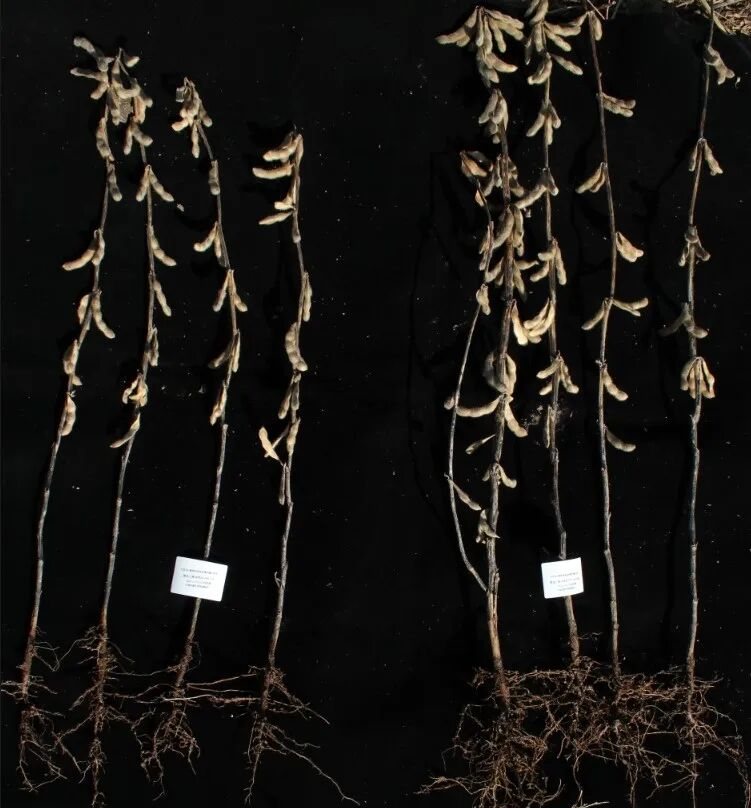
The gain was not confined to the scales. After treatment the proportion of empty pods fell and pods formed on more layers of the plant; on the day of harvest the roots still carried a mass of live nodules — nodulation still working when many crops have long since stopped. Against the control, plant height, pods per plant and grains per plant were up 16.83%, 25.65% and 29.32% respectively. One grower from the village, who had tried the inoculant simply to see what it would do, reported vigorous, disease-resistant seedlings that covered the ground well, and at maturity more pods, three or four grains to a pod, and a yield he could see was different.
The technology underneath it
The bio-coupling was developed over more than two decades at OCRI-CAAS by coupling control of aflatoxin risk at its soil source with the induction of nodulation and nitrogen fixation. Applied as a microbial inoculant, it induces nodulation and fixation from the rhizobia already in the soil rather than adding rhizobia of its own — the same logic on which our Orvan™ range is built.
Speaking at the site, OCRI-CAAS presented Heihe as one result among many: 2023 was the second year of national soybean demonstrations, and across the country the cut-and-weighed results showed the same pattern — stronger early growth, even and sturdy stands, markedly lower disease incidence, and at harvest more pods per plant, brighter and more uniform grain, and a higher hundred-grain weight. On that evidence, the coupling technology was presented as practical support for raising national soybean yields per unit area.
The partner, and the scale
Xinyangfeng, a leading producer of phosphate and compound fertilisers, took on the project jointly in July 2023 as a major Hubei science and technology programme, and did much of the work on co-formulating the inoculant with compound fertiliser — using its production capacity to make a biofertiliser carried on compound fertiliser. In 2023 the programme established 28 demonstration sites across the country — 13 in spring peanut, 7 in summer peanut, 8 in soybean — and the panel’s recommendation from Heihe was to prioritise extension of the coupling technology across the Northeast soybean belt.
Orvan™: technical background
The bio-coupling measured here is the same Aspergillus–Rhizobia Coupling that our Orvan™ range is built to deliver commercially. Applied alongside the crop’s rhizobia, it amplifies nodulation and nitrogen fixation rather than replacing the partner already in the soil. A gain measured in this way — by an official panel, harvested and weighed in their presence, against a control that differed only in the inoculant — is the kind of validation that stands behind what we put in the furrow.