Preemergence vs postemergence herbicides: how they work, soil and weather factors, and how to combine them
What separates soil applied residual herbicides from foliar herbicides, which soil and weather factors decide whether each works, how crop safety and timing are set, and how to combine residual and foliar products in one programme.
Author: Chen Zhiyuan, Senior AgronomistTechnical review: Wang Liqun, Researcher
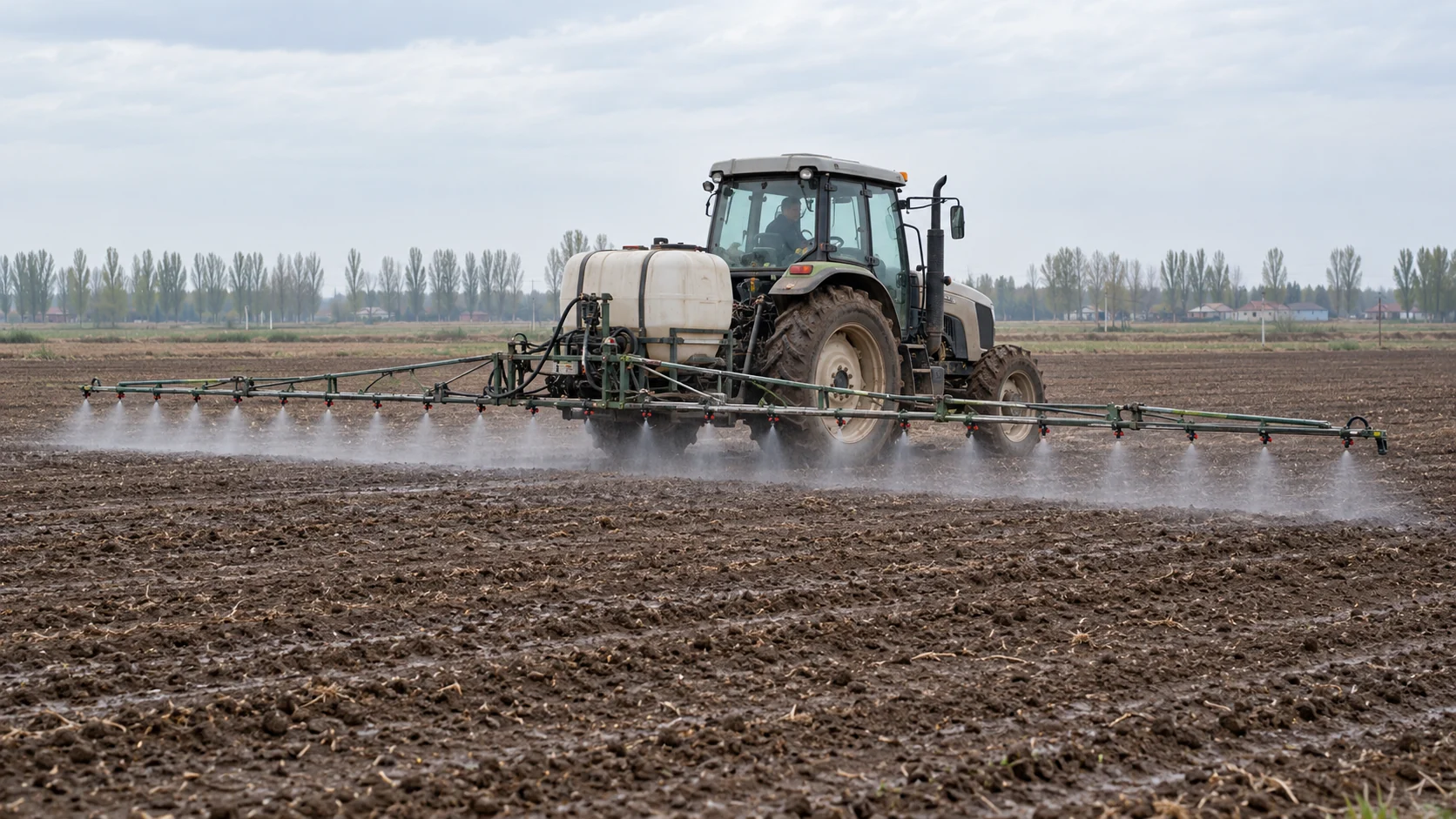
To work, any herbicide must reach the weed, be absorbed, move to its site of action and build up there [3]. A herbicide applied to soil does this through germinating roots and shoots, so it depends on soil moisture, texture and organic matter; a herbicide sprayed on emerged weeds does it through the leaf, so it depends on weed size, leaf surface and growing conditions [3][5]. This guide covers the timing terms, how each type works, what decides performance, crop safety and how to combine the two, with examples from Huasheng's catalogue.
1. What preemergence and postemergence mean
The crop protection guide of Ontario's agriculture ministry defines the main timings [1]:
- Preplant (PP): applied before planting and not incorporated. A preplant burndown is applied to a cover crop or weeds before planting.
- Preplant incorporated (PPI): applied before planting and incorporated into the soil.
- Preemergence (PRE): applied after seeding but before the crop emerges. In horticultural crops these are also called soil applied herbicides, because they may be applied before or shortly after crop emergence or transplanting, or after planting in orchards and vineyards.
- Early postemergence (EPOST): applied shortly after crop emergence or transplanting.
- Postemergence (POST): applied after the crop has emerged or been transplanted.
These definitions refer to the crop. The herbicide itself acts on weeds: VLCFA inhibitors, for example, affect susceptible weeds before they emerge but do not control emerged plants [3]. Penn State weed scientists add that the newer early, mid and late postemergence timings have no exact definitions, so the label decides timing relative to crop and weed stages [2]. Most maize herbicides usually applied preemergence can also be applied postemergence, with restrictions that differ by product and tank mix partner [2].
2. How preemergence herbicides work
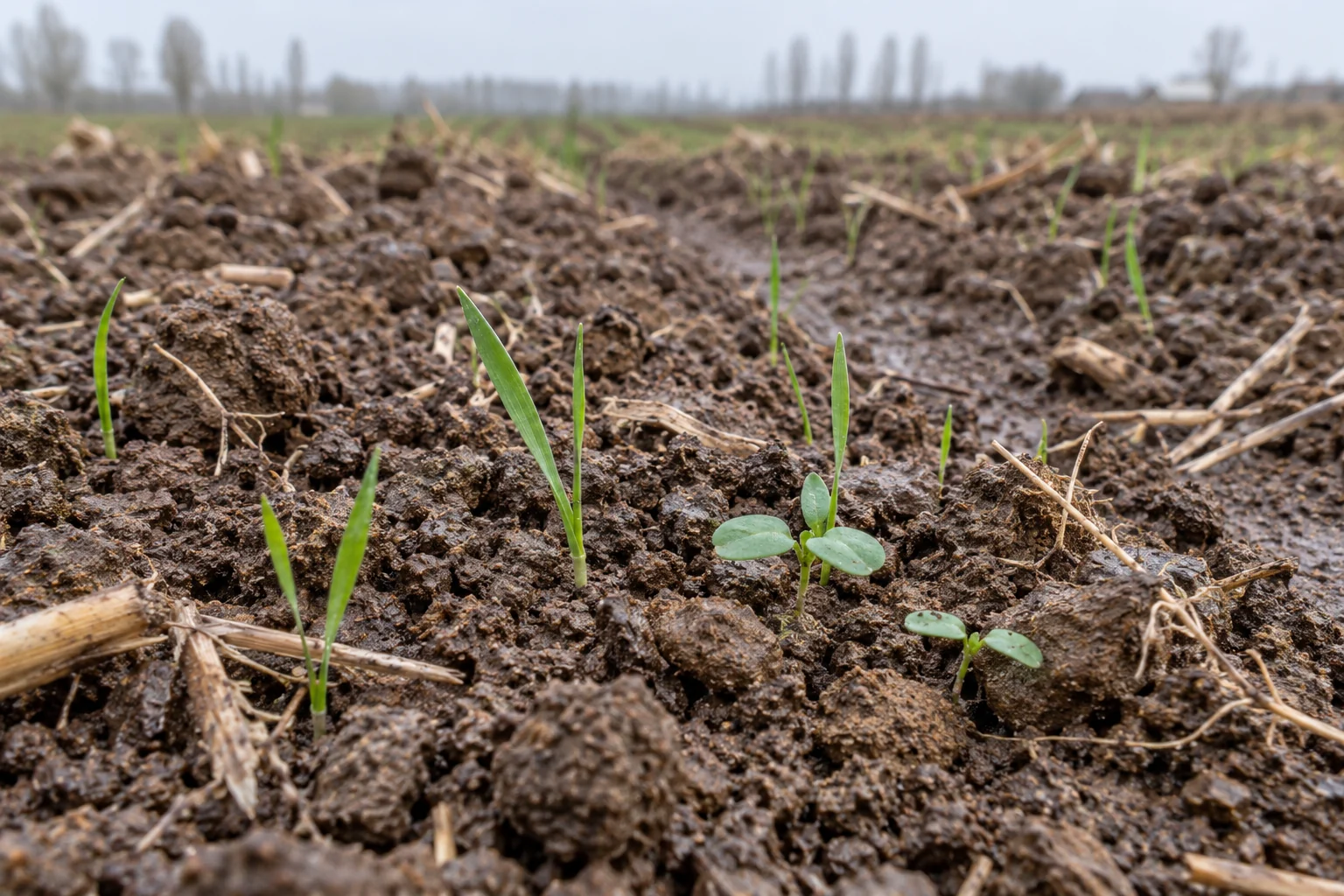
A soil applied herbicide is activated when it dissolves in soil water and moves into the upper 2.5 to 5 cm (one to two inches) of soil, where germinating roots and shoots take it up [4][5]. Most small weed seeds germinate in the top 1.3 cm (half inch), so herbicide near the surface reaches them; larger seeded weeds emerging from deeper may escape unless the herbicide is incorporated or moved down by water [3]. Mechanical incorporation tends to give more consistent control because the herbicide is in place and moisture is usually present, although incorporating too deep dilutes it [3].
Seedling growth inhibitors are typical preemergence products. Dinitroanilines (Group 3) are absorbed by roots and shoots of emerging seedlings and are generally applied preemergence against annual grasses and some broadleaf weeds; some must be incorporated to avoid losses to sunlight and volatility [3]. VLCFA inhibitors (Group 15) control annual grasses and some small seeded broadleaf weeds before emergence [3]. Other groups act through both soil and foliage: ALS inhibitors (Group 2) are absorbed by roots and foliage and are used soil applied or postemergence [3], and mesotrione (Group 27) is taken up via the soil or by green tissue and is used preemergence and postemergence [6].
3. Soil and weather factors for preemergence products
Moisture for activation
When the soil is dry, herbicide molecules stay bound to soil particles and cannot move into seedlings [5]; adsorption is greatest in dry soil, so control is generally best in moist conditions [3]. Sources differ on how much rain is needed. A Clemson specialist considers 0.25 to 0.50 inch (about 6 to 13 mm) sufficient for most soil applied herbicides within a few days of application, with at least 1 inch (25 mm) in total within two weeks for optimum activity [4]. Purdue's rule of thumb is about 0.75 to 1 inch (19 to 25 mm) in the first week and about 2 inches (50 mm) over the first two weeks [5]. The need also depends on water solubility, weed sensitivity, seedling stage and soil moisture at application, and labels differ [4][5].
Soil texture, organic matter and pH
Herbicides bind mainly to clay and organic matter, so fine textured soils high in organic matter hold more herbicide and leave less available to weeds. Coarse soils low in organic matter leave more available and carry a greater risk of crop injury, which is why labels set use by soil texture and organic matter [3]. Soil pH changes adsorption, solubility and breakdown: triazines and some sulfonylureas are more active and persistent above pH 7, while a few herbicides are somewhat more persistent in low pH soils [3].
Temperature, persistence and dry spells
Cool conditions delay emergence and slow metabolism, so young seedlings are more susceptible to soil applied herbicides [3]. Dry periods and extreme temperatures slow degradation and raise the risk of injury to the next crop, while repeated use of the same herbicide in a field can build up microbes that break it down faster and shorten its residual life [3]. If 10 to 14 days pass without rain and weeds start to emerge, Purdue advises planning a postemergence application; some products, HPPD inhibitors among them, can reach back to small emerged weeds once rain falls, but relying on that is uncertain [5].
4. How postemergence herbicides work
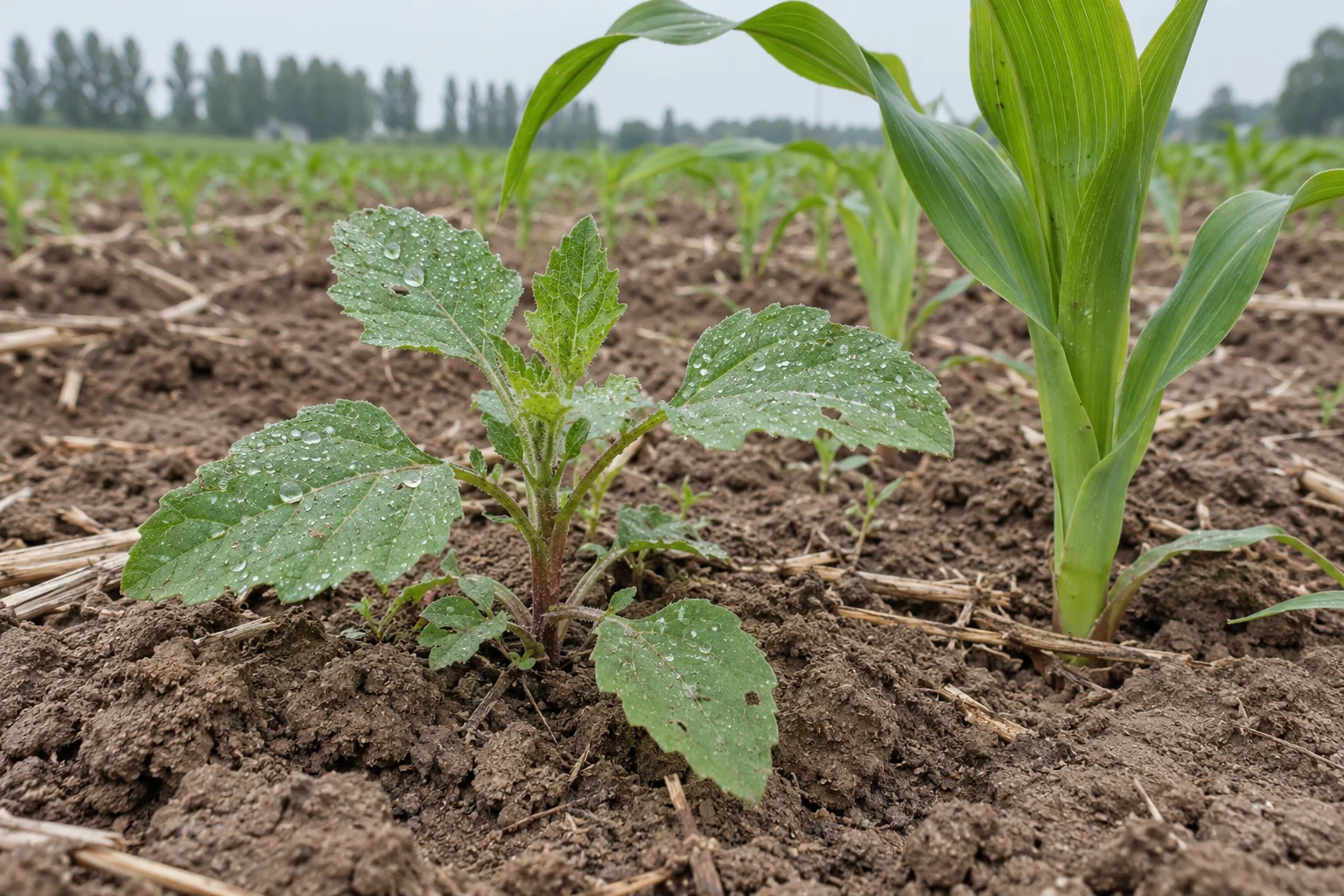
A foliar herbicide must stay on the leaf and enter it. Upright grass leaves are harder to wet than broadleaves [3]. Annual weeds are most susceptible when small: as they mature they develop thicker wax and are harder to cover, and drought stressed weeds with thicker cuticles and slow growth are controlled less well [3]. Plants are most susceptible when actively growing, and most labels caution against spraying in extreme conditions [3].
Movement in the plant matters. Contact herbicides such as glufosinate and bentazone act only where the spray lands, so thorough coverage of small weeds is essential; they are generally ineffective for long term perennial control, and young grasses, whose growing point sits at or below the soil surface, can escape [3]. Systemic herbicides move in the xylem, the phloem or both; phloem mobile products such as glyphosate move down into roots and rhizomes and give the best perennial weed control [3]. Activator adjuvants improve retention and absorption but can reduce selectivity, so use them only as the label recommends [3].
5. Crop safety and timing
Selectivity, the ability to kill some plants without injuring others, can rest on placement, spray retention, absorption, translocation, metabolism or an insensitive site of action, and it is relative: even a tolerant crop can be injured at a high enough rate [3]. Maize, for example, tolerates mesotrione because it metabolises it rapidly [3]. A seed protectant (safener) can raise crop tolerance to some VLCFA herbicides by speeding their metabolism [3].
Because tolerance often depends on fast metabolism, crop injury rises and weed control falls when plants are not actively growing [3]. ALS inhibitors can injure maize, especially in cold conditions after application or when applied with certain insecticides [3]. Labels limit postemergence use by crop stage: some maize products are restricted to very young plants, others allow taller crops [2]. For residual products, carryover to the following crop is the key concern: many ALS inhibitors can carry over, sulfonylureas more in high pH soils and imidazolinones more in low pH soils [3].
6. Combining residual and foliar products
HRAC recommends combining preemergence and postemergence herbicides, and using nonselective herbicides on early weed flushes before crop emergence and on escapes [8]. WSSA advises starting with a clean field, using a burndown or tillage together with a preemergence residual herbicide where appropriate, and using multiple modes of action with overlapping weed spectrums [9]. Glyphosate and glufosinate are nonselective foliar herbicides with no soil activity [3], so on their own they do not control weeds that emerge after the spray.
After a dry spell following a preemergence application, Clemson advises spraying the first postemergence treatment sooner and always adding a preemergence herbicide to it to extend residual activity [4]. Layering residuals is not a complete answer to resistance: University of Illinois weed scientists note that its effect on the evolution of resistance is not fully understood, and that the only certainty is that resistance frequency does not change if no weed seed is produced [10].
7. Catalogue examples by timing
The table lists active ingredients from Huasheng's catalogue by usual timing, with what the cited sources say about each ingredient or its group. HRAC groups follow the 2026 list [11].
Catalogue herbicides by usual application timing
| Active ingredient | HRAC group | Usual timing | What the sources say |
|---|---|---|---|
| Pendimethalin | 3 | Preemergence or incorporated | Dinitroanilines are generally applied preemergence against annual grasses and some broadleaf weeds; pendimethalin is less volatile than others in the group but generally works better when incorporated [3]. Clemson lists 0.75 inch (about 19 mm) of rain for activation [4]. |
| Pyroxasulfone | 15 | Preemergence | VLCFA inhibitors act on annual grasses and some small seeded broadleaf weeds before emergence and do not control emerged plants [3]; the label cited by Purdue calls for activation before weed emergence [5]. |
| Imazethapyr | 2 | Preemergence or postemergence | ALS inhibitors are absorbed by roots and foliage and used soil applied or postemergence [3]; moistening the top 2 inches (about 5 cm) of soil is normally adequate for activation [4]; imidazolinone carryover is more likely in low pH soils [3]. |
| Mesotrione | 27 | Preemergence and postemergence | Taken up via the soil or green tissue, for broadleaf weeds [6]; maize tolerates it through rapid metabolism [3]; HPPD inhibitors can reach back to small emerged weeds after rain [5]. |
| Nicosulfuron | 2 | Postemergence | Used postemergence in maize against annual grasses and weeds [7]; ALS inhibitors can injure maize, especially in cold conditions or with certain insecticides [3]. |
| Bentazone | 6 | Early postemergence | Contact herbicide, not translocated; thorough coverage is essential [3]. |
| Fluazifop-P-butyl, haloxyfop-P-methyl | 1 | Postemergence | Foliar applied, short lived in soil, for emerged grasses in broadleaf crops; mixing with broadleaf herbicides can reduce grass control (antagonism) [3]. |
| Glyphosate | 9 | Postemergence, burndown | Nonselective, inactive in soil because of adsorption, phloem mobile [3]. |
| Glufosinate | 10 | Postemergence, burndown | No soil activity; limited translocation, so coverage of small weeds matters [3]. |
The table is not a list of registered uses. Which crops, timings, rates and rotational intervals apply is set by each country's registration and by the product label.
8. A practical sequence
- Identify the main weeds and when they emerge, and record soil texture, organic matter and pH for each field [3].
- Start clean: control emerged weeds with tillage or a burndown before or at planting [9].
- Apply a preemergence residual chosen for the expected weeds and for the soil, following the label directions for soil type [3][9].
- Check rainfall after application; if activation is uncertain, plan an earlier postemergence spray [4][5].
- Spray postemergence products on small, actively growing weeds, within the crop stages and with the adjuvant on the label [2][3].
- Add a residual partner from a different group to the first postemergence spray to extend control [4][8][9].
- Check rotational crop restrictions for residual products before choosing the next crop [3].
Frequently asked questions
What is the difference between preemergence and postemergence herbicides?
A preemergence herbicide is applied before the crop emerges and acts in the soil on germinating weeds; a postemergence herbicide is applied after emergence, to the foliage of emerged weeds [1][3].
Do preemergence herbicides kill weeds that have already emerged?
Many do not. VLCFA inhibitors, for example, do not control emerged plants, so emerged weeds need tillage or a burndown first [3][9]. Some, such as mesotrione, also have foliar activity [6].
How much rain does a preemergence herbicide need?
It depends on the product and soil. Clemson considers 0.25 to 0.50 inch (6 to 13 mm) enough for most products; Purdue prefers about 0.75 to 1 inch (19 to 25 mm) in the first week. Check the label [4][5].
When should I apply a postemergence herbicide?
When weeds are small and actively growing, within the crop stages allowed on the label; large or drought stressed weeds are harder to control [2][3].
Can I mix a preemergence and a postemergence herbicide?
Yes, where the labels allow. Adding a residual to the first postemergence spray extends soil activity, and HRAC recommends combining both timings [4][8].
Is mesotrione a preemergence or postemergence herbicide?
Both. FAO/WHO JMPR describes it as a systemic preemergence and postemergence herbicide for broadleaf weeds, taken up via the soil or green tissue [6].
Further reading
- Enquire about pendimethalin, pyroxasulfone, mesotrione and nicosulfuron
- Pendimethalin: formulations and supply
- Pyroxasulfone: formulations and supply
- Imazethapyr: formulations and supply
- Mesotrione: formulations and supply
- Nicosulfuron: formulations and supply
- Glufosinate: formulations and supply
- Herbicides: sourcing from Huasheng
- [1] Ontario Ministry of Agriculture, Food and Agribusiness (n.d.). Herbicide application timing definitions. Crop Protection Hub.
- [2] Lingenfelter D., Curran B. (2015). Knowing the terminology is important in corn herbicide application timings. Weekly Crop Update, University of Delaware Cooperative Extension (originally in Penn State Field and Forage Crop News).
- [3] Lancaster S., Jugulam M., Falk Jones J. (2021). Herbicide mode of action. Kansas State University Research and Extension, C715 (revised).
- [4] Marshall M. (2021). Water requirements for activating preemergence herbicides. South Carolina Crops, Clemson University.
- [5] Johnson B., Zimmer M. (2022). Soil applied herbicides and rainfall for activation. Pest&Crop Newsletter, Purdue University.
- [6] FAO/WHO Joint Meeting on Pesticide Residues (2019). Mesotrione (277). Pesticide residues in food 2019, extra JMPR evaluations.
- [7] FAO (2014). FAO specifications and evaluations for agricultural pesticides: nicosulfuron.
- [8] HRAC (n.d.). Best management practices (prevention and management of herbicide resistance).
- [9] Weed Science Society of America (n.d.). Herbicide resistance.
- [10] Hager A. (2023). Recommendations to manage herbicide-resistant weeds: it's not as easy as some believe. Department of Crop Sciences, University of Illinois.
- [11] HRAC (2026). 2026 Herbicide MoA Classification Master List (spreadsheet).
Products in this article