Shipping pesticides by sea: dangerous goods classes, marks and documents
How the IMDG Code and the UN Model Regulations classify pesticide formulations, where the classification on the safety data sheet comes from, and which marks, labels and documents an importer should check before a container leaves port.
Author: Zhao Guohua, ResearcherTechnical review: Wang Liqun, Researcher
Products in this article
The International Maritime Dangerous Goods (IMDG) Code governs packaged dangerous goods at sea. It is mandatory under chapter VII of SOLAS, also carries the MARPOL Annex III rules on harmful substances, and is amended on a two year cycle that takes account of changes to the UN Recommendations on the Transport of Dangerous Goods, the basic requirements for all modes [1]. The 2024 edition (Amendment 42-24) entered into force on 1 January 2026 [2]. This guide summarises how pesticides are classified, marked and documented; it does not replace the Code or a trained specialist.
1. The classes that cover pesticides
The Code assigns every dangerous substance or mixture to one of nine classes by its hazard, or its most predominant hazard [2]. Its PESTICIDE entries are in class 6.1 or class 3, and products hazardous only to the aquatic environment go to class 9 [2]:
- Class 6.1, toxic substances, with the packing group set by LD50 or LC50 values. The WHO hazard classification of pesticides may supply LD50 data but not the transport class [2].
- Class 3, flammable liquids, with a flashpoint of 60 °C or below in a closed cup test [2]. Emulsifiable concentrates (EC) usually contain petroleum based solvents and are described as flammable [6]. Under the generic entries, a toxic liquid pesticide with a flashpoint below 23 °C is UN 3021 (class 3, subsidiary 6.1); from 23 °C it is UN 2903 (class 6.1, subsidiary 3) [2].
- Class 9, environmentally hazardous substances. A product classified Acute 1, Chronic 1 or Chronic 2 for the aquatic environment is a marine pollutant. If it meets no criteria of classes 1 to 8, it travels as UN 3077 (solid) or UN 3082 (liquid), packing group III; if it is also toxic or flammable, it takes the class 6.1 or class 3 entry and is declared a marine pollutant as well [2][3].
The proper shipping name depends on the active ingredient, physical state and subsidiary hazards, and the Code has group entries for carbamate, organophosphorus and pyrethroid pesticides beside the generic ones [2]. Generic and n.o.s. entries add a technical name in brackets: for pesticides the ISO common name or active substance name, never a trade name, and for mixtures at most the two constituents that contribute most to the hazard [2].
Table 1. IMDG Code entries most often used for pesticide consignments, 2024 edition [2]
| UN number | Proper shipping name | Class (subsidiary) | Packing group | Limited quantity per inner packaging | Excepted quantity code |
|---|---|---|---|---|---|
| UN 2588 | PESTICIDE, SOLID, TOXIC, N.O.S. | 6.1 | I / II / III | 0 / 500 g / 5 kg | E5 / E4 / E1 |
| UN 2902 | PESTICIDE, LIQUID, TOXIC, N.O.S. | 6.1 | I / II / III | 0 / 100 mL / 5 L | E5 / E4 / E1 |
| UN 2903 | PESTICIDE, LIQUID, TOXIC, FLAMMABLE, N.O.S., flashpoint not less than 23 °C | 6.1 (3) | I / II / III | 0 / 100 mL / 5 L | E5 / E4 / E1 |
| UN 3021 | PESTICIDE, LIQUID, FLAMMABLE, TOXIC, N.O.S., flashpoint less than 23 °C | 3 (6.1) | I / II | 0 / 1 L | E0 / E2 |
| UN 3077 | ENVIRONMENTALLY HAZARDOUS SUBSTANCE, SOLID, N.O.S. | 9 | III | 5 kg | E1 |
| UN 3082 | ENVIRONMENTALLY HAZARDOUS SUBSTANCE, LIQUID, N.O.S. | 9 | III | 5 L | E1 |
A limited quantity of 0 means the entry cannot use the limited quantity provisions; E0 means it cannot travel as an excepted quantity [2].
2. Catalogue examples in the IMDG Code index
The index of the Code marks marine pollutants with the letter P [2]. Four active ingredients in the Huasheng catalogue appear there.
Table 2. Catalogue active ingredients named in the IMDG Code 2024 index [2]
| Active ingredient | Index entry (P = marine pollutant) | What it means |
|---|---|---|
| Malathion | P; class 9, UN 3082 | Class 9 entry if no other class applies |
| Mancozeb | P; class 9, UN 3077 | Class 9 entry if no other class applies |
| Fenitrothion | P; see ORGANOPHOSPHORUS PESTICIDE | Group entry matching its state and hazards |
| Carbendazim | P; see Note 1 | Classified by its properties, otherwise UN 3077 or UN 3082 |
The index lists the active substance; a formulation is classified on its own properties, so a flammable EC takes a class 3 entry and stays a marine pollutant. Absence from the index proves nothing, because any substance meeting the criteria must be carried as a marine pollutant [2].
3. Where the classification comes from: section 14 of the SDS
Classification is the responsibility of the shipper [2], and buyers find it in section 14 of the safety data sheet (SDS). In the 16 section format, used for example in the US Hazard Communication Standard, section 14 gives the UN number, proper shipping name, transport hazard class, packing group, environmental hazards such as marine pollutant (yes or no), transport in bulk and special precautions [5]. The data behind it sit in section 9 (flash point), section 11 (toxicity) and section 12 (ecotoxicity) [5].
The classification belongs to the formulation, not the active ingredient: without test data, a preparation's LD50 is estimated from the LD50 and concentration of its active ingredient, and flashpoint depends on composition [2]. Read section 14 for the exact product and concentration being shipped.
4. Packing groups and UN packaging
Packing group I means high danger, II medium and III low [2]. For class 6.1 the group follows acute toxicity (Table 3). For class 3, a flashpoint below 23 °C gives group II and 23 to 60 °C gives group III, if the initial boiling point is above 35 °C; otherwise the liquid is group I [2]. UN 3077 and UN 3082 are group III [2].
Table 3. Packing group criteria for class 6.1 [2]
| Packing group | Oral LD50 (mg/kg) | Dermal LD50 (mg/kg) | Inhalation LC50, dusts and mists (mg/L) |
|---|---|---|---|
| I | 5.0 or less | 50 or less | 0.2 or less |
| II | above 5.0 to 50 | above 50 to 200 | above 0.2 to 2.0 |
| III | above 50 to 300 | above 200 to 1,000 | above 2.0 to 4.0 |
Packagings must withstand normal transport and stay closed under vibration and changes in temperature, humidity or pressure [2]. The UN packaging mark includes a letter for the packing groups the design type passed: X for I, II and III; Y for II and III; Z for III only [2]. A drum marked Y cannot take a group I product.
5. Labels and marks on packages and containers
- Packages show the proper shipping name and the UN number, at least 12 mm high, or 6 mm on packages of 30 L or 30 kg or less [2].
- Hazard labels show the primary class and any subsidiary hazard: skull and crossbones for class 6.1, a flame on red for class 3, seven vertical stripes for class 9 [2].
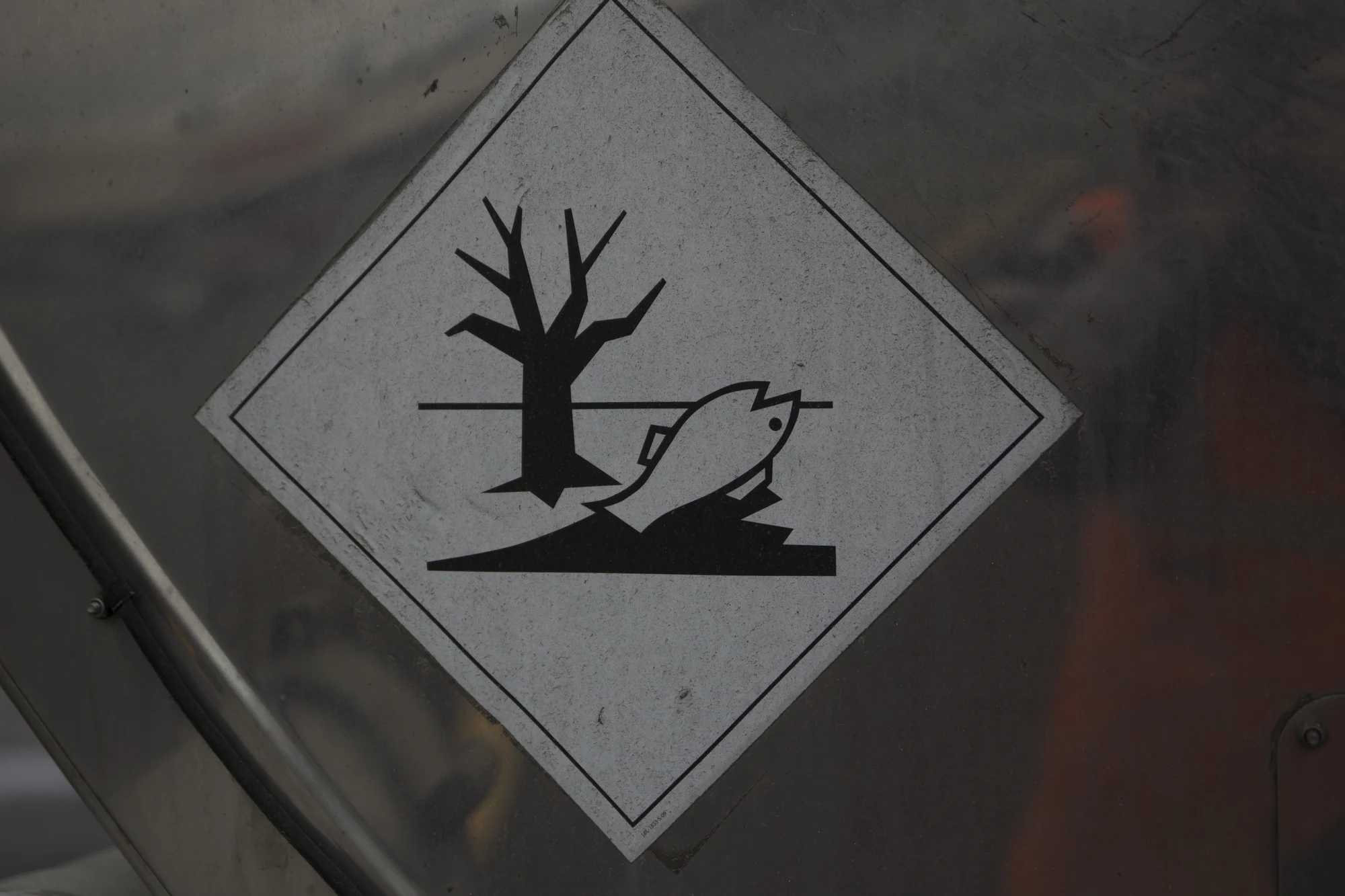
- Marine pollutants carry the marine pollutant mark beside the name: a diamond with a black fish and tree, at least 100 × 100 mm [2]. The UN Model Regulations call the same symbol the environmentally hazardous substance mark [4].
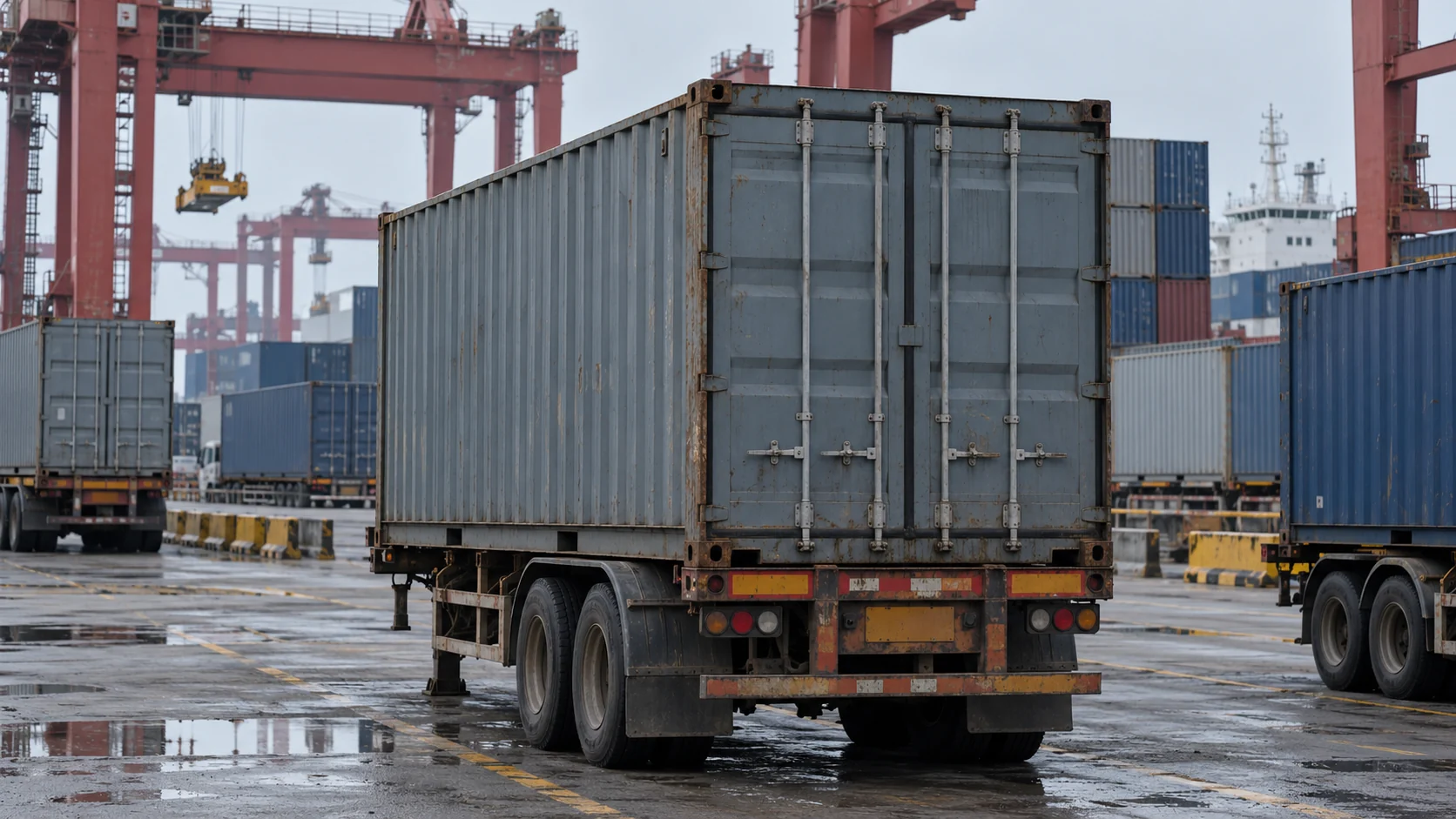
- Freight containers show placards on each side and each end, the marine pollutant mark of at least 250 × 250 mm in the same places, and the UN number when over 4,000 kg gross of packaged goods with one UN number are the only dangerous goods inside [2].
- Placards and marks from previous loads must be removed or masked [2][8].
Small packagings are partly exempt: a marine pollutant with another hazard class packed 5 L or 5 kg or less per inner packaging needs no marine pollutant mark, and UN 3077 or UN 3082 in such packagings is exempt from the rest of the Code if the general packaging provisions are met [2].
6. The dangerous goods declaration and the container packing certificate
The dangerous goods transport document gives, in this order, the UN number, proper shipping name with any technical name, class, subsidiary class in brackets and packing group; at sea it adds MARINE POLLUTANT where it applies and the minimum flashpoint for liquids with a class 3 hazard and a flashpoint of 60 °C or below [2]. A Code example reads “UN 2761, Organochlorine pesticide, solid, toxic, (Aldrin 19%), class 6.1, PG III, MARINE POLLUTANT” [2]. The shipper signs a declaration that the goods are correctly described, classified, packaged, marked and labelled [7].
Whoever packs the container signs a container packing certificate confirming that the container was clean, dry and fit, incompatible packages were segregated, only sound packages were loaded, drums were upright, the load was secured and marks and placards are correct [2]. It may be combined with the declaration [7]. The UK Maritime and Coastguard Agency notes that for consolidated cargo the consolidator should sign it, and that a master must not accept dangerous goods without signed documents [7].
Class 6.1 goods may not share a container with foodstuffs unless they are packing group III and loaded at least 3 m away [2]; CropLife International advises never carrying crop protection products in the same space as food or feed [8]. Shore staff who prepare sea shipments must be trained for their tasks [2].
7. Limited and excepted quantities
Limited quantity provisions let small inner packagings, up to the maximum in column 7a of the Dangerous Goods List (Table 1), travel with fewer requirements. Packages must not exceed 30 kg gross and carry the limited quantity mark, and at sea a dangerous goods document marked “LTD QTY” is still required [2]. Excepted quantities are smaller still, from 1 g or 1 mL up to 30 g or 30 mL per inner packaging depending on the code, with their own mark and document wording [2].
8. National rules: examples
China
Order No. 14 of 2024 of the Ministry of Transport, in force since 1 March 2025, requires packaged dangerous goods carried by ship to meet the IMDG Code and their packaging to hold inspection certificates. A container packing inspector checks the packing on site and signs the container packing certificate against standard GB 40163, and before delivery the shipper gives the carrier, and reports to the maritime administration, a declaration of safe carriage, the SDS and these certificates [9].
Latin America
In Colombia, DIMAR Resolution 0130 of 2019 allows packaged dangerous goods to be carried by sea only in accordance with the IMDG Code, and DIMAR approves and certifies packaging design types tested to the Code [10].
United Kingdom
The Code is brought into UK law through the Merchant Shipping (Carriage of Dangerous Goods and Harmful Substances) (Amendment) Regulations 2024 [7].
9. What an importer should check before shipment
- Obtain the current SDS for the exact formulation and read section 14 [5].
- Check that UN number, shipping name, class, packing group and marine pollutant status agree across the SDS, packages and draft declaration [2][5].
- For liquids, check the flash point in section 9 and that it appears on the declaration when it is 60 °C or below [2][5].
- Check the UN packaging mark: X, Y or Z must cover the packing group [2].
- Agree who packs the container and signs the packing certificate [7], and keep food and feed out of the unit [2][8].
- Check rules at origin and destination, such as packaging certificates in China or DIMAR approval in Colombia [9][10].
- On arrival, check quantities, look for leaks and replace damaged labels before onward transport [8].
Frequently asked questions
Is UN 3082 a dangerous good?
Yes. It is the class 9 entry, packing group III, for liquids hazardous to the aquatic environment that meet no other class [2][3]. Inner packagings of 5 L or less are exempt if the general packaging provisions are met [2].
What is the UN number for pesticides?
There is no single number: generic entries include UN 2588, UN 2902, UN 2903 and UN 3021, plus group entries, and products that are only environmentally hazardous use UN 3077 or UN 3082 [2]. Section 14 of the SDS gives the entry [5].
Are pesticides marine pollutants?
Those that meet the aquatic hazard criteria are, whether or not the Code names them; its index names some active ingredients, such as malathion and mancozeb [2].
Where do I find the dangerous goods classification of a pesticide?
In section 14 of the SDS [5]. The shipper is responsible for it [2].
Is an emulsifiable concentrate a flammable liquid?
It depends on the flashpoint. ECs usually contain petroleum based solvents [6]; at 60 °C or below the product involves class 3, and the flashpoint goes on the declaration [2].
What is a container packing certificate?
A signed statement by the packer that the container was fit and the packages were inspected, segregated, secured and marked [2]. It may be combined with the declaration [7].
Further reading
- Enquire about malathion, mancozeb, fenitrothion and carbendazim
- Malathion: formulations and supply
- Mancozeb: formulations and supply
- Fenitrothion: formulations and supply
- Carbendazim: formulations and supply
- Quality control and batch documents
- Sourcing and supply
- [1] International Maritime Organization (n.d.). The International Maritime Dangerous Goods (IMDG) Code.
- [2] International Maritime Organization (2024). Resolution MSC.556(108): Amendments (42-24) to the IMDG Code, 2024 edition. Annex text published by the Marine Department, Hong Kong SAR.
- [3] United Nations (2017). Recommendations on the Transport of Dangerous Goods: Model Regulations, 20th revised edition, Volume I.
- [4] United Nations (2017). Recommendations on the Transport of Dangerous Goods: Model Regulations, 20th revised edition, Volume II.
- [5] US Occupational Safety and Health Administration (n.d.). 29 CFR 1910.1200 Appendix D: Safety data sheets.
- [6] Fishel F. M. (revised 2013). Pesticide formulations. UF/IFAS Extension, PI231.
- [7] Maritime and Coastguard Agency (2018). Container packing certificated on dangerous goods notes. GOV.UK.
- [8] CropLife International (2006). Guidelines for the safe transport of crop protection products.
- [9] Ministry of Transport of the People's Republic of China (2024). Provisions on the safety supervision and administration of dangerous goods carried by ships, Order No. 14 of 2024 (in Chinese).
- [10] Dirección General Marítima, Colombia (2019). Resolución 0130-2019 MD-DIMAR-SUBMERC-AREM (in Spanish).