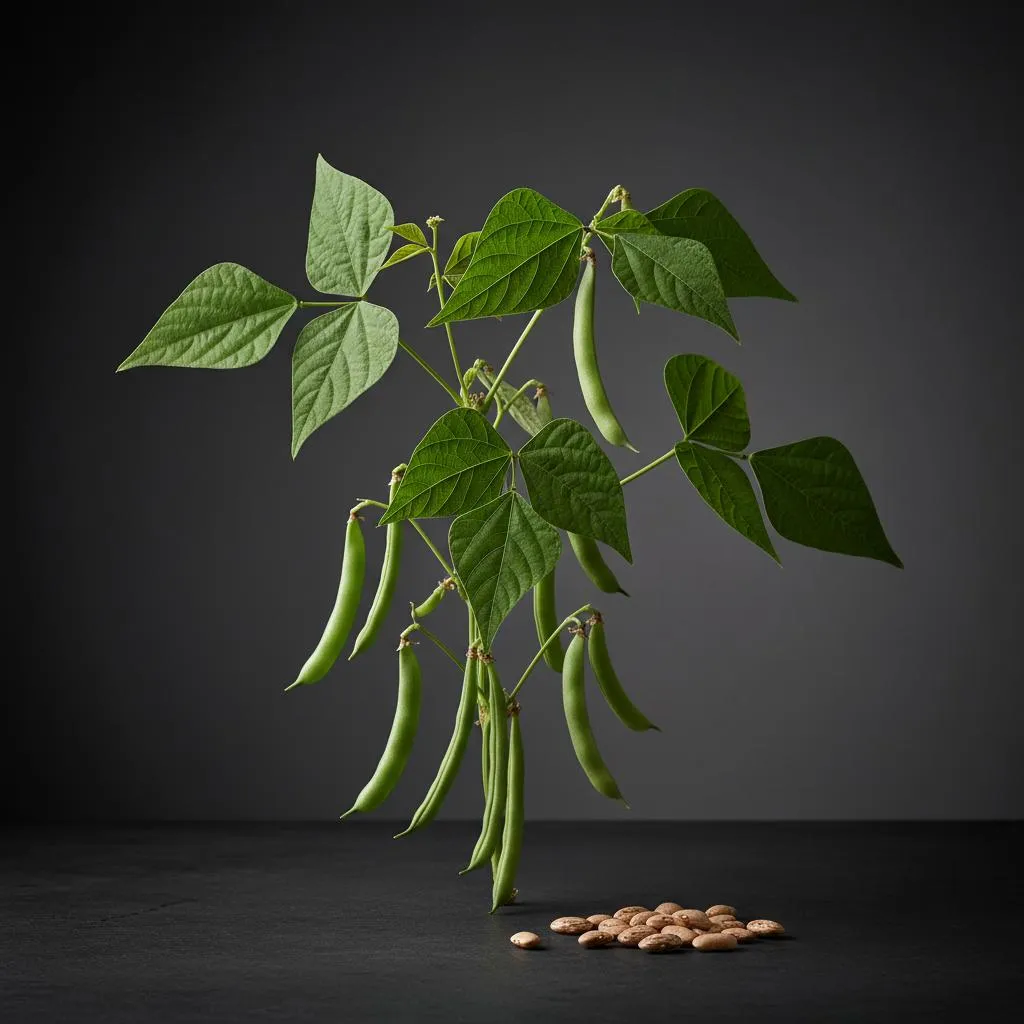
Common Bean · PGPR: phosphorus & stress
Vigor™
Stronger roots, more available phosphorus, and tougher stands for Common Bean — the PGPR layer of the program.
Standalone yield
+8.3%
Trial sites
22 sites
Applied phosphorus
−25%
Root biomass
+12%
Built for this crop
Common bean is the weakest nitrogen-fixer among the major grain legumes: it often under-nodulates and leans on fertilizer, and it responds most where native rhizobia are scarce or poorly matched.
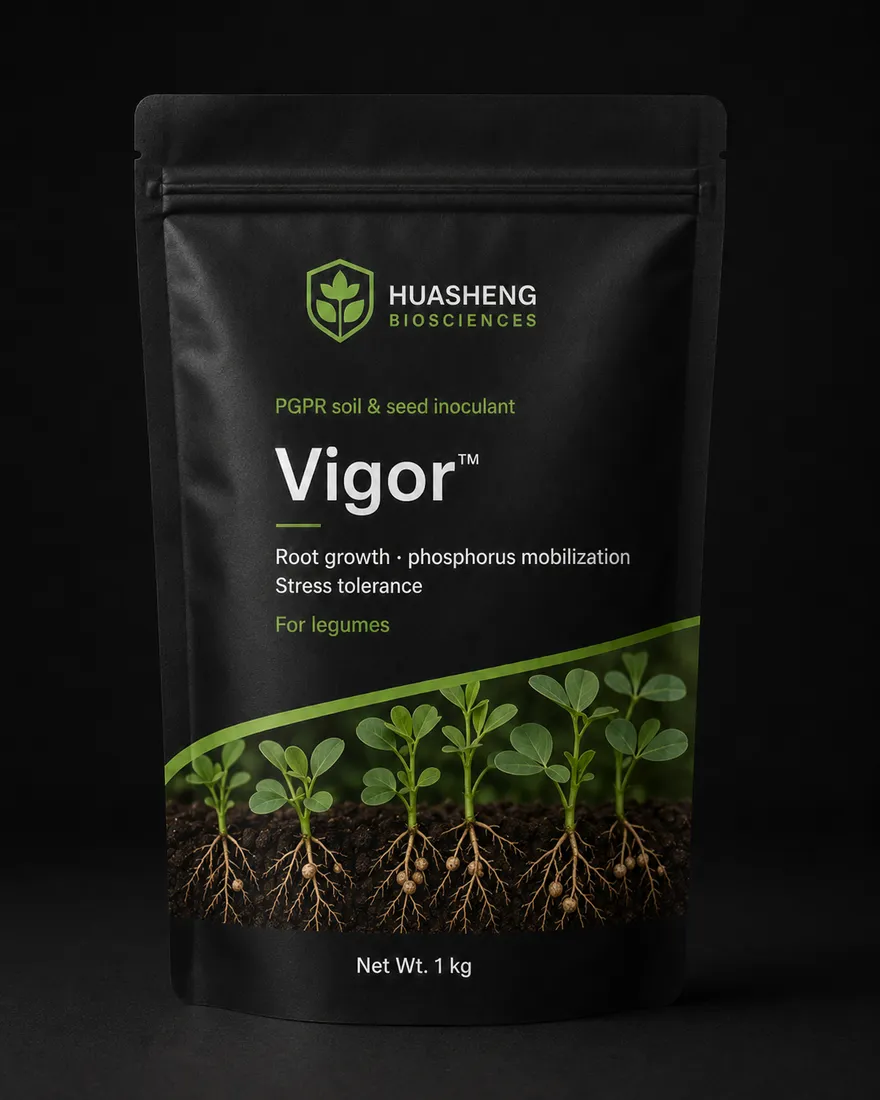
Vigor™ builds roots, nutrient uptake, and stress tolerance.
Packaging and label information may vary by product version and market.
Roots that reach further
Auxin (IAA)-producing strains drive root proliferation — about +12% root biomass — for better water and nutrient capture on Common Bean.
Unlocks bound phosphorus
Phosphate- and potassium-solubilizing strains release nutrients already locked in the soil, cutting applied P by up to 25% at equal yield.
Buffers drought & salinity
ACC-deaminase activity buffers stress for a stronger stand and faster recovery — one broad-spectrum formula for all eight legumes.
Vigor™ · Common Bean · vs. untreated control
Proven on Common Bean
+8.3%
Standalone yield
−25%
Applied phosphorus
+12%
Root biomass
22 sites
Trial sites
Common bean is nodulated by fast-growing Rhizobium and is our most mature rhizobial line. Nodu™ CB is built on Rhizobium tropici (CIAT 899-type), valued for its acid-, heat-, and aluminium-tolerance and exceptional field stability, alongside R. etli / phaseoli. Because bean is a weak, often ineffective fixer, a robust, well-matched strain matters most; Orvan™ amplifies it.
What's inside
A plant-growth-promoting rhizobacteria (PGPR) consortium of Bacillus subtilis, Pseudomonas fluorescens, Bacillus megaterium (phosphate-solubilizing), and Azospirillum brasilense that builds root systems, unlocks bound soil phosphorus and potassium, and improves drought and salinity tolerance.
Phosphate- and potassium-solubilizing strains release nutrients already locked in the soil; auxin (IAA) production drives root proliferation for better water and nutrient capture; ACC-deaminase activity buffers drought and salinity stress; associative diazotrophs add a modest nitrogen contribution.
Vigor™ science →Strains
Bacillus subtilis (root colonization), Pseudomonas fluorescens (phosphate solubilization & biocontrol), Bacillus megaterium (phosphate solubilization), and Azospirillum brasilense (Ab-V5 / Ab-V6-type; auxin + ACC-deaminase for stress tolerance). PGPR are not host-specific: one broad-spectrum formula serves all eight legumes (no crop-specific SKU).
Good to know
Vigor™ is the PGPR layer of the program. It does not form nitrogen-fixing nodules itself (that is Nodu™’s rhizobial symbiosis), but it unlocks bound soil phosphorus, drives root growth, and buffers drought and salinity stress.
How to use · Vigor™
At sowing: seed treatment 4–6 g/kg, in-furrow liquid 1–3 L/ha, or granule blended with starter fertilizer. For all eight legumes; co-applies with Nodu™ (nitrogen) and Orvan™ (coupling).
The full program · Common Bean
At sowing: Nodu™ CB 3–5 g/kg seed; Orvan™ Coat on seed or Root in-furrow.
Specifications
Available formats
?Available across granule, liquid, and seed-treatment application. We’ll match the right formulation to your crop, planter, and local conditions. How formulations differ →
- Viable count
- ≥ 10⁸–10¹⁰ CFU/g, formulation-dependent
- Shelf life
- 6–8 months at 5–25 °C
- Storage
- Cool and dry, 5–25 °C, out of direct sun
- Origin
- Manufactured in China
- Registration
- MARA-registered microbial inoculant
- Standard
- GB 20287-2006
CFU guaranteed to expiry; 6–8 month shelf life (form-dependent). Non-GMO, naturally isolated.
Packaging formats, minimum order quantity, and lead time depend on the formulation, the destination market, and the registration route that applies there. Tell us your crop, region, and intended volume and we will confirm exactly what is available to you.
Certifications & documents
The SDS provided covers the granule formulation. For the SDS of other formulations, please contact us.
Full technical documentation available to qualified partners.
Complete the Common Bean program
Common questions
Can I use it with my rhizobial inoculant and fungicide seed treatment?+
Yes. Vigor™ co-applies with Nodu™ rhizobia, Orvan™ and starter NPK. Apply it after any fungicide seed treatment; avoid copper fungicides, strong alkali (pH > 9) and chlorinated water (> 2 ppm).
Which formulation should I choose for Common Bean?+
We match the format to your crop, planter and conditions — granule banded with base fertilizer, liquid in-furrow, or an on-seed treatment. Tell us your setup and we’ll recommend the right one.
Do you ship internationally, and what documents are included?+
Yes. Each shipment comes with the technical data sheet and a safety data sheet (granule); phytosanitary and import documents are prepared per destination market. Contact us for your country.
How should it be stored, and what is the shelf life?+
Store cool, dry and out of direct sunlight; do not freeze liquid forms. Shelf life is formulation-dependent — see the data sheet for the exact figure by format.
Is the product safe and non-GMO?+
Yes. All strains are naturally isolated, non-GMO and handled as low-risk (BSL-1). The product is registered with China’s MARA and meets the heavy-metal limits of GB 38400-2019.