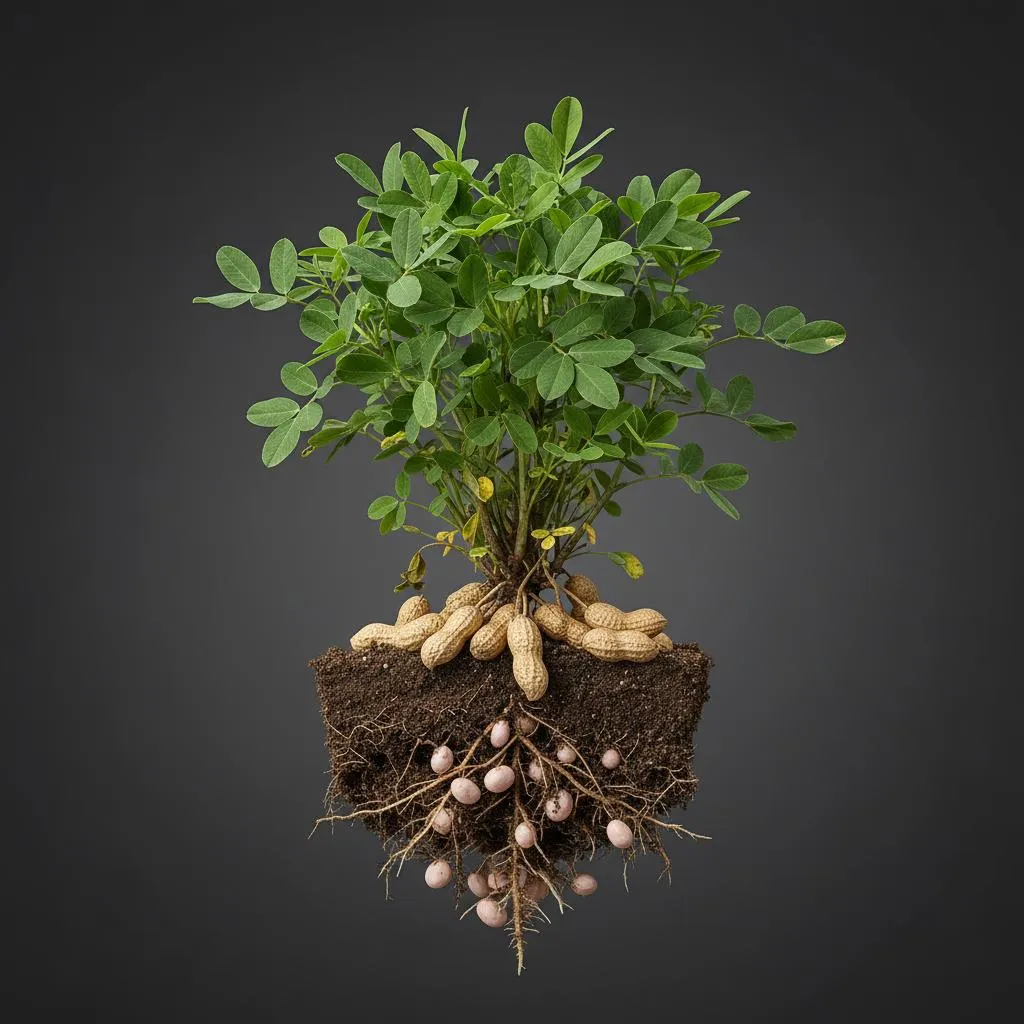
Rhizosphere coordination consortium
Orvan™ Peanut
The aflatoxin–nitrogen coupling, tuned for peanut: amplified nodulation and a cleaner rhizosphere, in a single pass.
average yield
+19.9%
More nodules
up to 8.5× more nodules
Also measured
>80% less soil A. flavus (trials)
Trial network
405 sites / 19 provinces
Built for this crop
Two of peanut’s costliest problems strike at once: Aspergillus flavus contaminates kernels with aflatoxin, while nitrogen use stays inefficient, so growers pay for fertilizer and still lose value to contamination and trade rejection.
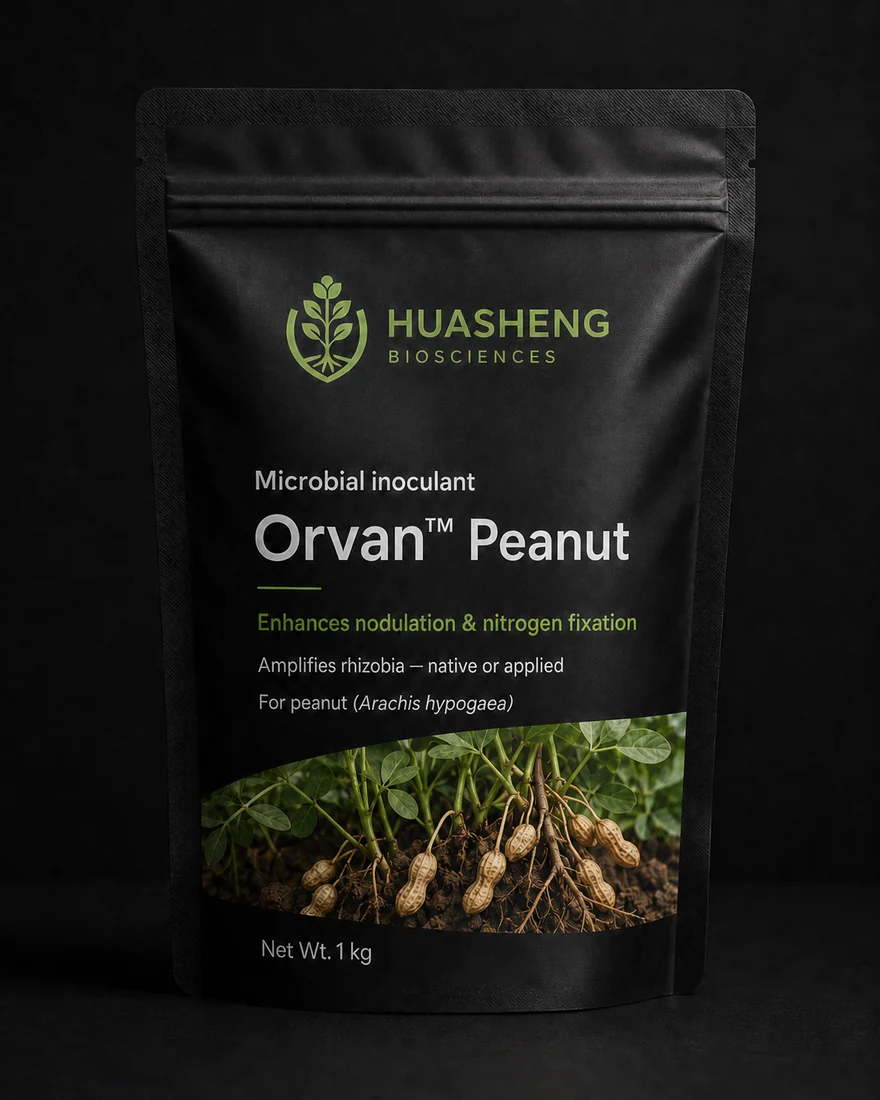
Orvan™ Peanut pairs the aflatoxin–nitrogen coupling with amplified nodulation, in one pass.
Packaging and label information may vary by product version and market.
The aflatoxin–nitrogen coupling
In peanut, Orvan™ is the basis of our Aspergillus–Rhizobia Coupling (ARC) research: in multi-season OCRI-CAAS field trials, Orvan™-treated peanut showed >80% less soil Aspergillus flavus alongside stronger nitrogen fixation.
Amplified nodulation
Orvan™ reshapes the root zone so native rhizobia nodulate harder — up to 8.5× more nodules and nitrogenase activity up to 10.7× in peer-reviewed peanut trials, largest where native rhizobia are scarce.
One pass, no extra operation
Co-applies with your Nodu™ inoculant and starter NPK in a single pass at sowing — no added field trip.
Orvan™ Peanut · Peanut · vs. untreated control
Proven on Peanut
+19.9%
average yield
up to 8.5×
More nodules
>80% less soil A. flavus (trials)
Also measured
405 sites / 19 provinces
Trial network
Across 405 sites in 19 provinces (Henan, Shandong, Liaoning; 2021–2025): +19.9% average yield, >80% less soil A. flavus, up to 8.5× more nodules, and nitrogenase activity up to 10.7× — largest where native rhizobia are scarce or the variety is susceptible. A well-nodulated peanut crop can also leave nitrogen worth ~96 kg N/ha for the following cereal.
What's inside
A three-strain rhizosphere consortium, applied alongside your rhizobial inoculant, that strengthens nodulation and nitrogen fixation for better stands and higher yield across eight legumes. In peanut, the same shift in the root-zone microbiome is the focus of our peer-reviewed coupling research — where it is also associated with markedly lower soil A. flavus, the fungus that produces aflatoxin.
The strains reshape the rhizosphere to improve the nodulation environment for native or co-applied rhizobia, while stronger crop vigor sustains nitrogen fixation through pod fill. In peanut, our research also examines the aflatoxin side of the coupling — how the same shift in the root-zone microbiome relates to Aspergillus flavus, the fungus that produces aflatoxin — in peer-reviewed studies and multi-season OCRI-CAAS field trials.
Orvan™ science →Strains
Bacillus velezensis · Brevibacillus laterosporus · Paenibacillus mucilaginosus.
Species names follow current genomic taxonomy. Bacillus velezensis was reported as B. amyloliquefaciens in earlier studies and re-identified by whole-genome sequencing as the distinct species B. velezensis; Paenibacillus mucilaginosus was transferred from the genus Bacillus in 2010 and is listed under its basionym Bacillus mucilaginosus on its Chinese registration.
Works with
Bradyrhizobium (Arachis group)
Good to know
Orvan™ is a rhizosphere-coordination consortium, not a rhizobial inoculant. It carries no Rhizobium of its own, and no fungus either — all three strains are bacteria. Applied alongside (or on top of) your rhizobial inoculant, it amplifies the native and co-applied rhizobia already adapted to your soil. Fully complementary to existing programs. Non-GMO; all three strains spore-forming.
How to use · Orvan™
At sowing, matched to how the product reaches the crop: Base 30–60 kg/ha broadcast or banded with base fertilizer · Root 30–60 kg/ha dissolved in clean water and applied in-furrow through the planter · Coat 2.5 mL/kg seed on the seed, by hand or through a coater. The dose does not change by crop. A live-culture product: with a fungicide seed treatment apply that first, let the seed dry, then Orvan™; apply any rhizobial inoculant after Orvan™. Avoid copper fungicides, agricultural antibiotics, strong alkali (pH > 9) and chlorinated water (> 2 ppm). Blend with fertilizer immediately before application rather than storing a prepared blend. Storage differs by format: the dry formats keep at or below 30 °C with no cold chain and are used within 30 days of opening; Coat is held at 5–25 °C, must not freeze, and is used within 14 days of opening.
The full program · Peanut
At sowing: Orvan™ Base (granule, 30–60 kg/ha), Root (dissolved, in-furrow), or Coat on seed; Nodu™ GN 3–5 g/kg seed. Apply Orvan™ last, after any fungicide seed treatment.
Specifications
Available formats
?Available across granule, liquid, and seed-treatment application. We’ll match the right formulation to your crop, planter, and local conditions. How formulations differ →
- Viable count
- ≥ 10⁸–10¹⁰ CFU/g, formulation-dependent
- Shelf life
- 18 months from manufacture, sealed
- Storage
- Cool and dry, 5–25 °C, out of direct sun
- Origin
- Manufactured in China
- Registration
- MARA-registered microbial inoculant (granule, powder and compound forms)
- Standard
- GB 20287-2006
Registered technical indicator: total effective viable count ≥ 5×10⁸ CFU/g (Orvan™ Base granule). Viable count guaranteed to expiry; all three strains spore-forming, for heat and desiccation tolerance and no cold chain on the dry formats. Non-GMO, BSL-1.
Packaging formats, minimum order quantity, and lead time depend on the formulation, the destination market, and the registration route that applies there. Tell us your crop, region, and intended volume and we will confirm exactly what is available to you.
Certifications & documents
The SDS provided covers the granule formulation. For the SDS of other formulations, please contact us.
Full technical documentation available to qualified partners.
Complete the Peanut program
Common questions
Can I use it with my rhizobial inoculant and fungicide seed treatment?+
Yes. At sowing it co-applies with your rhizobial inoculant and starter NPK. The order matters: a fungicide seed treatment goes on first and is left to dry, then Orvan™, then the rhizobial inoculant. Avoid copper fungicides, agricultural antibiotics, strong alkali (pH > 9) and chlorinated water (> 2 ppm).
Which formulation should I choose for Peanut?+
We match the format to your crop, planter and conditions — granule banded with base fertilizer, liquid in-furrow, or an on-seed treatment. Tell us your setup and we’ll recommend the right one.
Do you ship internationally, and what documents are included?+
Yes. Each shipment comes with the technical data sheet and a safety data sheet (granule); phytosanitary and import documents are prepared per destination market. Contact us for your country.
How should it be stored, and what is the shelf life?+
Store cool, dry and out of direct sunlight; do not freeze liquid forms. Shelf life is formulation-dependent — see the data sheet for the exact figure by format.
Is the product safe and non-GMO?+
Yes. All strains are naturally isolated, non-GMO and handled as low-risk (BSL-1). The product is registered with China’s MARA and meets the heavy-metal limits of GB 38400-2019.