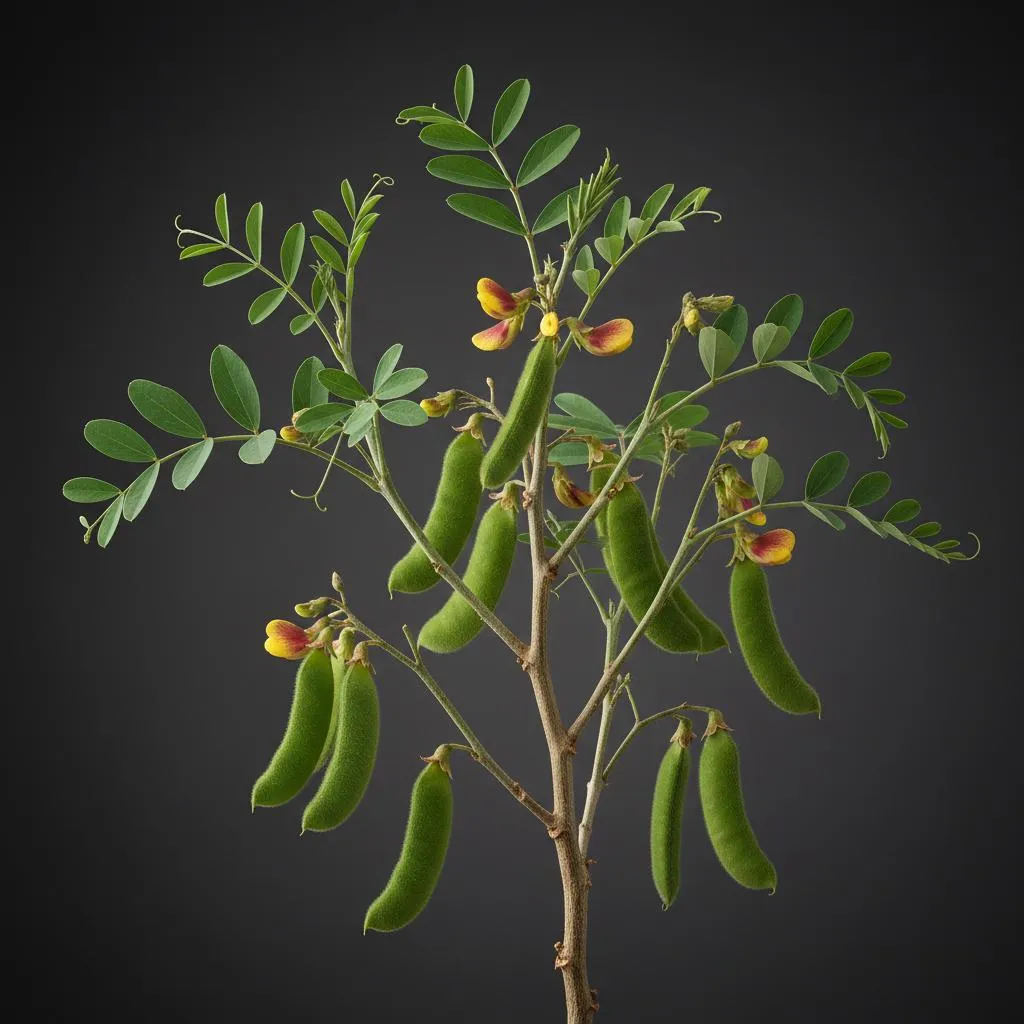
Pigeon Pea · Rhizobial inoculant
Nodu™ PP
The nitrogen your Pigeon Pea can make for itself — elite, region-matched rhizobia for strong nodulation from sowing.
Standalone yield
+8.9%
Trial sites
18 sites
Rhizobium
Bradyrhizobium (Cajanus group)
Viable count
≥ 10⁹ CFU/g
Built for this crop
A long-season crop with high cumulative nitrogen demand, usually grown in low-input smallholder systems where native rhizobia are often sparse, so much of its fixation potential goes uncaptured.
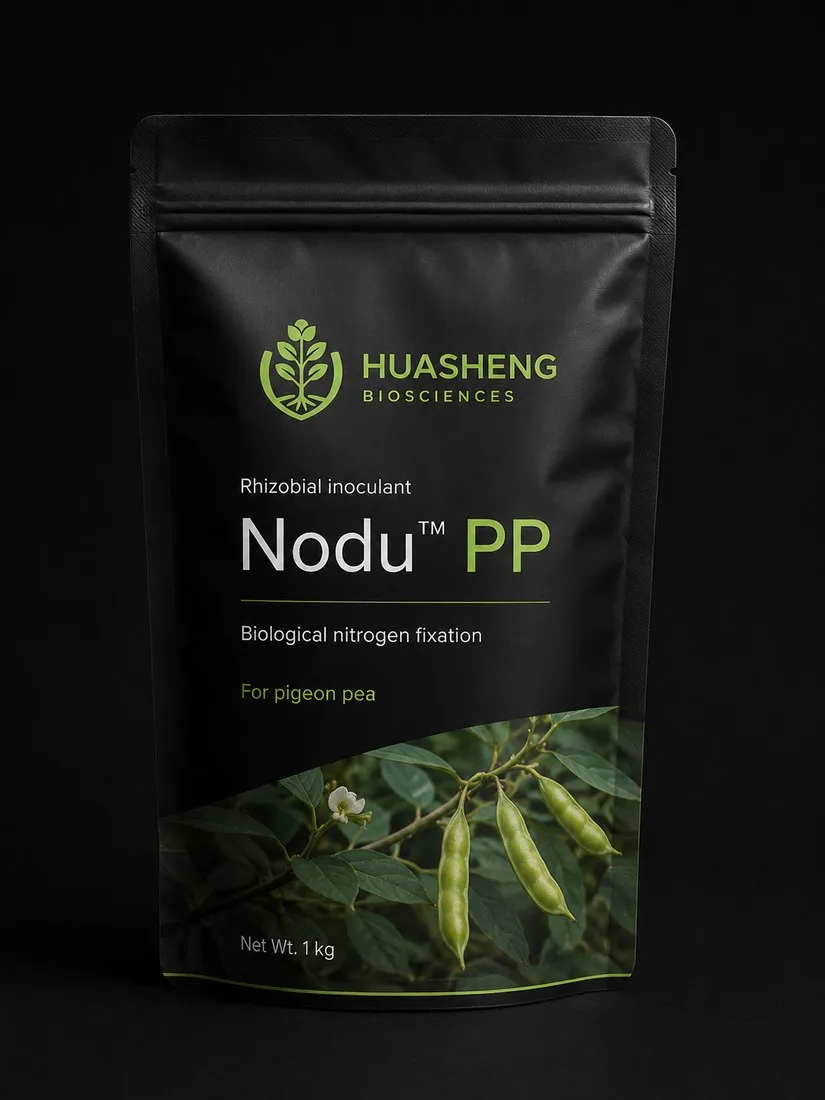
Nodu™ PP establishes a season-long Bradyrhizobium symbiosis.
Packaging and label information may vary by product version and market.
The right strain for Pigeon Pea
Nodu™ delivers Bradyrhizobium (Cajanus group), matched to your region and confirmed against local populations before it ships — because rhizobia are host-specific.
Nitrogen you don’t have to buy
A well-nodulated legume draws 50–75% of its nitrogen from the air. On Pigeon Pea: Up to ~140 kg N/ha, 90%+ of vegetative N; ~30–40 left for next crop.
Strong, early nodulation
Vigorous nodulation establishes within ~2–3 weeks of sowing, with 3–6× more nodules per plant than uninoculated controls.
Nodu™ PP · Pigeon Pea · vs. untreated control
Proven on Pigeon Pea
+8.9%
Standalone yield
3–6×
More nodules
Up to ~140 kg N/ha, 90%+ of vegetative N; ~30–40 left for next crop
Nitrogen fixation
18 sites
Trial sites
Pigeon pea is nodulated by the cowpea-miscellany Bradyrhizobium group (Cajanus). Nodu™ PP is matched to local Bradyrhizobium; inoculation pays off most where resident nodulating bacteria fall below ~10³/g soil, common in the low-input systems where pigeon pea is grown. Orvan™ amplifies native populations.
What's inside
Elite Bradyrhizobium / Rhizobium inoculants that establish a strong, early, and persistent nitrogen-fixing symbiosis in legumes, so the crop fixes more of its own nitrogen and you buy less.
Live rhizobia colonize the root, form nodules, and reduce atmospheric nitrogen (N₂) to a plant-available form throughout the season, lifting early vigor, biomass, and yield. Because rhizobia are host-specific, each legume needs its own compatible strain, selected for local soil conditions and confirmed against local populations before deployment.
Nodu™ science →Strains
Crop-specific and region-matched: soybean-specific Bradyrhizobium japonicum / diazoefficiens (USDA 110-type); fast-growing Rhizobium tropici (CIAT 899-type) for common bean; cowpea-miscellany Bradyrhizobium (incl. BR 3267-type) for peanut, cowpea, mung bean, black gram and pigeon pea; and Sinorhizobium (Ensifer) meliloti for alfalfa. One SKU per crop.
Good to know
Nodu™ delivers the nitrogen-fixing rhizobia, the symbiotic partner the crop needs. It is built to work with Orvan™, a rhizosphere-coordination consortium applied alongside or on top of the rhizobial inoculant that strengthens the nodulation environment, and with Vigor™ for roots and phosphorus.
How to use · Nodu™
Inoculate seed in shade just before sowing and sow within 24–72 h, or apply the liquid in-furrow. Apply after any fungicide seed treatment; keep away from chlorinated water (> 2 ppm) and strong acids/alkali. Co-applies with Vigor™ and Orvan™.
The full program · Pigeon Pea
At sowing: Nodu™ PP 3–5 g/kg seed; Orvan™ Coat on seed; well suited to intercropped and ratoon systems.
Specifications
Available formats
?Available across granule, liquid, and seed-treatment application. We’ll match the right formulation to your crop, planter, and local conditions. How formulations differ →
- Viable count
- ≥ 10⁸–10¹⁰ CFU/g, formulation-dependent
- Shelf life
- 6–8 months (longer freeze-dried)
- Storage
- Cool and dry, 5–25 °C, out of direct sun
- Origin
- Manufactured in China
- Registration
- MARA-registered microbial inoculant; per-crop SKU registrations by market
- Standard
- GB 20287-2006
CFU guaranteed to expiry; shelf life typically 6–8 months at 5–25 °C (longer for the freeze-dried form). Non-GMO, naturally isolated.
Packaging formats, minimum order quantity, and lead time depend on the formulation, the destination market, and the registration route that applies there. Tell us your crop, region, and intended volume and we will confirm exactly what is available to you.
Certifications & documents
The SDS provided covers the granule formulation. For the SDS of other formulations, please contact us.
Full technical documentation available to qualified partners.
Complete the Pigeon Pea program
Common questions
Can I use it with a fungicide seed treatment and my other inoculants?+
Yes. Nodu™ co-applies with Orvan™, Vigor™ and starter NPK. Inoculate in the shade after Orvan™ has been applied, sow within 24–72 hours, and keep the rhizobia away from copper fungicides, strong alkali (pH > 9) and chlorinated water (> 2 ppm). Rhizobia are the most heat- and desiccation-sensitive of the three, so inoculated seed should not be left in the sun or held overnight.
Which formulation should I choose for Pigeon Pea?+
We match the format to your crop, planter and conditions — granule banded with base fertilizer, liquid in-furrow, or an on-seed treatment. Tell us your setup and we’ll recommend the right one.
Do you ship internationally, and what documents are included?+
Yes. Each shipment comes with the technical data sheet and a safety data sheet (granule); phytosanitary and import documents are prepared per destination market. Contact us for your country.
How should it be stored, and what is the shelf life?+
Store cool, dry and out of direct sunlight; do not freeze liquid forms. Shelf life is formulation-dependent — see the data sheet for the exact figure by format.
Is the product safe and non-GMO?+
Yes. All strains are naturally isolated, non-GMO and handled as low-risk (BSL-1). The product is registered with China’s MARA and meets the heavy-metal limits of GB 38400-2019.