Beauveria bassiana and Metarhizium: how entomopathogenic fungi infect insects and how to use them
How Beauveria and Metarhizium conidia attach to and penetrate the insect cuticle, which pests the evidence supports, how humidity, temperature and UV light change results, and how to read conidia counts, formulations and storage terms.
Author: Liu Xiaomin, AgronomistTechnical review: Zhao Guohua, Researcher
Products in this article
Entomopathogenic fungi are one of the core classes of microbial insecticides, distinguished by a mode of action based on contact [1]. Their host ranges are wide: B. bassiana reportedly infects over 700 insect species across 15 orders, and M. anisopliae over 200 species from 7 orders [1]. IRAC, the Insecticide Resistance Action Committee, places Beauveria bassiana strains and Metarhizium brunneum strain F52 in Group UNF, fungal agents of unknown or uncertain mode of action [2]. This article explains how infection works, which pests the evidence supports, which conditions change results, and how to read a product specification.
1. The fungi and their names
Metarhizium anisopliae was originally a complex of several varieties that were only recognised as separate species in 2009 [3]; the genus now includes M. anisopliae, M. robertsii, M. brunneum and M. acridum among others [3]. Strain F52, for example, is now M. brunneum but was previously classified as M. anisopliae [4]. Metarhizium is also a soil and root fungus: root colonisation from the soil appears to be the ancestral condition of the lineage [3]. When comparing products, identify the species and the strain together.
2. How infection works
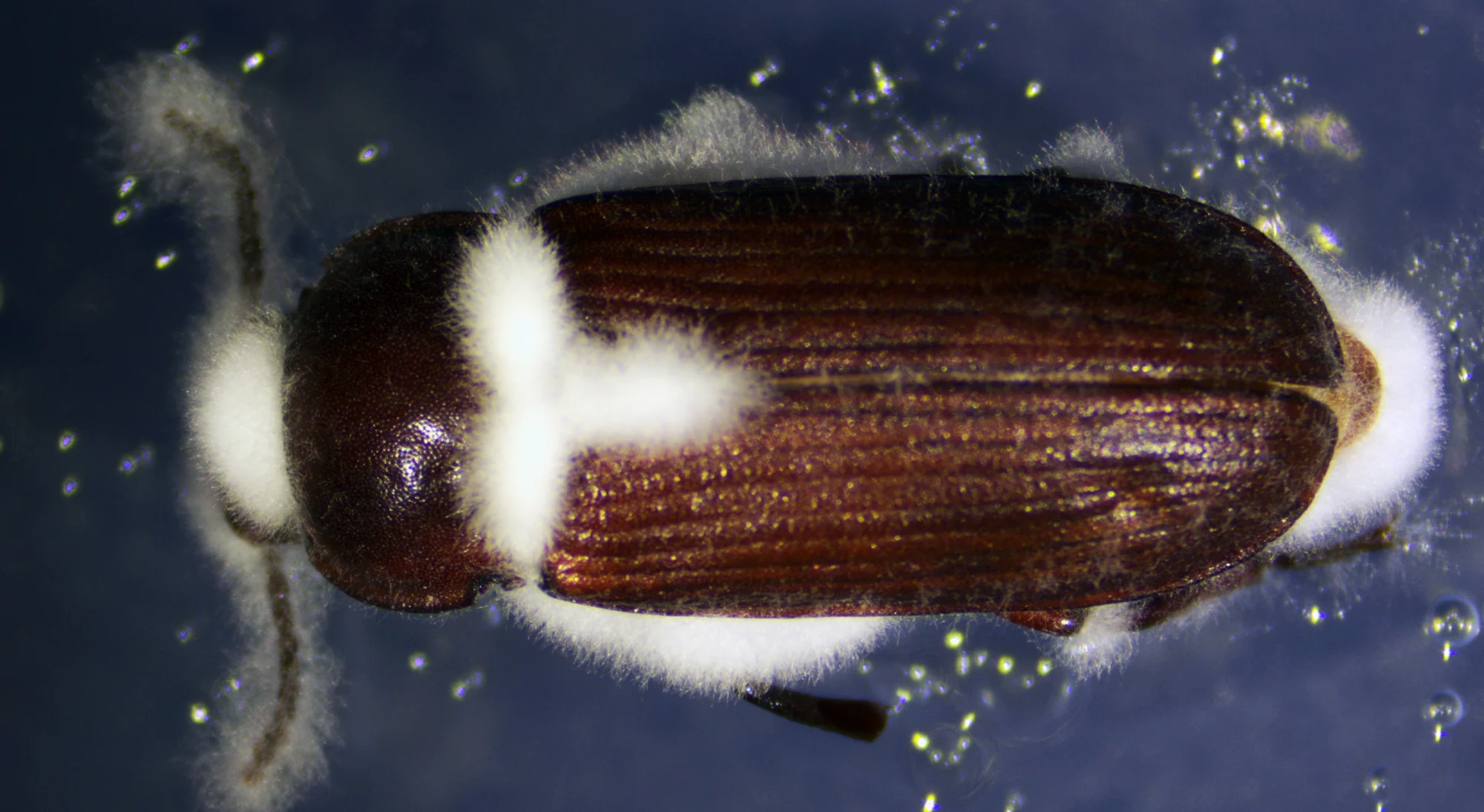
Infection by Metarhizium follows six stages, which are also found in other entomopathogenic fungi: adhesion, germination, appressorium formation, penetration, colonisation of the haemolymph, and extrusion and sporulation [5]. The fungi respond to cues on the insect surface by producing enzymes such as lipases, proteases and chitinases, specialised infection structures such as appressoria, and metabolites that help infection [6].
Stages of infection by entomopathogenic fungi
| Stage | What happens | Sources |
|---|---|---|
| Adhesion | Conidia attach to the cuticle; in M. anisopliae, adhesins anchor the conidium more firmly and allow germination | [5][6] |
| Germination and appressorium | Conidia germinate when external carbon and nitrogen sources are present, and form an appressorium | [5] |
| Penetration | Turgor pressure in the appressorium supplies mechanical force, while chitinases, proteases and lipases degrade the cuticle | [5] |
| Colonisation | The fungus multiplies in the haemolymph; M. anisopliae produces destruxins that suppress the insect's immune response | [5] |
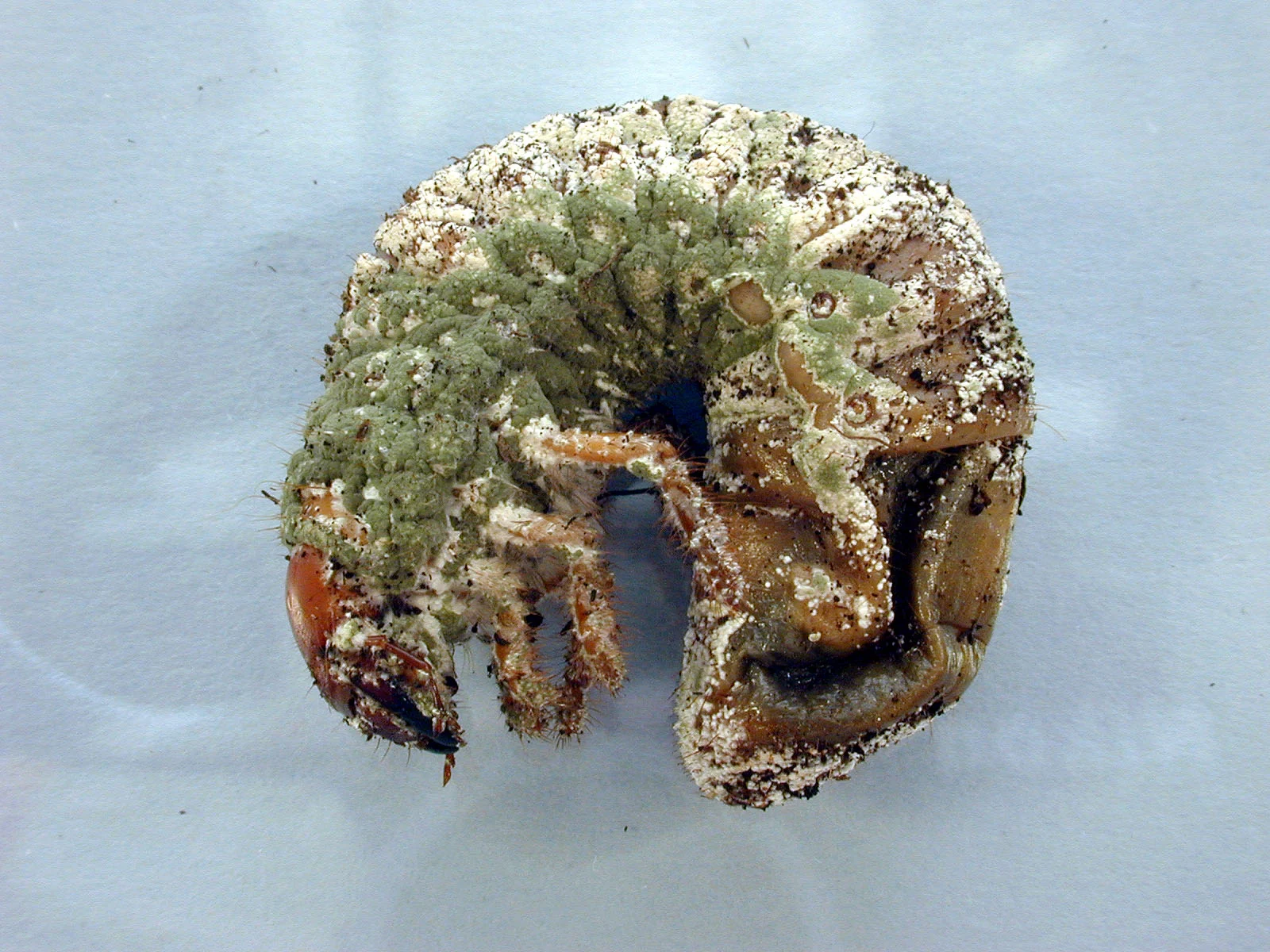
| Extrusion and sporulation | Hyphae grow back out through the cuticle and produce new conidia; M. anisopliae forms green spores on the cadaver | [5] |
In western flower thrips pupae treated with B. bassiana, conidia completed attachment, germination and penetration of the body wall and entered the host within 60 hours [7]. Because infection starts on the cuticle, the insect must be hit by, or walk over, viable conidia, which is why extension advice for B. bassiana against whiteflies is to start early and repeat applications [8].
3. Target pests supported by sources
The sources concern mainly soft bodied pests on foliage and pests or life stages in the soil. The table lists pests named in extension and review sources; it is not a list of registered uses.
Pests for which sources report the use of Beauveria and Metarhizium
| Pest group | Fungus | What the sources say |
|---|---|---|
| Whiteflies | B. bassiana; Metarhizium | B. bassiana kills whiteflies by contact, with early and repeated applications [8]; a 2014 listing of microbials registered for European greenhouses includes B. bassiana and M. brunneum strains aimed primarily at whiteflies and thrips [9] |
| Thrips, foliar stages | B. bassiana; Metarhizium | Same European greenhouse listing, primarily whiteflies and thrips [9]; in China, the national monitoring report advises preferring biologicals such as M. anisopliae against bean flower thrips [10] |
| Thrips, soil stages | B. bassiana granules | Granules applied to soil controlled the soil dwelling stages of western flower thrips in greenhouse tomato, cucumber and eggplant [11]; conidia penetrated pupae within 60 hours [7] |
| Aphids | B. bassiana | Commercial B. bassiana products reviewed in 2025 list aphids, whiteflies and thrips among their targets [1] |
| Rice planthoppers | B. bassiana; M. anisopliae | Two fungal insecticides controlled planthoppers for four weeks in field trials in rice and shrimp rotation fields in southern China, where chemical control is prohibited [12] |
| Spittlebugs and soil pests | Metarhizium | In Brazil, M. anisopliae products target the spittlebugs Mahanarva fimbriolata, Deois flavopicta and Zulia entreriana [13]; granules can persist and act in the soil [1] |
4. Humidity, temperature and UV light
Temperature, humidity and sunlight affect adhesion, germination, growth and penetration on the cuticle [6].
Humidity
Entomopathogenic fungi are generally favoured by high relative humidity, and fungi need a baseline of humid conditions to grow and produce spores [14]. Humidity at the leaf surface may be high enough for infection even when the air is drier, and greenhouses often provide suitable conditions [9].
Temperature
The optimal growth temperature range for B. bassiana is 22 to 28 °C [15]. For Metarhizium, many reports give an optimum of 25 to 30 °C, while most M. anisopliae isolates can germinate and sporulate between 15 and 35 °C; isolates differ, and some grow better at 33 °C [16]. In storage and transport, products may be exposed to 40 to 60 °C, especially in tropical climates [1].
UV light
Four hours of UV-B exposure can considerably reduce the viability of Metarhizium conidia and delay their germination [16]. UV-B in sunlight is very harmful to formulated conidia [12]. In a field study in southern China, fungal insecticide sprays applied after 5 p.m., avoiding solar UV, were consistently more efficacious against rice planthoppers than sprays applied before 10 a.m. [12]. Formulations can add UV protectants, humectants and dispersants to protect the conidia [1].
5. Fungicides and other inputs
These are living fungi, so fungicides matter. Conservation of fungal entomopathogens includes avoiding frequent fungicide use and intense soil disturbance, since many of them spend part of their life cycle in the soil [9]. Compatibility depends on the product: oil dispersion formulations have shown compatibility with certain chemical fungicides, and B. bassiana coated onto seed already treated with insecticide and fungicide tolerated certain fungicide concentrations [1]. Check compatibility data for the specific products before mixing, and avoid applying an untested fungicide on the same surfaces at the same time.
6. How content is expressed
Products declare the number of conidia (also called spores) or colony forming units (CFU), per gram for powders and granules and per millilitre or litre for liquids. An EU assessment, for example, described an oil dispersion of B. bassiana by a minimum CFU per litre and the technical agent by viable CFU per kilogram [15]. Viability is usually checked as the germination rate of conidia: in one study, coated M. anisopliae conidia kept 80% germination after six months at 4 °C, against 50% for unformulated conidia [1]. Ask for the count and the germination result of the batch together.
Entomopathogenic fungi supplied by Huasheng (catalogue specifications)
| Product | Component | Form | Declared content |
|---|---|---|---|
| Beauvia™ | Beauveria bassiana GHA | Wettable powder (WP) | ≥ 2 × 10¹⁰ conidia/g |
| Beauvia Z435™ | Beauveria bassiana ZJU435 | Oil dispersion (OD) | ≥ 1 × 10¹⁰ spores/mL |
| Metavia™ | Metarhizium brunneum F52 | Granule (GR) | ≥ 9 × 10⁸ CFU/g |
| Metavia CQ421™ | Metarhizium anisopliae CQMa421 | Oil dispersion (OD) | ≥ 8 × 10⁹ spores/mL |
7. Formulations, storage and shelf life
The international coding system defines the forms used for these fungi [17]:
- WP, wettable powder: a powder applied as a suspension after dispersion in water [17].
- OD, oil dispersion: a stable suspension of the active ingredient in a fluid that does not mix with water, diluted with water before use [17].
- GR, granule: a free flowing solid of defined granule size, ready for use [17].
Oil dispersions protect conidia against imbibition damage and heat, increase UV tolerance and improve rainfastness [1]. Granules absorb soil moisture, after which the fungus germinates and colonises the surrounding soil, which can extend persistence; conidia near the soil surface remain exposed to UV [1]. Maintaining viability during storage and transport is a major constraint for these products [1], and an EU assessment noted that label instructions on low temperature storage might be needed [15]. Store products as the label directs, keep them away from heat, and use them within the expiry date.
8. Regional notes
China
A 2023 review counted 16 fungal strains, mainly entomopathogenic fungi and mycofungicides, registered in China [18]. The national resistance monitoring report for 2024 advises, for highly resistant whitefly populations, suspending spirotetramat and cyantraniliprole and preferring biologicals such as Metarhizium anisopliae, and gives the same preference for bean flower thrips [10]. Field work in southern China supports evening application to avoid UV damage [12].
Latin America
Brazil has the largest biocontrol programme applied in sugarcane, and its industry relies on Metarhizium isolates; M. anisopliae products target the spittlebugs Mahanarva fimbriolata, Deois flavopicta and Zulia entreriana [13]. On farm production is common in Brazil, but such products usually do not undergo quality control or shelf life tests [13], which is one reason to ask for batch counts and germination data.
9. Using fungi in a pest programme
IRAC considers that members of Group UNF are not thought to share a common target site, so they are exempt from the rule against rotating within a group [2]. Fungi therefore fit well alongside numbered insecticide groups, which should still be rotated so that successive pest generations are not treated with the same group [2].
- Start early and plan repeated applications [8].
- Aim for thorough coverage of the leaf surfaces where pests feed, since infection is by contact [1][8].
- Spray late in the day to avoid solar UV [12].
- Use granules or soil applications against soil dwelling stages [11].
- Keep fungicides away from the fungus unless compatibility is known [1][9].
- Store cool, use within the expiry date and check counts and germination of the batch [1][15].
Frequently asked questions
How does Beauveria bassiana kill insects?
Conidia attach to the cuticle, germinate, penetrate it with enzymes and pressure, multiply inside the insect and then sporulate on the cadaver [5][6].
What pests does Beauveria bassiana control?
Sources report its use against whiteflies, thrips and aphids, and against soil dwelling stages of thrips [1][8][9][11]. Registered uses differ by country and product.
What is the difference between Beauveria and Metarhizium?
Both infect through the cuticle in similar stages [5][6]. Metarhizium also lives in soil and on roots [3], forms green spores on cadavers [5], and in Brazil is the basis of spittlebug control [13].
Can Beauveria bassiana be mixed with fungicides?
Only where compatibility is known. Some oil dispersions are compatible with certain fungicides [1], but avoiding frequent fungicide use is part of conserving these fungi [9].
Why does Beauveria bassiana work poorly in hot, dry, sunny weather?
The fungi need humid conditions [14], B. bassiana grows best at 22 to 28 °C [15], and UV-B damages conidia [12][16].
How should fungal insecticides be stored?
As the label directs, away from heat and within the expiry date; viability during storage is a major constraint, and low temperature storage may be specified [1][15].
Further reading
- Enquire about Beauvia™, Beauvia Z435™, Metavia™ and Metavia CQ421™
- Beauvia™ (Beauveria bassiana GHA)
- Beauvia Z435™ (Beauveria bassiana ZJU435)
- Metavia™ (Metarhizium brunneum F52)
- Metavia CQ421™ (Metarhizium anisopliae CQMa421)
- Biopesticides: sourcing and supply
- [1] Couceiro J. C., Wood M. J., Papadopoulos A., Silva J. J., Vontas J., Dimopoulos G. et al. (2025). Development of mycoinsecticides: advances in formulation, regulatory challenges and market trends for entomopathogenic fungi. Journal of Fungi 12(1): 7.
- [2] IRAC (2026). Mode of Action Classification Scheme, version 11.5, February 2026.
- [3] St Leger R. J., Wang J. B. (2020). Metarhizium: jack of all trades, master of many. Open Biology 10(12): 200307.
- [4] Fischhoff I. R., Keesing F., Ostfeld R. S. et al. (2017). The tick biocontrol agent Metarhizium brunneum (= M. anisopliae) (strain F52) does not reduce nontarget arthropods. PLoS One 12(11): e0187675.
- [5] Aw K. M. S., Hue S. M. (2017). Mode of infection of Metarhizium spp. fungus and their potential as biological control agents. Journal of Fungi 3(2): 30.
- [6] Ortiz-Urquiza A., Keyhani N. O. (2013). Action on the surface: entomopathogenic fungi versus the insect cuticle. Insects 4(3): 357.
- [7] Zhang X., Lei Z., Reitz S. R., Wu S., Gao Y. (2019). Laboratory and greenhouse evaluation of a granular formulation of Beauveria bassiana for control of western flower thrips, Frankliniella occidentalis. Insects 10(2): 58.
- [8] Pundt L. (2014, revised 2019). Managing whiteflies in the greenhouse. UConn Extension.
- [9] Gonzalez F., Tkaczuk C., Dinu M. M., Fiedler Ż., Vidal S., Zchori-Fein E. et al. (2016). New opportunities for the integration of microorganisms into biological pest control systems in greenhouse crops. Journal of Pest Science 89: 295.
- [10] National Agro-Tech Extension and Service Center (2025). 2024 resistance monitoring report for pests of oil and economic crops. Ministry of Agriculture and Rural Affairs of China. In Chinese.
- [11] Rodríguez D., Coy-Barrera E., Verle Rodrigues J. C., Pietrantonio P. V. et al. (2023). Overview of updated control tactics for western flower thrips. Insects 14(7): 649.
- [12] Xu W. Y., Wen Z. X., Li X. J., Hu E. Z., Qi D. Y., Feng M. G. et al. (2023). Timing of fungal insecticide application to avoid solar ultraviolet irradiation enhances field control of rice planthoppers. Insects 14(4): 307.
- [13] Mesquita E., Hu S., Lima T. B., Golo P. S., Bidochka M. J. (2023). Utilization of Metarhizium as an insect biocontrol agent and a plant bioinoculant with special reference to Brazil. Frontiers in Fungal Biology 4: 1276287.
- [14] Athanassiou C. G., Kavallieratos N. G., Rumbos C. I., Kontodimas D. C. (2017). Influence of temperature and relative humidity on the insecticidal efficacy of Metarhizium anisopliae against larvae of Ephestia kuehniella on wheat. Journal of Insect Science 17(1): 22.
- [15] EFSA (2018). Peer review of the pesticide risk assessment of the active substance Beauveria bassiana strain PPRI 5339. EFSA Journal 16(4): e05230.
- [16] Couceiro J. C., Fatoretto M. B., Demétrio C. G. B., Meyling N. V., Delalibera Í. (2021). UV-B radiation tolerance and temperature dependent activity within the entomopathogenic fungal genus Metarhizium in Brazil. Frontiers in Fungal Biology 2: 645737.
- [17] CropLife International (2022). Catalogue of pesticide formulation types and international coding system. Technical Monograph No. 2, 8th edition.
- [18] Jiang Y., Wang J. (2023). The registration situation and use of mycopesticides in the world. Journal of Fungi 9(9): 940.