Inoculating cowpea: when a promiscuous legume still needs help
Cowpea nodulates with a wide range of native Bradyrhizobium, so some partner is often already in the soil. That makes the inoculation decision more nuanced than for soybean. This guide sets out when it still pays.
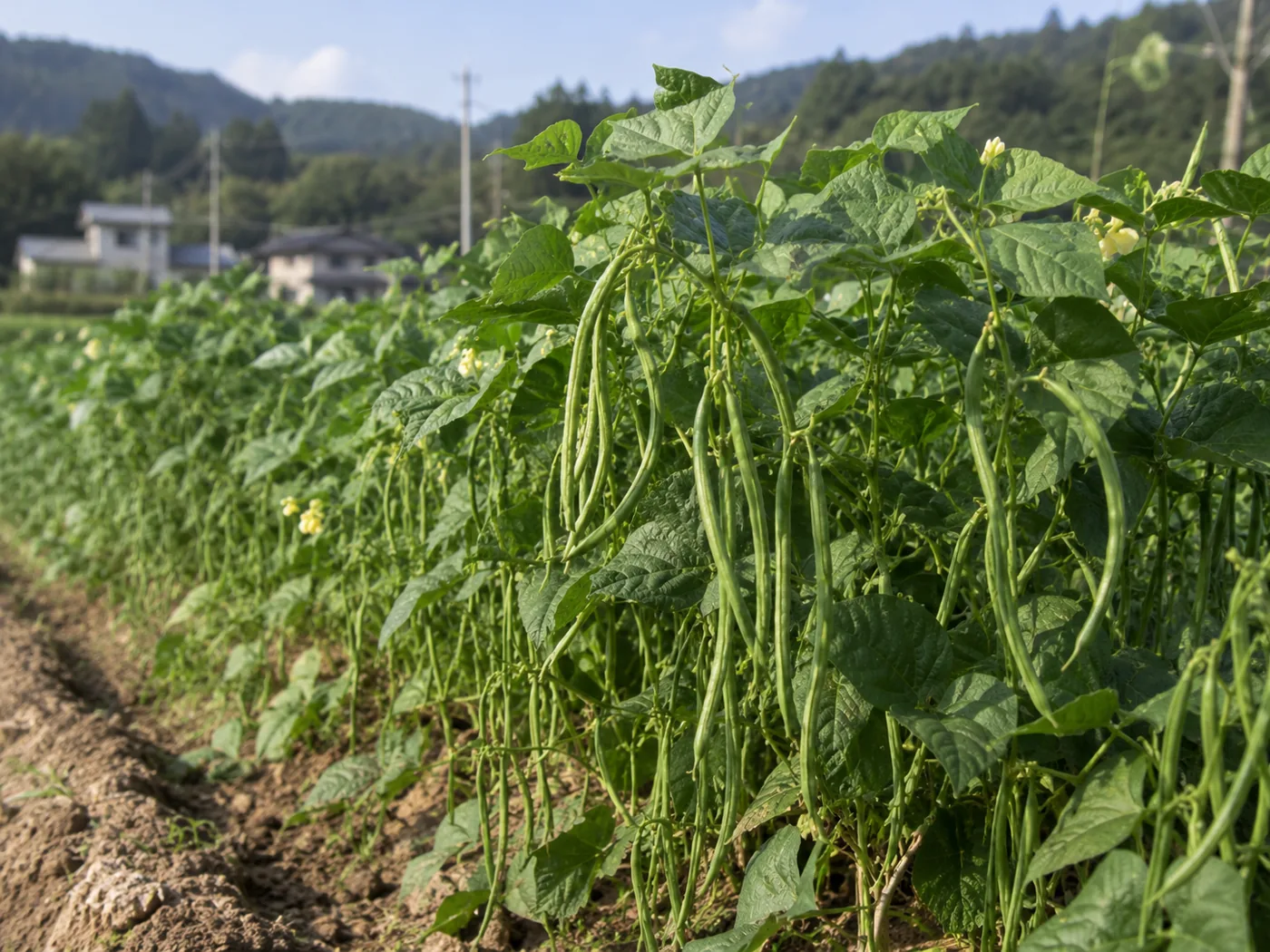
Cowpea (Vigna unguiculata) is a heat- and drought-tolerant grain legume and a staple across the semi-arid tropics, valued precisely because it yields on poor, dry soils where other crops fail. It gives its name to the notably promiscuous cowpea-miscellany group, which also includes pigeon pea, mung bean and black gram. A wide range of slow-growing Bradyrhizobium will nodulate all of them, so some compatible partner is usually already in the soil, and cowpea often nodulates to some degree without inoculation. That makes its inoculation decision genuinely different from soybean’s. The question is not “will it nodulate?” — it usually will — but “is it nodulating well enough, with effective partners, to leave alone?”
What “promiscuous” means — and why it changes the decision
Legumes fall into cross-inoculation groups: sets of crops that share compatible rhizobia. Cowpea belongs to the broadest of them. Whereas soybean accepts only its specific Bradyrhizobium japonicum, cowpea and its relatives accept a wide, cosmopolitan range of slow-growing Bradyrhizobium that are common in tropical and subtropical soils. As a result, unlike soybean on new ground, cowpea rarely fails to nodulate outright. But “rarely fails to nodulate” is not the same as “nodulates well”, and that gap is the whole subject of this guide.
Promiscuous does not mean effective
The key point for cowpea is that a native rhizobium able to nodulate the crop is not necessarily an effective one. Many indigenous strains form nodules but fix little nitrogen — they occupy the root, take the plant’s carbon, and do little work in return. Worse, these less effective strains are often highly competitive for nodule sites, so they can crowd out better partners even when those partners are added. The result is a crop that looks nodulated when dug up, yet is short of nitrogen.
This is why inoculating cowpea is best understood not as “adding bacteria to bare ground” but as upgrading the partnership: introducing a selected, effective strain in sufficient numbers to win a meaningful share of the nodules and raise the average quality of fixation. The value of inoculation therefore depends on two things: how scarce the native population is, and how effective the resident strains are.
When cowpea inoculation pays
Because the crop usually nodulates anyway, the response to inoculation varies along a gradient rather than switching on or off. It is largest where effective native strains are absent or few, and smallest where an effective population is already established:
Cowpea and its group: when to inoculate
| Situation | Likely native partner | Inoculate? |
|---|---|---|
| Long-cultivated field, cowpea grown well before | Present, often effective | Optional — modest response |
| New or reclaimed ground | Scarce | Yes — clear response |
| Sandy, low-organic-matter or eroded soil | Survives poorly | Yes |
| Nodulates, but plants look nitrogen-short | Present but weak fixers | Yes — add effective strains |
| Continuous cropping without fertiliser | Depleted, often weak | Yes — a cheap way to lift fixation |
One decision for four crops — with a few caveats
Because pigeon pea, mung bean and black gram share cowpea’s rhizobial group, a single cowpea-group inoculant serves all four, and the same “present but not necessarily effective” logic applies across them. The crops themselves differ in ways worth noting: mung bean and black gram are fast-maturing, short-season pulses that fix nitrogen over a brief period; pigeon pea is a long-season, deep-rooted crop that keeps fixing for months and is often grown in mixtures. In every case the rhizobial decision is the same, and the return is, as always, largest on new or depleted ground.
Where it matters most: poor soils and low-input systems
Cowpea and its relatives are typical legumes of semi-arid smallholder farming — grown on sandy, low-fertility soils, often without access to expensive nitrogen fertiliser. This is precisely where an effective inoculant proves its value. When purchased nitrogen is out of reach, the free nitrogen from a good rhizobial partnership is not a marginal gain but a large share of what the crop can achieve. A small, cheap dose of the right effective strain can be one of the highest-leverage inputs available on soils where every other input is scarce — which is why the aim is to upgrade the partnership rather than rely on whatever the soil already holds.
Getting it right in the field
- Use a cowpea-group Nodu™ — one product serves cowpea, pigeon pea, mung bean and black gram.
- Prioritise inoculation on new, sandy, low-organic-matter, or long-depleted fields, where the response is largest.
- Because the inoculant must compete with resident strains, apply an adequate rate — rate matters more here than on ground with no native rhizobia.
- Keep the inoculant alive — store it cool and apply it at sowing into moist soil.
- Where the crop nodulates but still looks nitrogen-short, effective strains are the remedy — check the nodules to confirm.
When inoculation seems to “do nothing”
Two situations look like failure but are not. On a long-cultivated field that already carries an effective native population, a small response is the expected outcome, not a fault of the product — the native rhizobia were already doing the work. And where the real limitation is water, pH, or phosphorus rather than rhizobia, no inoculant can help; addressing the actual constraint comes first. The way to tell the difference is to dig up plants and read the nodules: pink, active nodules on an uninoculated plant show that native strains are doing the job, while pale nodules — or few of them — mean inoculation has something to add.
Products in this article